Open Source vs Closed LLMs: Which Fits Your Product?
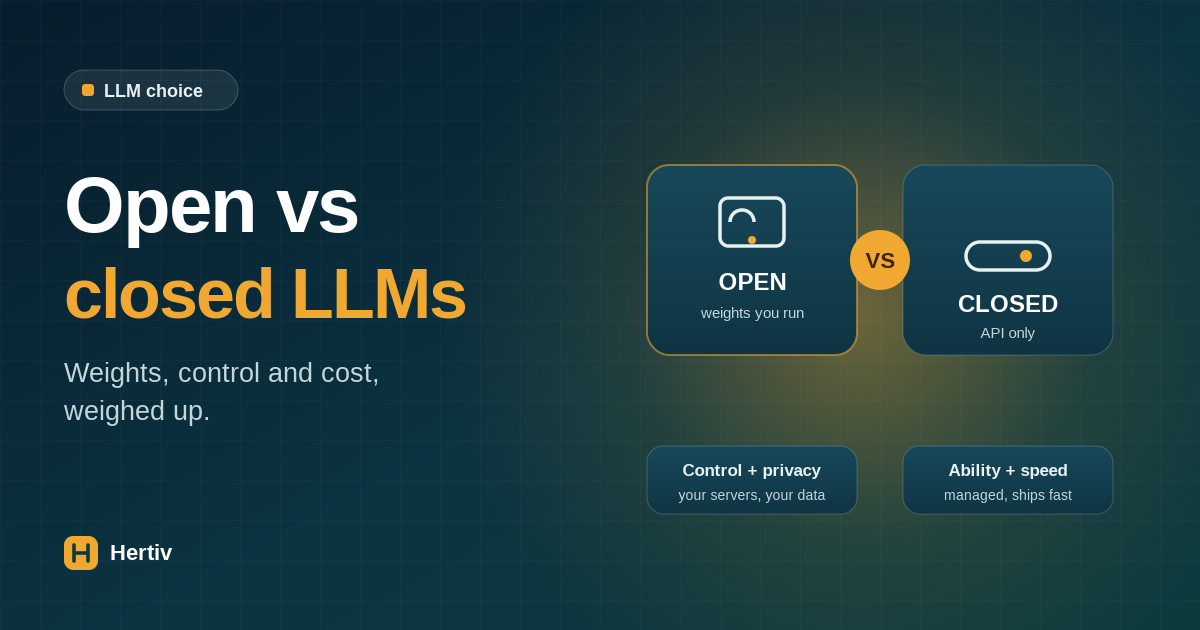
Open source vs closed LLMs: open models give you weights, control and self-hosting, while closed models give you a managed API and the strongest general ability.
On this page
Short answer
An open source LLM ships its weights so you can run, inspect and fine-tune it yourself, while a closed LLM is only available through the vendor's API. Open models win on control, privacy and cost at scale; closed models win on raw ability, speed to ship and managed safety, so the choice follows your data rules and your budget.
What is the difference between an open source and a closed LLM?
An open source LLM is a model whose weights are published, so anyone can download it, run it on their own hardware, inspect how it behaves and fine-tune it on their own data. A closed LLM is only available through the vendor's API: you send text in and get text back, but you never see the weights and cannot run the model yourself.
The difference is about control, not just price. With an open model you control where data goes, which version runs and what the model is allowed to do. With a closed model you trade that control for a managed service that is usually stronger out of the box and needs no infrastructure from you.
| Factor | Open source LLM | Closed LLM |
|---|---|---|
| Weights | Published, yours to run | Hidden, API only |
| Where data goes | Your servers | Vendor servers |
| Fine-tuning | Full control, your data | Vendor service, if offered |
| General ability | Strong, behind the leaders | Usually the strongest |
| Speed to ship | Needs setup and hosting | An API key and a prompt |
| Cost shape | Hardware and ops | Per-token billing |
Most products do not need to pick one forever. Many teams start on a closed API, then move the parts that handle sensitive data or high volume to an open model once the use case is proven.
Where open source LLMs win
Open source LLMs win where control matters more than raw ability. If your product handles health, legal or financial data that cannot leave your servers, a model you host yourself is often the only option that passes a security review. The same applies when a regulator or a customer contract limits where data can be processed.
They also win on cost at steady volume. A closed API bills per token, so a high-volume feature gets more expensive with every user. A hosted open model costs roughly the same whether it answers a hundred questions or a hundred thousand, once the hardware is paid for. That shape suits internal tools, support deflection and any feature with predictable, repeated traffic.
Fine-tuning is the third win. With the weights in hand, you can train on your own data, test the result on your own evaluation set and ship a version that fits your domain. Closed fine-tuning services exist, but you cannot inspect the result as closely, and you cannot move it to another vendor. For the fine-tuning path, how to fine-tune an LLM covers the steps and the costs.
Where closed LLMs win
Closed LLMs win on ability and speed. The strongest closed models still lead on hard reasoning, long documents, tool use and multilingual work, and the gap shows up on tasks where a small accuracy difference changes the outcome, such as drafting legal summaries or answering complex support questions.
They also win on time to ship. There is no hardware to buy, no serving stack to build and no model to update. A team can go from an idea to a working proof of concept in days, which matters when the use case is still unproven and the budget is small.
The managed safety layer is a real benefit too. Closed providers filter harmful output, monitor abuse and update the model when new risks appear. An open model leaves all of that to you, which is fine for a team with platform skills and a burden for a team without them. If you are still proving the idea, an AI proof of concept on a closed API is usually the cheapest way to learn.
Cost, control and compliance compared
Cost depends on volume and on what you count. A closed API looks cheap at low volume because there is nothing to set up, and expensive at high volume because every token is billed. An open model looks expensive at first because of hardware and engineering time, and cheaper later because the marginal cost of one more answer is small.
Control follows the same split. With an open model you choose the version, the hosting region, the logging and the safety rules, and you can keep running an old version while you test a new one. With a closed model the vendor can retire a version, change behaviour or raise prices, and your product has to follow.
| Question | Favours open | Favours closed |
|---|---|---|
| Data must stay on your servers | Yes | No |
| Volume is high and steady | Yes | No |
| Need the strongest reasoning | No | Yes |
| Ship in days, not weeks | No | Yes |
| Deep fine-tuning on your data | Yes | Sometimes |
| Small team, no platform skills | No | Yes |
Compliance is where the decision often gets made for you. If a customer contract or a regulation bars sending data to a third party, the closed option is off the table no matter how strong the model is. Check that constraint first, before comparing ability. The trade-offs with retrieval are covered in RAG vs fine-tuning, which applies to both kinds of model.
How to choose in five steps
Choose in five steps, and test before you commit to either side.
- List the hard constraints: where data may go, which regulations apply, and what your customers' contracts require.
- Define the job: what the model must do, how often, and what a wrong answer costs.
- Test one open and one closed model on the same 30 real cases from your own data, with the same prompts.
- Price both honestly: tokens and API fees for closed, hardware, engineering time and maintenance for open.
- Ship the winner on a small slice of traffic, with logging and a fallback, then decide whether to move more.
Example (hypothetical): a support team tests a closed API and a hosted open model on 30 past tickets. The closed model answers 26 well and the open model 24, but the team handles 40,000 tickets a month and the closed API would bill per token on every one.
They ship the open model for the routine tickets and keep the closed model for the 2,000 hardest cases a month. The split costs less than either option alone: routine traffic at a fixed hosting cost, hard cases at per-token prices, and a measured gap of 2 answers in 30 to watch.
For teams building the retrieval layer around either kind of model, how to build a domain-specific LLM covers the data and evaluation work that decides the outcome.
Common mistakes with open and closed LLMs
Most mistakes come from choosing on ability alone and discovering the cost or the data rule later.
- Picking a closed model, then learning customer data cannot leave your servers
- Picking an open model for its price, then underestimating the hosting and maintenance work
- Comparing models on vendor benchmarks instead of your own cases
- Testing with different prompts for each model, so the result measures the prompt, not the model
- Fine-tuning before retrieval is proven, when retrieval over your own documents would have been enough
- Locking the whole product to one vendor's API with no fallback model
- Skipping evaluation, so nobody can tell whether a model swap helped or hurt
The safest pattern is a hybrid: a closed model while you prove the idea, an open model where data rules or volume demand it, and a clean interface between your product and the model so either can change. If you want help making the call, LLM development covers the build and the decision.
Key takeaways
- Open models give you weights, hosting control and fine-tuning; closed models give you a managed API.
- Open wins on privacy, steady high volume and deep fine-tuning.
- Closed wins on raw ability, speed to ship and managed safety.
- Check data and compliance rules first; they often decide the question.
- Test one open and one closed model on the same 30 real cases before committing.
- A hybrid split is often cheaper than either option alone.
Frequently asked questions
Are open source LLMs as good as closed ones?
Open models are close on many everyday tasks, such as summarising, drafting and retrieval, and they keep improving. Closed models still lead on hard reasoning, long documents and tool use, so the gap matters most on the hardest cases.
Can I fine-tune a closed LLM?
Some vendors offer fine-tuning through their API, but you cannot inspect the weights or move the result to another provider. With an open model you train and host the result yourself, which gives you full control over the data and the version.
Is an open source LLM really free?
The weights are free to download, but running them is not. You pay for hardware, hosting, engineering time and maintenance. At low volume a closed API is usually cheaper; at high steady volume a hosted open model often wins.
Which is safer for sensitive data?
An open model you host yourself keeps data inside your own systems, which suits health, legal and financial work. A closed API sends data to the vendor, so it only fits when your contracts and regulations allow that.
Can I switch from a closed LLM to an open one later?
Yes, if your product talks to the model through a clean interface rather than vendor-specific features. Keep prompts, evaluation sets and retrieval code separate from the model, and the swap becomes a test, not a rebuild.
Do I need a GPU to run an open source LLM?
You need hardware that can hold the model in memory, which usually means a GPU for the larger models and can mean a strong CPU for the smallest ones. Most teams start with a hosted GPU service before buying hardware of their own.


