Open Source AI for Fraud Detection in Fintech
Open source AI gives fintech teams free building blocks for fraud detection, from scikit-learn and XGBoost to Kafka and MLflow. Here is how the stack fits together.
On this page
Short answer
Open source AI for fraud detection in fintech means using available libraries and tools — such as scikit-learn, XGBoost, Kafka and MLflow — to score transactions and flag suspicious behaviour. It suits teams that want full control over models and data, but it needs in-house skill to build, run and monitor. The stack works best when a rules layer sits beside the model and every decision is logged for review.
What is open source AI for fraud detection?
Open source AI for fraud detection is the use of freely available machine learning libraries and tools to spot suspicious payments and accounts in a fintech product. Instead of buying a vendor's fraud platform, the team builds its own scoring system from open components and keeps full control over the models and the data.
The core idea is scoring: every transaction gets a risk score, and high scores go to a human reviewer or get blocked by a rule. The model learns from past fraud cases, while a rules layer catches patterns the model has not seen. Together they form a system that can be tuned, audited and improved in-house.
| Layer | Job | Open source options |
|---|---|---|
| Data streaming | Move transactions in real time | Apache Kafka, Apache Flink |
| Feature store | Prepare signals for the model | Feast |
| Model | Score each transaction | scikit-learn, XGBoost, LightGBM |
| Rules | Catch known fraud patterns | Custom rules, Drools |
| Tracking | Version models and results | MLflow |
| Monitoring | Watch drift and false positives | Evidently AI, Grafana |
No single open source tool does the whole job. The stack is a set of parts that fit together, and the team's skill is what makes it work. That is the key difference from a vendor platform, where the parts arrive pre-assembled.
Which open source tools do teams use?
The open source tools fintech teams use for fraud detection fall into six groups, and most teams pick one tool per group rather than trying to use them all. The choices below are the common ones in production systems.
- scikit-learn. The standard Python library for training and testing models such as logistic regression, random forests and isolation forests. Good for first models and for baselines.
- XGBoost and LightGBM. Gradient boosting libraries that often score well on tabular transaction data. A common choice once a baseline model is working.
- Apache Kafka and Flink. Streaming tools that move transaction data in real time, so scoring can happen before a payment clears rather than after.
- Feast. A feature store that keeps the signals a model needs — such as recent transaction counts — consistent between training and live scoring.
- MLflow. A tracking tool that records which model version, data and settings produced each result, so experiments can be repeated and audited.
- Evidently AI and Grafana. Monitoring tools that watch model drift and false positive rates, and alert the team when performance slips.
Deep learning frameworks such as TensorFlow and PyTorch also appear, but they are less common for transaction scoring, where tabular models usually do the job with less effort. Start with the simpler tools and add complexity only when the simpler model misses fraud that matters.
Choosing tools is the easy part. The hard part is the labelled data: past transactions marked as fraud or genuine. Without enough labelled cases, even the best library cannot learn the difference. Teams that lack that data often start with rules and add a model later.
How does an open source fraud stack work?
An open source fraud stack works as a pipeline: transactions stream in, features are computed, the model scores each one, rules add extra checks, and high-risk cases go to a reviewer. The whole path should take well under a second for a payment that needs an instant answer.
- Stream the transaction. Kafka or Flink carries each payment event to the scoring service as it happens.
- Compute features. The feature store supplies signals such as the number of transactions from this device in the last hour.
- Score it. The model returns a risk score, and the rules layer adds flags for known patterns such as impossible travel.
- Decide. Low scores pass, high scores are blocked, and middle scores go to a human reviewer.
- Log everything. Every score, rule hit and decision is stored, so the team can audit cases and retrain the model.
- Monitor and retrain. Drift and false positive rates are watched, and the model is retrained when fraud patterns change.
The reviewer is part of the system, not an afterthought. Fraud teams learn from the cases reviewers overturn, and those labels feed the next round of training. A model with no review loop goes stale fast, because fraud patterns change constantly.
For the analytics side of the same problem, see the guide to how analytics catches fraud in finance, which covers the signals and metrics that feed the model.
Open source vs vendor tools: the trade-offs
The trade-offs between open source and vendor fraud tools come down to control, cost shape, speed and responsibility. Open source gives you control and no licence fee; a vendor gives you a working system and someone to call when it breaks.
| Factor | Open source stack | Vendor platform |
|---|---|---|
| Licence cost | Free tools | Subscription or per-transaction fee |
| Control | Full control over models and data | Limited to vendor settings |
| Speed to launch | Weeks to months of building | Days to weeks of setup |
| Skill needed | Data and engineering team | Vendor support plus your analysts |
| Maintenance | Your team owns it | Vendor handles updates |
| Audit trail | You build the logging | Built in, to vendor standard |
Cost is the point most teams misjudge. Open source tools are free, but the engineers who build and run them are not. A vendor fee can be cheaper than a small team once the full year of salaries, on-call cover and upkeep is counted. Price both routes for a year before choosing.
Control matters most in regulated work. If auditors need to see exactly how a decision was made, an open stack you built is easier to explain than a vendor's black box. That alone pushes many fintech teams toward open source, even when a vendor would be faster.
How to start in 5 steps
You start an open source fraud stack by proving the data exists, then building one scoring path for one payment type. The five steps below keep the project small enough to finish.
- Check the labelled data. Count past fraud cases and genuine transactions. Without enough labels, start with rules, not a model.
- Pick one payment type. Card payments, transfers or wallet top-ups — one flow, not all three at once.
- Build a baseline model. Train a simple scikit-learn or XGBoost model and measure it against your current rules.
- Add the review loop. Send middle scores to reviewers and feed their decisions back as new labels.
- Monitor from day one. Track false positives and drift, so you know when the model needs retraining.
A finance AI review can help size the first project, but the pilot itself should stay small: one payment type, one model, one reviewer queue. A pilot that covers everything usually covers nothing well.
Example: a payments startup trials open source scoring
Example (hypothetical): a payments startup handles 100,000 transactions a month and wants to trial open source scoring on card payments. Its analysts already review suspicious cases by hand, so the team has labelled data to learn from.
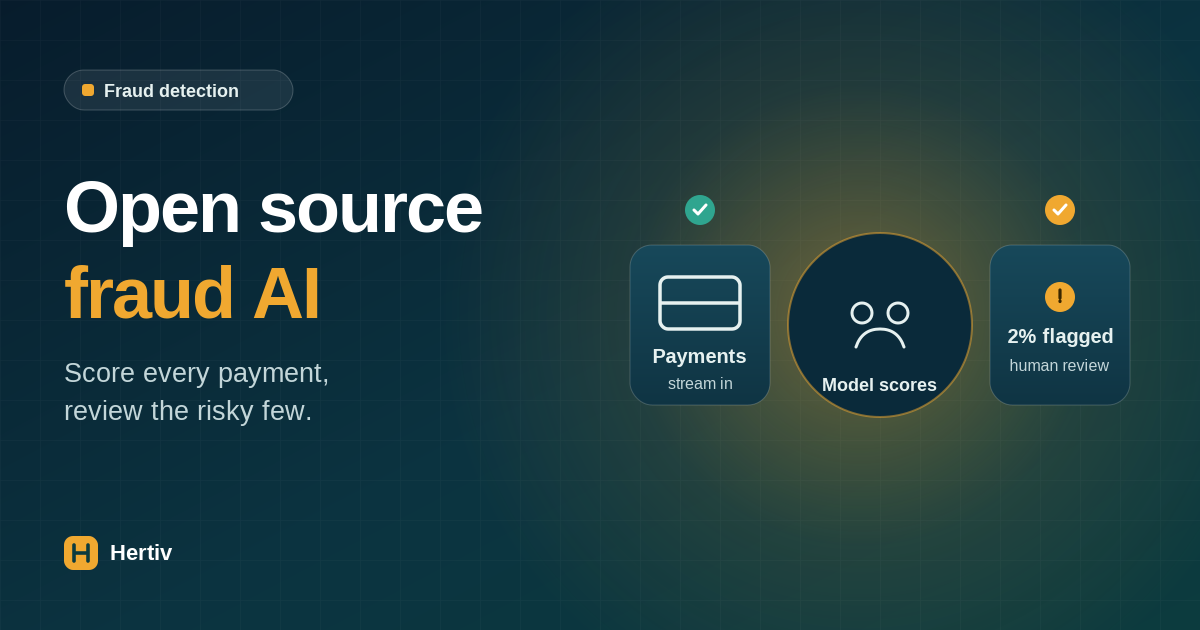
The team trains a simple model that flags 2% of transactions for review. That is 100,000 × 2% = 2,000 cases a month. Each review takes 3 minutes, so the review load is 2,000 × 3 = 6,000 minutes, which is 100 hours a month. Two analysts can cover that in 50 hours each, alongside their other work.
After one month, the reviewers confirm fraud in 300 of the 2,000 flagged cases and clear the rest. The team uses those 2,000 new labels to retrain the model, and the false positive rate falls in the next round. The pilot costs the team its own time plus hosting, with no licence fee — but the review hours are a real cost, and the team budgets for them before scaling up.
The lesson is that the model is only half the system. The review queue, the labels it produces and the monitoring around it are what make open source scoring work in practice. A team that budgets only for the model will run out of review capacity in the first month.
What are the common mistakes?
The most common open source fraud detection mistakes are starting without labelled data, trusting the model with no rules beside it, and skipping monitoring until fraud patterns have already changed.
- No labelled data. A model trained on guesses learns guesses. Start with rules if labels are thin.
- Model only, no rules. Known fraud patterns such as impossible travel are cheaper to catch with a rule than with a model.
- No review loop. Without reviewers feeding labels back, the model goes stale as fraud changes.
- Skipping monitoring. Drift and false positives creep up quietly; without alerts, the team finds out from customers.
- Overfitting the past. A model that fits last year's fraud perfectly may miss this year's new patterns.
For the engineering side of the stack, a partner for data engineering can build the streaming and feature store so the model always scores on fresh, consistent data.
Key takeaways
- Open source AI gives fintech teams free building blocks — scikit-learn, XGBoost, Kafka, Feast, MLflow — but the team builds and runs the stack
- The stack is a pipeline: stream, compute features, score, apply rules, review, log and monitor
- Labelled data is the real constraint — without enough fraud labels, start with rules, not a model
- A vendor fee can be cheaper than a small in-house team once a full year of upkeep is counted
- The review loop is what keeps the model fresh: reviewer decisions become the next round of training labels
Frequently asked questions
What open source tools are used for fraud detection?
Common choices are scikit-learn, XGBoost and LightGBM for models, Apache Kafka and Flink for streaming, Feast for features, MLflow for tracking, and Evidently AI or Grafana for monitoring. No single tool does the whole job; the stack is a set of parts.
Is open source fraud detection free?
The tools are free, but the engineers, review hours and hosting are not. A small team building and running the stack for a year can cost more than a vendor fee. Price both routes for a full year, including review time, before choosing.
Do I need labelled data for fraud detection AI?
Yes, for a model. The model learns from past transactions marked as fraud or genuine. If you lack enough labels, start with a rules layer and build the label set from reviewer decisions before training a model.
Can open source AI catch fraud in real time?
Yes, when the pipeline is built for it. Kafka or Flink streams transactions, the feature store supplies signals, and the model scores each one in well under a second. The review queue handles the cases the model is unsure about.
How do I stop a fraud model going stale?
Monitor drift and false positive rates, and retrain on fresh labels from the review queue. Fraud patterns change constantly, so a model with no retraining plan will miss new attacks within months.
Should a small fintech build or buy fraud detection?
Buy if you need a working system fast and lack a data team; build with open source if you need full control, have labelled data and can staff the build and the review queue. Many teams start with a vendor and move parts in-house later.


