How Analytics Catches Fraud in Finance
Fraud analytics spots suspicious payments and claims before money leaves the bank. Here is how detection works, what data it needs and how teams act on alerts.
On this page
Short answer
Analytics catches fraud in finance by scoring transactions, accounts and claims against known fraud patterns and unusual behaviour, then routing the riskiest cases to investigators. It combines rules, statistical models and network checks on payment, account and device data, and it works best when alerts are reviewed quickly and confirmed fraud feeds back into the models.
How does analytics detect fraud in finance?
Fraud analytics in finance is the use of data, rules and models to spot transactions, accounts or claims that look like fraud, before or shortly after the money moves. It turns the traces every payment leaves behind into a score or a flag that a team can act on.
A single payment rarely proves fraud on its own. What gives it away is usually a combination: an amount that is out of line for that customer, a new payee, a device that has never been used before, and a time of day that does not fit the usual pattern. Analytics weighs those signals together instead of judging one at a time.
Most finance teams use several techniques at once, because each one catches a different kind of fraud:
| Technique | What it looks for | Strength | Limit |
|---|---|---|---|
| Rules | Known patterns, such as large transfers to new payees | Clear, easy to explain | Misses new fraud types |
| Anomaly detection | Behaviour that breaks from a customer's normal pattern | Catches new patterns | Can flag genuine activity |
| Supervised models | Cases that resemble past confirmed fraud | Learns from labelled cases | Needs good labelled data |
| Network analysis | Accounts, devices or payees linked to known fraud | Finds fraud rings | Needs linked data |
| Device and behaviour checks | New devices, odd locations, unusual typing or timing | Works before payment | Can annoy real users |
No single technique is enough. Rules catch what you already know, models learn from what you have seen, and anomaly checks catch what is new. The combination is what makes the system useful in practice.
What data does fraud analytics need?
Fraud analytics needs clean, joined-up data about who is paying, what is being paid, and how the payment is made. Without that, even a good model has nothing solid to score.
The core data is transaction history: amounts, payees, dates, channels and the result of past reviews. On top of that, teams add account data, such as age of account, recent changes to contact details and failed login attempts. Device data matters too, including device type, location signals and whether the device has been seen before.
Two other sources are often overlooked. The first is the outcome of past investigations, because confirmed fraud and confirmed genuine cases are the labels that teach models what to look for. The second is shared fraud lists and watchlists, which flag accounts and devices already linked to fraud elsewhere. A predictive analytics in finance programme usually starts by getting these sources into one place before any modelling begins.
Data quality decides the result. Missing fields, duplicated accounts and stale watchlists all produce noisy scores, and noisy scores produce alerts that investigators learn to ignore.
Rules or models: which catches more fraud?
Rules catch more of the fraud you already understand, while models catch more of the fraud you have not seen before. Most teams need both, and the balance shifts as the fraud changes.
Rules are simple statements such as flag any first transfer above a set amount to a new payee, or block a card after three failed PIN attempts. They are easy to explain to auditors and quick to change when a new scam appears. Their weakness is that fraudsters learn the rules and stay just inside them.
Models score each transaction against patterns learned from past cases. A model can weigh dozens of signals at once and spot combinations no single rule would catch. Their weakness is that they need labelled examples, and they can drift as customer behaviour changes, so they need regular review and retraining.
A practical setup is to let rules handle the clear cases, such as known bad devices and blocked payees, and let models rank everything else by risk. Investigators then work down the ranked list instead of guessing where to start.
How does an alert become a decision?
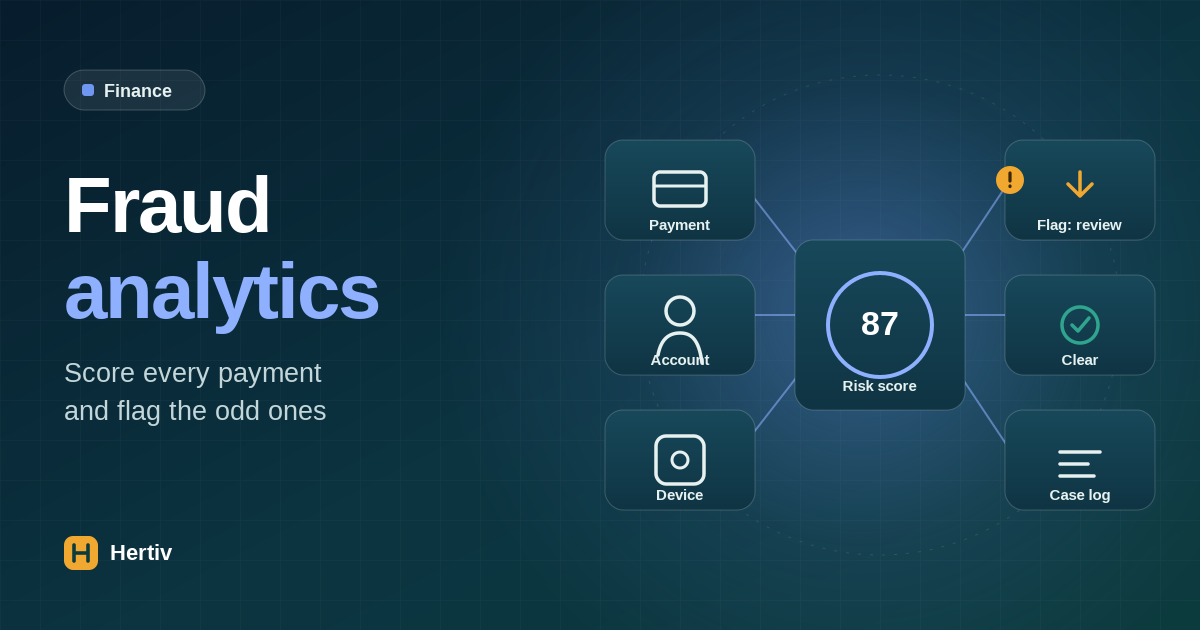
An alert becomes a decision through a short, timed workflow: score, rank, review, act, and record the outcome. The speed of that loop matters more than the cleverness of the model behind it.
- Score the event. Each transaction, claim or account change gets a risk score as it happens, or within minutes for slower channels.
- Rank and route. High scores go to investigators first, medium scores go to a queue, and low scores pass with no action.
- Review with context. The investigator sees the customer's history, the device, related accounts and why the score is high, not just a number.
- Act. The team blocks, holds, calls the customer, or clears the case, and records the reason.
- Feed the outcome back. Confirmed fraud and false alarms go back into the data so rules and models improve.
The handoff between machine and person is where most programmes fail. If alerts arrive without context, reviewers guess. If they arrive too late, the money is gone. AI orchestration can help here: AI orchestration for banking fraud detection shows how scoring, case routing and review can run as one joined-up flow.
Example (hypothetical): a small bank's card fraud pilot
Example (hypothetical): a small bank processes 40,000 card transactions a day. Its old setup flags 400 of them with simple rules, and reviewers confirm 40 as fraud. That is a 10% hit rate, and the team spends most of its day on false alarms.
The bank adds a model that ranks transactions by risk. It now sends only 120 alerts a day to reviewers, and 24 of them turn out to be fraud. The hit rate rises from 10% to 20%, and the review load falls from 400 cases to 120.
The time saving is easy to check. Each review takes about 5 minutes, so 120 reviews take 600 minutes, which is 10 hours. Two reviewers working 5 hours each cover the day, where the old queue needed more than three times that effort.
The money side also adds up. If the average confirmed fraud is $800, the 24 cases caught are worth $19,200 a day in stopped losses. The bank still misses some fraud that scores low, so it reviews a sample of low-scoring cases each week to find what the model is missing.
What are the common mistakes?
The most common fraud analytics mistakes are chasing the model and neglecting the review loop, the data and the false alarms.
- Too many alerts. A system that flags a large share of genuine payments trains reviewers to dismiss alerts without reading them.
- No feedback loop. If confirmed fraud and false alarms never reach the model, it keeps making the same errors.
- Dirty account data. Duplicated customers and missing device history make scores unreliable.
- Ignoring new channels. Fraud moves to the channel with the weakest checks, so a strong card system and a weak instant-payment system is a weak system.
- No time limit on reviews. Alerts that sit for days are only useful for reporting, not for stopping losses.
- Measuring catches only. A team that counts fraud caught but not genuine customers blocked will keep tightening until customers leave.
How to start with fraud analytics
You start with fraud analytics by picking one fraud type, getting its data in order, and building a review loop before you buy or build any model.
- Pick one fraud type. Card fraud, account takeover or false claims are each a different problem; start with the one costing the most.
- Gather the data. Bring together transactions, accounts, devices and past investigation outcomes for that fraud type.
- Add simple rules first. Block known bad devices and payees, and set thresholds for the clearest patterns.
- Rank the rest. Add a model or a scored checklist to order the remaining cases by risk.
- Staff the review loop. Give reviewers context, a time target and a way to record outcomes.
- Review weekly. Check hit rates, false alarms and missed cases, then adjust rules and retrain the model.
Keep the first version small enough to measure. A single fraud type with a working review loop teaches you more than a wide programme with no feedback. Financial analytics for enterprises covers the wider data foundations that fraud work sits on.
Key takeaways
- Fraud analytics scores payments, accounts and claims against known patterns and unusual behaviour
- Rules catch known fraud fast; models and anomaly checks catch what is new
- Clean, joined-up data matters more than the model: history, devices and past outcomes
- Alerts only help if reviewers get context and act within minutes, not days
- Confirmed fraud and false alarms must feed back into the system or it stops improving
- Start with one fraud type and a working review loop before widening coverage
Frequently asked questions
How is fraud analytics different from a fraud rule engine?
A rule engine applies fixed statements, such as flagging transfers above a set amount to a new payee. Fraud analytics adds scoring, anomaly detection and models that weigh many signals together, so it can catch cases no single rule would flag. Most teams use both, with rules for clear cases and models to rank the rest.
How fast must fraud detection work?
For card and instant payments, scoring should happen in seconds, because the money moves that fast. For claims and account changes, minutes to hours can be enough. The review loop matters as much as scoring: an alert that sits unreviewed for a day only helps with reporting, not with stopping losses.
What is a good alert hit rate?
There is no fixed good rate, because it depends on the fraud type and the cost of a false alarm. What matters is the trend: hit rate should rise as the feedback loop improves, and false alarms should fall. Track both, and review a sample of low-scoring cases to find fraud the system misses.
Do small banks need machine learning for fraud?
Not at first. Simple rules, device checks and a disciplined review loop catch a large share of fraud for a small bank. Machine learning becomes worth it when the volume of transactions makes manual ranking slow, or when fraud patterns keep changing faster than rules can be written.
How do you handle false positives in fraud detection?
Reduce them by improving data quality, tuning thresholds and feeding review outcomes back into the model. Give reviewers the context to decide fast, and track how many genuine customers are blocked or delayed. If false alarms rise, loosen the threshold on low-risk segments before adding more rules.
Can analytics stop account takeover fraud?
It can reduce it a lot. Device checks, login behaviour, password reset patterns and changes to contact details are strong signals. The key is to score the login and the first transaction after it together, and to step up checks, such as extra verification, when the risk score rises.


