7 NLP Use Cases in Legal Work That Save Time
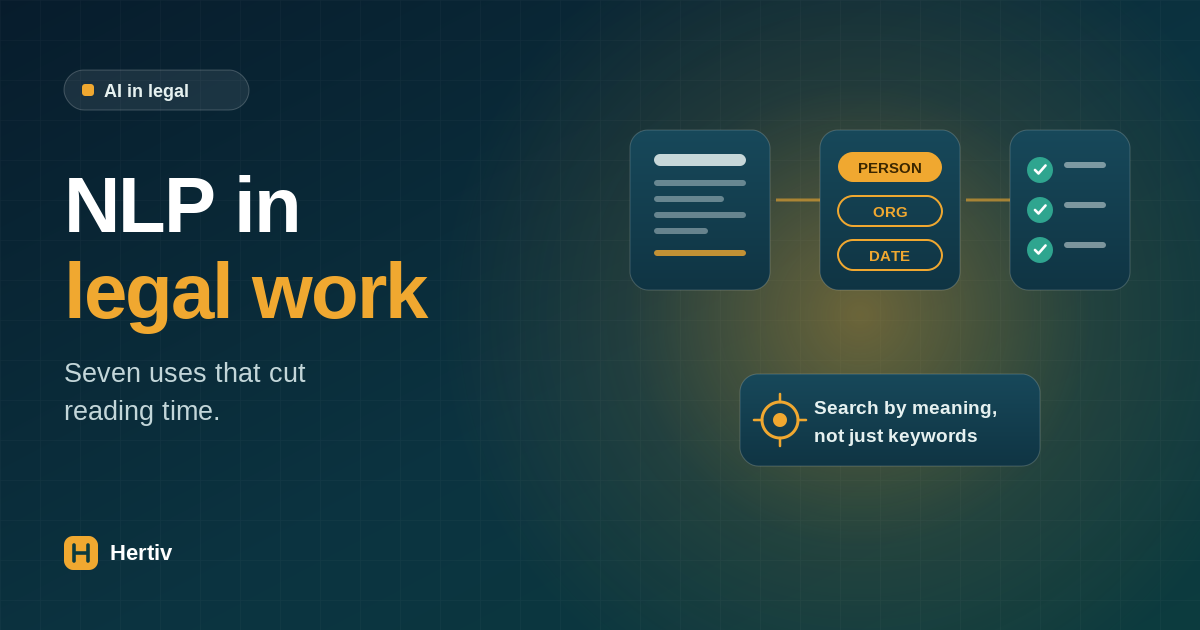
NLP helps legal teams read faster, not replace lawyers: clause extraction, e-discovery search and compliance checks, with a human reviewing every output.
On this page
Short answer
NLP use cases in legal work help lawyers read faster by pulling structured facts out of long documents: clauses, deadlines, names and risks. The strongest uses are clause extraction, e-discovery search, research summarisation and compliance monitoring, each with a lawyer checking the output before it is relied on.
Which NLP use cases fit legal work best?
The NLP use cases that fit legal work best are the ones that read long documents and pull out structured facts: clauses, dates, names, obligations and risks. They work because legal documents are dense, repetitive and written in a narrow vocabulary, which is exactly the kind of text NLP handles well.
Use this comparison to shortlist. Every row still needs a lawyer to review the output before it is relied on.
| Use case | What it does | Documents it reads | Human check |
|---|---|---|---|
| Clause extraction | Finds and labels key clauses | Contracts, agreements | Every clause |
| Obligation tracking | Pulls out duties and deadlines | Contracts, leases | Every deadline |
| E-discovery search | Finds relevant text across files | Emails, messages, files | Sampled results |
| Research summaries | Summarises cases and statutes | Judgments, statutes | Every summary |
| Entity extraction | Finds people, firms, amounts | Filings, pleadings | Spot checks |
| Compliance monitoring | Flags clauses that breach policy | Policies, contracts | Every flag |
| Due diligence review | Scans a deal room for risks | Deal documents | Every finding |
Start with one row, not all seven. Clause extraction on a single contract type teaches a team more about data quality and review workflow than a firm-wide rollout.
Clause extraction and obligation tracking
1. Clause extraction: best for contract review
Clause extraction reads a contract and labels the parts that matter: termination, liability caps, renewal terms, governing law and payment terms. Instead of reading 40 pages to find the renewal clause, a lawyer opens the extracted list and jumps straight to it.
The pattern that works is extraction plus a side-by-side view of the source text. The lawyer never trusts the label alone; they click through and read the clause in context. That keeps speed up without giving up accuracy.
2. Obligation tracking: best for deadlines and duties
Obligation tracking pulls out what each party must do and by when: deliver a report by a date, renew insurance, give notice before a deadline. It turns a signed contract into a list of dated tasks that can be put on a calendar.
This is where missed obligations get caught. A lease that requires notice 90 days before renewal is easy to forget and expensive to miss, and a tracked list makes the deadline visible months ahead.
Search and research across legal text
3. E-discovery search: best for finding relevant documents
E-discovery search uses NLP to find documents that answer a question, not just documents that contain a keyword. It understands that "end the agreement" and "terminate the contract" mean the same thing, so a search for one finds the other.
The value is in the long tail of a document set. In a review of thousands of emails, keyword search returns the obvious hits and misses the paraphrased ones, while NLP ranks documents by meaning and surfaces the ones a keyword list would skip.
4. Research summarisation: best for long judgments and statutes
Research summarisation turns a long judgment or statute into a short brief: the facts, the holding, the reasoning and the cited authorities. A lawyer reads the summary first and then reads the full text only where the summary raises a question.
Summaries must cite the passages they come from, so the lawyer can check them. A summary without citations is hard to verify, and verification is the whole point of legal research. See best AI legal research software for how research tools handle this.
Entities, compliance and deal review
5. Entity extraction: best for filings and pleadings
Entity extraction finds the names, firms, dates and amounts inside filings and pleadings and puts them in a table. A 200-page filing becomes a list of parties, dates and money figures that a lawyer can scan in minutes.
This is most useful when the same entities appear under different spellings or in different documents. The extracted table links each mention back to its source page, so a discrepancy can be checked rather than guessed at.
6. Compliance monitoring: best for policy checks
Compliance monitoring reads contracts and policies against a checklist and flags the clauses that do not match. A firm policy might require a data protection clause in every vendor agreement, and the monitor flags the agreements that lack one.
Every flag still needs a human decision, because a clause can satisfy a policy in words the checklist did not expect. The monitor narrows the pile; it does not make the call. For the wider pattern, document AI covers extraction and validation across document types.
7. Due diligence review: best for deal rooms
Due diligence review scans the documents in a deal room and flags risks: change-of-control clauses, unusual indemnities, missing consents and expiring licences. It gives the deal team a risk list in the first days rather than the last weeks.
The review works best on a defined checklist, because "find risks" is too vague for a model to do well. A checklist of 20 known risk types, applied to every document, produces a consistent list that lawyers can work through in order.
How to choose an NLP use case for your legal team
Choose by document volume and review pain, not by how impressive the demo looks. A use case that saves a reviewer an hour a day and can be checked will beat a flashy one nobody can verify.
- List the document types your team reads most often, and count the pages per month.
- Pick the type where a wrong extraction is caught by a normal review step.
- Assemble a sample of real documents and the correct extractions, to test against.
- Check that the tool shows its source passage for every extracted fact.
- Run a pilot on one contract type with a defined accuracy bar, then decide.
Data readiness is usually the bottleneck. If your contracts live in scanned PDFs with no text layer, extraction quality will suffer until the documents are properly digitised. NLP development services cover the document preparation and evaluation work that makes these use cases hold up.
What are the common mistakes?
The most common mistakes in legal NLP are trusting output without checking it, and starting with the hardest documents instead of the most repetitive ones.
- Skipping the source check. An extracted clause that cannot be traced to its passage is not usable in legal work.
- Starting with bespoke contracts. Standard-form agreements extract far better than one-off negotiated documents.
- No evaluation set. Without a labelled sample of correct answers, quality debates are anecdotal.
- Treating extraction as advice. NLP can find a clause; it cannot tell you whether the clause is good for your client.
- Ignoring privilege and confidentiality. Documents sent to a third-party service need the same controls as any other client file.
What to get right before you scale
Before scaling, fix the document pipeline: clean text layers, consistent file naming and a labelled evaluation set. These three things decide extraction quality more than the choice of model.
Then agree on the review standard. Every use case needs a written rule for what "checked" means: which outputs a lawyer reads in full, which are spot-checked, and what happens when the model and the lawyer disagree. Without that rule, review either becomes a bottleneck or quietly stops happening.
Finally, keep the human in the loop by design. The goal is a lawyer who reads faster with a reliable assistant, not a process that produces legal conclusions nobody has read. See legal document review software for how review tools structure this workflow.
Key takeaways
- Clause extraction and obligation tracking save the most time on repetitive contract review
- E-discovery search finds relevant documents by meaning, not just by keyword
- Research summaries must cite their source passages to be verifiable
- Compliance monitoring narrows the pile of documents; it does not make the decision
- Start with one contract type and a labelled evaluation set before scaling
Frequently asked questions
What is NLP in legal work?
NLP in legal work is the use of language models to read legal documents and pull out structured facts, such as clauses, dates, names and obligations. It speeds up reading and review; it does not give legal advice or replace a lawyer's judgement.
Can NLP review a contract on its own?
No. NLP can extract and label clauses, but a lawyer must check the extraction against the source text before it is relied on. The reliable pattern is extraction plus a side-by-side view of the original clause, so the check is fast.
Which legal documents work best with NLP?
Standard-form contracts, leases, filings and pleadings work best, because they are repetitive and use a narrow vocabulary. Bespoke negotiated agreements extract less reliably, since their wording varies more from document to document.
How is NLP different from RAG in legal work?
NLP extracts and labels facts from documents, such as clauses and entities. RAG retrieves relevant passages and generates answers grounded in them. They are complementary: NLP structures the text, and RAG answers questions over it.
Is client data safe when using NLP tools?
It depends on the tool and its settings. Client documents need the same confidentiality controls as any other file, including data residency, access limits and retention rules. Check where the documents are processed before uploading client material.
How do you measure whether legal NLP is working?
Use a labelled sample of documents with known correct extractions, and track accuracy against it. Also track time saved per review and how often lawyers correct the output, so you can see whether the tool is improving or drifting.


