NFT Use Cases in Retail That Go Beyond Digital Collectibles
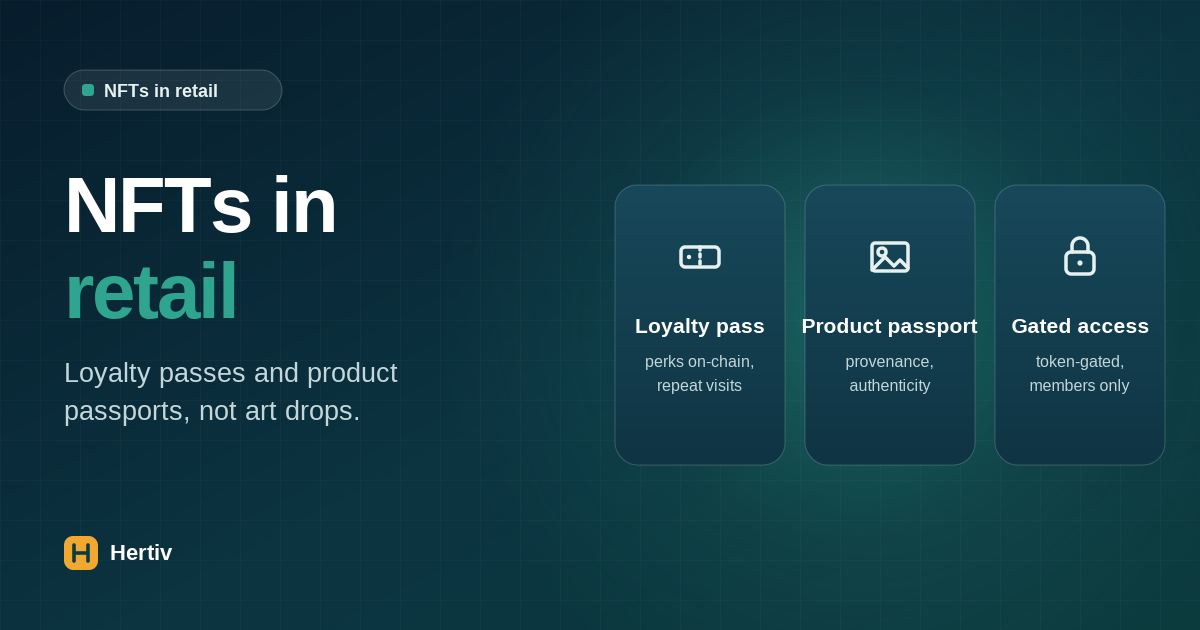
NFTs in retail work best as loyalty passes, product passports and token-gated access, not as speculative art drops. Here are the patterns that hold up.
On this page
Short answer
NFTs give retailers a way to issue unique, transferable digital records tied to a wallet. In retail they work best for loyalty tiers, authenticity and product passports, token-gated perks, event tickets and resale royalty tracking, not as speculative collectibles.
Which NFT use cases actually fit retail?
Retail NFT programs make sense when the token represents something the customer already values: status, access, proof of purchase or a resale right. Speculation is the wrong foundation.
The table below compares the patterns that come up most often in retail scoping. Effort is a rough guide to build complexity, not a price.
| Use case | What it does | Typical data needed | Effort |
|---|---|---|---|
| Loyalty tier pass | NFT acts as a membership card with perks | Customer ID, tier rules, wallet link | Low to medium |
| Product passport | Records origin, materials, warranty | SKU data, supplier records, serial numbers | Medium |
| Token-gated access | Unlocks drops, events or content | Wallet allowlist, access rules | Low |
| Event and experience tickets | Verifiable, transferable entry tokens | Event data, seat or zone mapping | Medium |
| Resale royalty tracking | Pays a share on secondary sales | Marketplace integration, payout rules | Medium to high |
| Digital twin with physical item | Token paired to a physical product | Serial numbers, minting workflow | Medium |
| Community membership | Gives holders a channel and votes | Member list, governance rules | Low to medium |
| Phygital collectible drop | Limited edition tied to a purchase | Campaign data, redemption logic | Medium |
The right starting point depends on whether the goal is retention, trust or new revenue. Most retailers get more value from retention and trust than from a one-off drop.
Loyalty tiers and token-gated perks
Loyalty is the strongest retail NFT use case because the token replaces a database row with something the customer can hold and carry across channels. It is a membership pass with rules attached.
Loyalty tier pass: best for retention programs
A retailer mints a pass per tier. Holding the pass unlocks early access, free shipping or members-only stock. The wallet is usually created behind the scenes in the retailer's app so the customer never manages keys.
Pros - Clear value for the customer from day one. - Easy to test alongside an existing loyalty program. - Tiers can be upgraded or revoked by the retailer.
Cons - Adds wallet and custody complexity to the app. - Perceived as a gimmick if perks are weak.
Token-gated access: best for launches and events
A token in a wallet unlocks a product drop, a fitting session or content. Access rules live in a contract or a backend check, and the storefront reads the wallet before showing the offer.
Pros - Small build, quick to launch. - Creates a reason to join the program.
Cons - Needs a clear rule for what happens when the token is sold. - Scarcity messaging can attract the wrong audience.
Authenticity, product passports and resale
A product passport is an NFT or on-chain record paired to a physical item. It carries origin, materials, warranty and service history, and it can follow the item through resale.
This matters most for premium goods, footwear, watches and anything with a secondary market. The token does not prove the item is real on its own; it proves a record was issued and who issued it. Pair it with a serial number, a tamper-evident tag or a QR code on the item.
Product passport: best for trust and warranty
Mint at manufacture, link to the serial, and let the customer claim it at purchase. Service events can be added over time.
Pros - Reduces disputes in resale and warranty claims. - Gives the brand a direct channel to second owners.
Cons - Depends on supplier data quality. - Needs a plan for lost wallets and account recovery.
Resale royalty tracking: best for premium and limited items
A contract can route a share of secondary sales back to the brand or the original buyer. This only works where the marketplace honours the royalty, which is not guaranteed. Treat it as a bonus, not a revenue line.
Tickets, experiences and community
Event and experience tokens work well for retailers that run launches, in-store events or brand communities. The token is a verifiable ticket that can carry perks and post-event access.
Event and experience tickets: best for brand moments
A token replaces or supplements a QR ticket. It can be checked at the door, transferred under rules, and upgraded with content after the event.
Pros - Strong fit with pop-ups and product launches. - Easy to combine with loyalty tiers.
Cons - Ticketing fraud is a process problem as much as a tech problem. - Needs a fallback for customers without a wallet.
Community membership: best for owned audiences
Holders get a channel, votes on products or early sight of collaborations. The value comes from the brand's continued attention, not from the token itself.
Pros - Builds a direct line to superfans. - Low technical lift once a wallet exists.
Cons - Communities decay without regular programming. - Moderation and support cost real money.
For broader patterns that pair with these, see the AI and blockchain use-case library. If you are weighing a build partner, blockchain consulting with a straight answer is a sensible first call.
How to choose your first retail NFT use case
Pick the use case with the clearest customer benefit and the smallest operational surface. A loyalty pass or a gated drop usually beats a broad passport program for a first release.
- Define the job. Decide whether the goal is retention, trust, resale control or new revenue. Write it as one sentence with a measurable outcome.
- Check the data. Passports need clean SKU and supplier data. Loyalty needs a customer identity and tier rules. If the data is messy, fix that first.
- Choose the chain. Low-fee networks suit high-volume loyalty and ticketing. Higher-value items may justify a more established network.
- Hide the wallet. Most retail customers should never see a seed phrase. Plan custody, recovery and support before launch.
- Run a closed pilot. Limit it to a segment, measure redemption and repeat purchase, then decide on expansion.
For retail-specific context on where this fits with other AI and Web3 work, see AI for retail and e-commerce. Teams building on Ethereum or similar networks can review enterprise blockchain development for architecture patterns.
Common mistakes in retail NFT programs
Most retail NFT failures come from treating the token as the product rather than as a record or a key. The technology is rarely the hard part.
- Leading with speculation. Messages about resale value attract flippers and repel loyal customers. Lead with perks and access.
- No wallet plan. Asking customers to install a wallet and buy tokens kills conversion. Use custodial or embedded wallets.
- Ignoring support. Lost access, transfers and tier changes all generate tickets. Budget for support from day one.
- Unclear legal claims. Do not call a token a certificate of authenticity unless you can defend the claim. Document what it proves.
- No end state. Decide what happens to perks when the program changes, and whether tokens are burned, migrated or frozen.
- Skipping measurement. Define the metrics before launch: redemption rate, repeat purchase, support volume per thousand users.
Key takeaways
- Treat the NFT as a membership or record, not as an asset to flip.
- Loyalty tiers and token-gated perks are the lowest-risk entry point.
- Product passports help with authenticity, warranty and resale tracking.
- Most retail programs should run on a low-fee chain and hide the wallet behind the app.
- Budget for custody, support and compliance, not just smart contract work.
Frequently asked questions
Do customers need a crypto wallet to use a retail NFT?
No. Most retail programs use embedded or custodial wallets created inside the brand's app. The customer signs in normally and the wallet sits behind the scenes. Brands keep recovery and support processes in their own hands.
Which blockchain is best for retail NFTs?
Low-fee networks are usually the better fit for loyalty and ticketing because customers transact often and small fees add up. Higher-value items and resale programs may justify a more established network. The choice should follow your volume and partner integrations, not hype.
Are NFT product passports legally binding proof of authenticity?
Not by themselves. A token records who issued a claim, not whether a physical item is genuine. Pair it with serial numbers or tamper-evident tags, and state clearly in your terms what the token certifies.
How much does a retail NFT program cost?
Typical ranges vary widely with scope. A token-gated drop is a small build; a loyalty program with embedded wallets and app integration is substantially more. Include smart contract audit, support and compliance in the budget, not only development.
Can NFTs work with an existing loyalty platform?
Yes. Most integrations map existing tiers and points to token rules, with the loyalty platform remaining the source of truth. The NFT acts as a portable pass while the backend decides perks and eligibility.
What should we measure to know if it worked?
Track redemption of token-gated offers, repeat purchase among holders, program sign-up conversion, transfer activity and support tickets per thousand users. Compare a pilot segment against a control group before expanding.


