8 Benefits of Building NEO Smart Contracts for Insurance
NEO smart contracts can speed up claims, cut admin work and give every party the same record. Here are eight benefits for insurance providers, and how to start.
On this page
Short answer
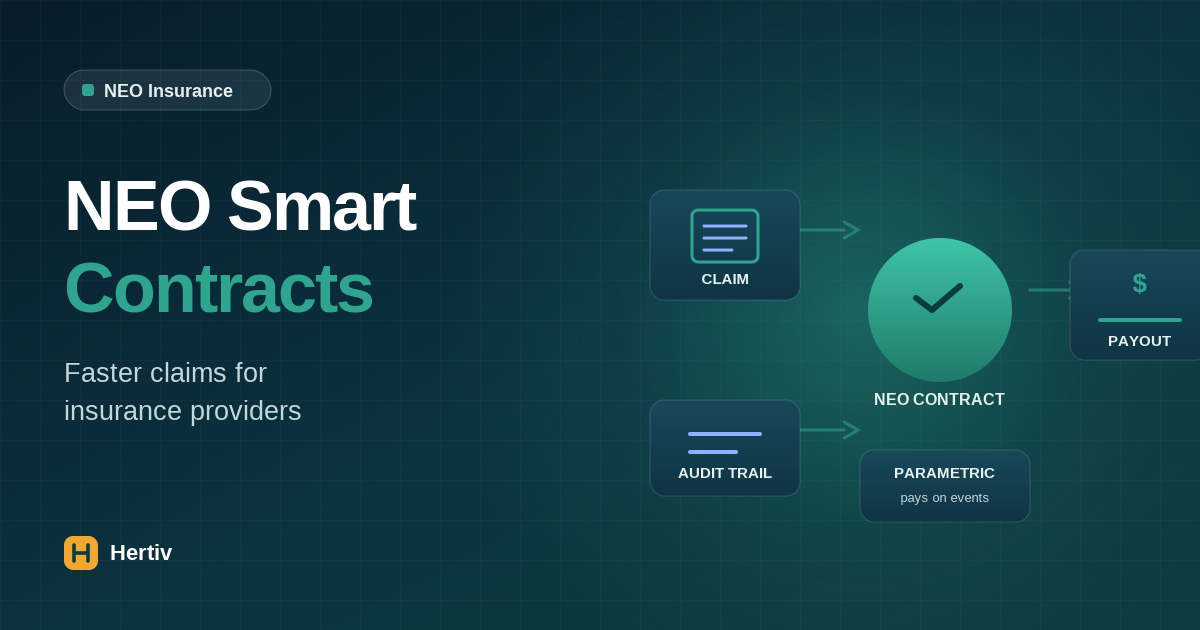
NEO smart contracts can help insurance providers settle claims faster, cut admin work and give every party the same record of what happened. The eight benefits cover faster claims, lower costs, clearer fraud checks, transparent payouts, parametric cover, a full audit trail, fewer disputes and simpler reinsurance.
What are the benefits of NEO smart contracts for insurance?
NEO smart contracts can help insurance providers settle claims faster, cut admin work and give every party the same record of what happened. NEO is a blockchain platform whose smart contracts are written in common languages such as C#, and its built-in tools for identity and data make it a practical fit for insurance work.
The eight benefits below cover the full claim journey, from the moment a policy is sold to the moment a payout is made. Not every benefit matters to every insurer, so read the table first, then go to the benefits that match the problem you are trying to solve.
| Benefit | What it means | Who gains most |
|---|---|---|
| Faster claims | Checks run automatically when a claim is filed | Policyholders and claims teams |
| Lower admin costs | Less manual retyping and chasing | Operations and finance teams |
| Clearer fraud checks | One shared record makes odd claims easier to spot | Fraud and underwriting teams |
| Transparent payouts | Policyholders see why a payout was made | Policyholders and regulators |
| Parametric cover | Payouts trigger on a measured event | Travel and weather cover buyers |
| Full audit trail | Every step is written to the chain | Compliance and audit teams |
| Fewer disputes | Terms are code, not only paper | Claims handlers and customers |
| Simpler reinsurance | Shared data speeds up reporting | Reinsurers and finance teams |
Start from the problem, not the platform. An insurer with slow claims should look at benefits one and five first, while an insurer with audit pressure should start with benefit six. Smart contract development is the service that turns these benefits into working code.
Faster claims decisions and Lower admin costs
1. Faster claims decisions: best for cutting settlement time
A NEO smart contract can check a claim against the policy terms as soon as it is filed, instead of waiting for a handler to pick it up, read the file and look up the cover. If the claim matches the terms and the documents are in order, the contract can approve it and start the payout, which shortens the wait for the policyholder.
Its strength is the removal of the queue. Simple claims that used to wait days for a first look can be checked in minutes, and handlers can spend their time on the complex claims that need judgement. The trade-off is that the contract only handles what its rules cover, so a claim with unusual facts still needs a person.
Pros:
- Simple claims are checked as soon as they arrive
- Handlers focus on complex claims that need judgement
- Policyholders get a faster answer
Cons:
- Only claims that fit the written rules are automated
- Rules must be kept up to date when policies change
- Edge cases still need a human handler
2. Lower admin costs: best for cutting manual work
Insurance admin is full of retyping: a claim is copied from a form into a system, then into another system, then into a report. A smart contract on NEO takes the claim data once and uses it for the checks, the payout and the record, so the same facts are not typed three times by three people.
Its strength is the single source of facts. When the policy, the claim and the payment all read from the same record, there is less to reconcile at month end and fewer errors from copying. The trade-off is the setup cost: the contract, the data feeds and the links to existing systems must be built and tested before the savings appear.
Pros:
- Claim data is entered once and reused
- Fewer copying errors to fix later
- Month-end reconciliation gets simpler
Cons:
- Setup and integration take time and budget
- Old systems may need new links to the chain
- Savings appear only after the build is live
Clearer fraud checks and Transparent payouts
3. Clearer fraud checks: best for spotting odd claims
Fraud is harder when every claim, policy and payout sits in one shared record that cannot be quietly changed. A NEO smart contract can flag a claim that does not fit the pattern, such as a second claim for the same event, or a policy bought just before a loss, and send it to a handler for a closer look.
Its strength is the shared history. Because the record is the same for the insurer, the broker and any other party on the chain, a claim that looks odd in one place is visible in the others too. The trade-off is that the contract flags patterns, it does not prove fraud, so a person must still decide.
Pros:
- One shared record makes odd claims easier to spot
- Duplicate claims for the same event are flagged fast
- Handlers get a clear reason for each flag
Cons:
- Flags are not proof, so a person must still decide
- Rules need tuning to avoid flagging good claims
- Only works for claims on the shared record
4. Transparent payouts: best for trust with policyholders
A policyholder who waits for a payout usually wants to know why it is taking so long and how the amount was worked out. A smart contract can show the steps: the claim was received, the cover was checked, the amount was calculated from the policy terms, and the payment was sent. Each step is visible on the record.
Its strength is that the workings are open. When a policyholder can see the same steps the insurer sees, there is less room for suspicion and fewer calls to ask where the money is. The trade-off is that the terms must be written clearly enough for a non-expert to follow, or the openness does not help.
Pros:
- Policyholders can see each step of the payout
- Fewer calls asking where the money is
- Regulators can check the same record
Cons:
- Terms must be written in plain language too
- Some claim details cannot be shown openly
- Openness does not fix a slow payment process
Parametric cover and Full audit trail
5. Parametric cover: best for payouts on measured events
Parametric cover pays when a measured event happens, such as a flight delay of more than three hours or rainfall above an agreed level, rather than after a loss is assessed. A NEO smart contract can read the event data from a trusted feed, check it against the policy, and pay automatically.
Its strength is speed and certainty. The policyholder knows in advance what event triggers a payout and how much it will be, and the insurer does not need to send an assessor. The trade-off is that the event data must come from a feed everyone trusts, and a wrong feed reading can trigger a wrong payout.
Pros:
- Payouts happen as soon as the event is measured
- No loss assessment needed for simple events
- Terms are clear before the policy starts
Cons:
- Needs a trusted data feed for the event
- Does not fit losses that need judging
- A wrong feed reading can pay the wrong amount
6. Full audit trail: best for compliance and audits
Every action a NEO smart contract takes is written to the blockchain in order, with a time stamp, so an auditor can follow a claim from filing to payout without asking three teams for three different files. The record cannot be edited after the fact, which is what auditors want to see.
Its strength is that the evidence is built in. Instead of preparing for an audit by gathering documents, the insurer can point the auditor at the chain and show the same record the team worked from. The trade-off is that the record must be complete: if part of the work happens off-chain, the trail has a gap.
Pros:
- Every step is recorded in order and cannot be edited
- Auditors can follow a claim without chasing files
- Disputes can be settled from the same record
Cons:
- Off-chain steps leave gaps in the trail
- Records must be readable, not only stored
- Data rules still apply to what is stored
Fewer disputes and Simpler reinsurance and reporting
7. Fewer disputes: best for clearer policy terms
Many insurance disputes come from two sides reading the same policy words differently. A smart contract turns the key terms into code, so the cover, the excess and the payout rule are the same for the insurer and the policyholder, and the contract applies them the same way every time.
Its strength is consistency. The same claim facts give the same result, which removes the argument about how the terms were read. The trade-off is that the code must match the written policy exactly, so the legal and technical teams must work together on the wording, or the code can say something the policy did not intend.
Pros:
- Same facts give the same result every time
- Terms are written as code as well as words
- Disputes can be checked against the contract
Cons:
- Code must match the written policy exactly
- Legal and technical teams must agree the wording
- Fixing a wrong rule needs a new contract version
8. Simpler reinsurance and reporting: best for sharing data with reinsurers
Reinsurance and reporting need the same claim data the insurer already holds, but today it is often copied into reports by hand. A NEO smart contract can share the agreed figures with a reinsurer from the same record, so both sides work from the same numbers and the reporting takes less effort.
Its strength is the shared numbers. When the insurer and the reinsurer read from the same record, there is less to argue about at renewal and less time spent rebuilding reports. The trade-off is access control: the reinsurer should see the figures it needs, not every policyholder detail, so permissions must be set with care.
Pros:
- Reinsurers work from the same figures as the insurer
- Reports are built from the live record, not by hand
- Renewal talks start from agreed numbers
Cons:
- Access must be limited to what each party needs
- Data sharing rules still apply
- Needs agreement on which figures are shared
How to choose a NEO smart contract approach
You choose a NEO smart contract approach by starting with one claim type, proving the benefit, and only then widening the scope. A narrow start keeps the build small and the result easy to measure.
- Pick one claim type. Choose a high-volume, low-complexity claim, such as flight delay or small property damage.
- Write the rules with legal. Turn the policy terms for that claim into written rules, and check the code matches them.
- Choose the data feeds. Decide which trusted feeds supply the event data, and what happens if a feed fails.
- Run a pilot with real claims. Pay a small set of real claims through the contract and compare the time and cost with the old process.
- Plan the audit trail. Agree what is stored on-chain, what stays off-chain, and who can see each part.
NEO's C# contracts suit teams that already work in .NET, since the same engineers can write and review the code. How blockchain is changing insurance companies gives the wider picture of where the technology fits.
What are the common mistakes?
The most common mistakes are automating a claim type that needs judgement, trusting a data feed without a fallback, and writing the contract without the legal team. Each of these turns a working idea into a costly fix.
- Automating the wrong claims. Complex injury or liability claims need a person; automating them creates wrong decisions.
- No fallback for a failed feed. If the event feed stops, the contract should pause, not pay or refuse wrongly.
- Code without legal review. A contract that does not match the written policy creates disputes, not fewer of them.
- Ignoring data rules. Policyholder data on a shared record still needs consent, access limits and a retention plan.
- Skipping the audit. Smart contracts handle money, so they need an independent check before they go live.
NEO smart contracts work best when they handle clear, repeatable claims and leave the judgement calls to people. A smart contract audit is the step that catches the errors a build team can miss.
Key takeaways
- NEO smart contracts check simple claims automatically when they are filed
- Claim data is entered once and reused, which cuts admin work and errors
- Parametric cover pays on a measured event, with no loss assessment
- Every step is recorded on the chain, which makes audits simpler
- Start with one simple claim type and a pilot before widening the scope
Frequently asked questions
What is a NEO smart contract?
A NEO smart contract is code that runs on the NEO blockchain and carries out agreed rules automatically, such as checking a claim and starting a payout. NEO contracts can be written in C# and other common languages, which suits teams that already work in those languages.
Do NEO smart contracts replace claims handlers?
No. They handle simple claims that fit clear rules, and they flag the rest for a person. Complex claims, such as injury or liability, still need a handler's judgement. The contract takes the routine work so handlers can focus on the hard cases.
What is parametric insurance?
Parametric insurance pays when a measured event happens, such as a flight delay over an agreed time or rainfall above an agreed level, rather than after a loss is assessed. A smart contract reads the event data from a trusted feed and pays automatically when the trigger is met.
Are smart contracts safe for insurance money?
They can be, but only with care. The code must match the written policy, the data feeds must be trusted, and the contract should be checked by an independent audit before it goes live. A contract with a bug can pay the wrong amount, so testing matters.
How much does it cost to build a NEO smart contract?
Costs vary with the claim type, the data feeds and the links to existing systems, so check with a development team for a quote. A narrow pilot for one claim type costs far less than a full rebuild, and it shows whether the savings are real.
Does the policyholder need to understand blockchain?
No. The policyholder files a claim and receives a payout in the usual way. The blockchain sits behind the scenes, recording the steps and running the checks. What the policyholder sees is a faster answer and a clearer record of what happened.


