MVP vs EVP: What Each One Means and When It Matters
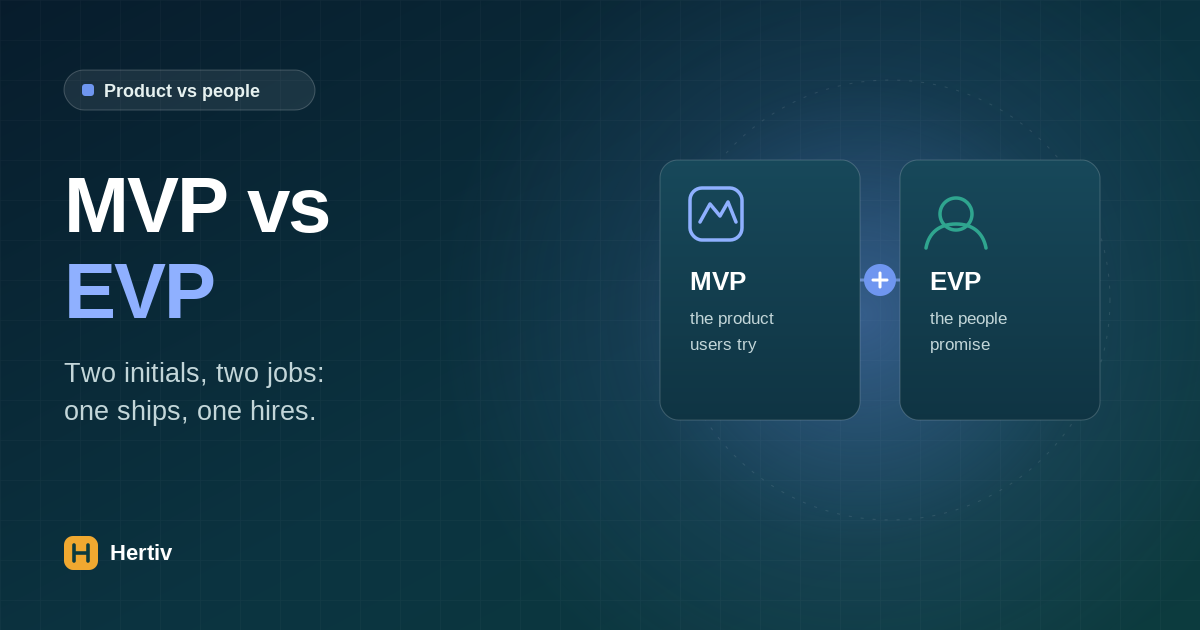
MVP means minimum viable product; EVP means employee value proposition. One tests a product, the other explains why a person would join your company.
On this page
Short answer
An MVP is a minimum viable product, the smallest working version of a product that real users can try, while an EVP is an employee value proposition, the set of reasons a person would choose to work for a company. They share three letters and nothing else: one is about a product and the other is about people, and each needs its own owner and its own measure.
What do MVP and EVP mean?
An MVP is a minimum viable product, the smallest version of a product that real users can try, and an EVP is an employee value proposition, the set of reasons a person would choose to work for a company. They share three letters and nothing else: one is about a product, the other is about people.
The confusion is understandable, because both appear in startup conversations and both are shortened to three letters. But they answer different questions. An MVP answers "is this product worth building?" An EVP answers "is this company worth joining?"
This article explains both, compares them side by side, and shows how to tell which one your company needs to work on. If you only need the product side, what is an MVP covers it in more depth.
What is an MVP?
An MVP is the smallest version of a product that lets real users do the core job and lets you learn whether the product is worth continuing. It is not a rough demo and it is not a full product: it is a working product with one job, built to test an assumption.
A good MVP has a real user, a real task and a way to measure the result. A landing page with a waitlist tests interest; a working checkout tests buying. The version you build depends on what you need to learn, and the cheapest test that answers the question is usually the right one.
The MVP is owned by the product team, and its success is measured in usage: do people sign up, return, and do the core task? If they do not, the team learns and changes the product. MVP development usually runs in about ten weeks for a focused first version.
What is an EVP?
An EVP is an employee value proposition: the full package of reasons a person would choose your company over another one. It covers pay, but also the work itself, the people, the flexibility, the growth and the reputation of the team.
A good EVP is specific and honest. It is not a list of perks; it is the answer to "what is it actually like to work here, and why would a good person stay?" It is written down, it is consistent with how the company behaves, and it shows up in job adverts, interviews and onboarding.
The EVP is owned by leadership and people teams, and its success is measured in hiring and retention: do good candidates apply, do they accept, and do they stay? If they do not, the problem is usually the reality behind the promise, not the wording.
MVP vs EVP: the differences at a glance
The table below puts the two side by side. Read it as a check: if you are talking about users and usage, you mean an MVP; if you are talking about candidates and retention, you mean an EVP.
| Aspect | MVP — minimum viable product | EVP — employee value proposition |
|---|---|---|
| What it is | The smallest working product real users can try | The reasons a person would join and stay |
| Who it is for | Users and customers | Candidates and employees |
| What it proves | Whether the product is worth building | Whether the company is worth joining |
| How you measure it | Signups, usage, retention of users | Applications, offers accepted, staff staying |
| Who owns it | Product and engineering teams | Leadership and people teams |
| When it matters | Before you invest in a full build | Before you hire at scale |
The two can exist in the same company at the same time, and often do. A startup building its first product also needs to hire the people who will build it, so it needs both. The mistake is working on the wrong one for the problem in front of you.
Example: one company, both at once
Example (hypothetical): a 40-person startup is building its first product and hiring 12 people this year. Its MVP is a working tool that 120 trial users can sign up for and use to complete one core task. Its EVP is a written promise about pay, flexibility and the work itself, used in every job advert.
After six months the numbers tell two stories. The MVP has 120 signups, 45 of whom return in the second week, which is 45 out of 120, or 37.5% returning. The hiring has 12 offers made and 9 accepted, which is 9 out of 12, or 75% accepted, and 3 of the 12 new hires leave in the first year, which is 3 out of 12, or 25% leaving.
The product numbers say the MVP is worth continuing. The hiring numbers say the EVP needs work: people accept the offer, then leave. The fix is not a better job advert; it is the reality behind it. The two sets of numbers point at two different problems, and each needs its own owner.
What are the common mistakes?
The most common mistakes are mixing the two up, treating one as a substitute for the other, and writing either one down without testing it against reality.
- Confusing the initials. An MVP is a product and an EVP is a people promise. If your sentence is about hiring, you mean EVP.
- Using an MVP to test hiring. A product prototype tells you nothing about why people join or leave.
- Using an EVP to test a product. A good employer brand will not save a product nobody uses.
- Writing an EVP nobody believes. If the promise does not match the working day, new hires leave and the next hire hears about it.
- Shipping an MVP with no measure. Without usage numbers, an MVP is a demo, not a test. Decide the measure before you build.
How to decide which one needs your attention
Decide by the problem in front of you, not by which acronym is in fashion. Ask what is failing: users or hiring?
- Name the problem in one sentence. If the sentence is about users not using the product, work on the MVP. If it is about candidates not joining or staff leaving, work on the EVP.
- Check the numbers you already have. Usage numbers for the product, hiring and retention numbers for the people side. If you have neither, measure first.
- Pick one owner for each. Product owns the MVP, leadership owns the EVP. One owner for both usually means neither gets done.
- Set a review date. Revisit the MVP after real users try it, and the EVP after the next few hires. A product discovery pass can help when the product problem is unclear.
Most early companies need both, but they rarely need both at the same intensity at the same time. Work on the one whose failure is costing you most right now, and keep the other one honest with a written version and a review date.
Key takeaways
- MVP is a product test; EVP is a people promise. They are not interchangeable.
- An MVP is measured in usage; an EVP is measured in hiring and retention.
- The two often exist in the same company and need different owners.
- A written EVP that does not match reality drives new hires away.
- Decide which needs attention by naming the failing side: users or hiring.
Frequently asked questions
What does MVP stand for?
MVP stands for minimum viable product: the smallest version of a product that real users can try, built to test whether the product is worth continuing. It has one core job, real users and a way to measure the result.
What does EVP stand for?
EVP stands for employee value proposition: the full set of reasons a person would choose to work for a company, including pay, the work itself, flexibility, growth and the team. It is the answer to what it is actually like to work there.
Are MVP and EVP related?
No, beyond sharing three letters. An MVP is about a product and its users; an EVP is about a company and its people. A startup often needs both at the same time, but they answer different questions and are measured differently.
Which should a startup work on first?
Work on the one whose failure is costing you most right now. If users will not try the product, work on the MVP. If good candidates will not join or new hires leave, work on the EVP.
Can a company have both an MVP and an EVP?
Yes, and most growing companies do. The MVP is owned by the product team and the EVP by leadership and people teams. Each needs its own measure and its own review date.
What is the biggest mistake with an EVP?
Writing a promise that does not match the working day. People accept the offer, discover the reality, and leave, and the next candidate hears about it. Fix the reality before you rewrite the wording.


