MVP Use Cases: Where a Minimum Viable Product Actually Pays Off
MVPs fit best where uncertainty is high and the cost of building the wrong thing is large. Here are the use cases that justify one, and the ones that don't.
On this page
Short answer
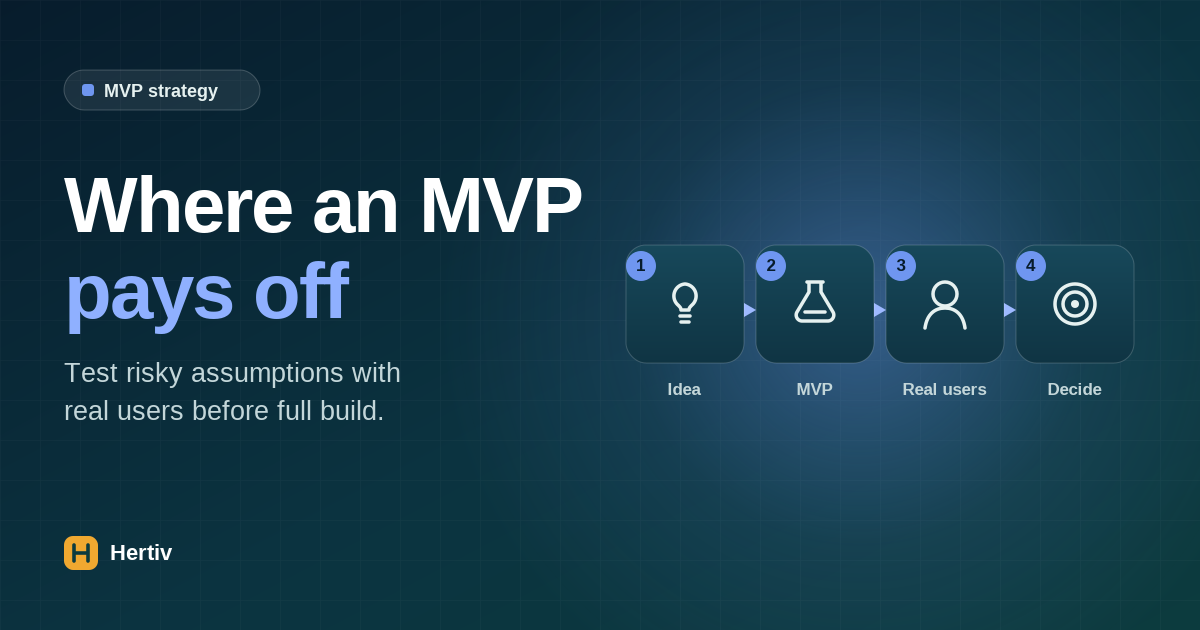
An MVP is worth building when you need to test a risky assumption with real users before committing a full budget. Common use cases are new product validation, internal tool pilots, AI feature proof, and market entry. It is a poor fit when requirements are already known.
What counts as a real MVP use case?
A real MVP use case is one where you cannot answer a decision-critical question without putting working software in front of users. The MVP exists to produce evidence, not to be a small version of the final product.
A useful test: name the decision the MVP will inform. If you cannot finish the sentence "After the MVP we will decide whether to...", the project is a small build, not an MVP. Good MVPs end in a clear go, pivot or stop.
The table below groups the use cases that come up most often for software teams, with a rough sense of what each needs and how much effort it takes relative to the others.
| Use case | What it proves | Typical data or input needed | Effort |
|---|---|---|---|
| New product validation | Whether a real audience wants the core outcome | A handful of target users, a working core flow | Medium |
| Internal tool pilot | Whether a manual process can be replaced | Process owner, sample records, access to systems | Low to medium |
| AI feature proof | Whether a model is accurate and affordable on your data | Representative documents or tickets, evaluation criteria | Medium |
| Market or region entry | Whether a new segment responds to the offer | Localised core flow, a few pilot customers | Medium |
| New channel or integration | Whether an existing product can reach a new platform | API access, one integration path | Low to medium |
| Replacement of a legacy module | Whether a rewrite can match current behaviour | Legacy logs, user interviews, test cases | High |
| Workflow automation | Whether a repetitive task can run unattended | Task samples, exception cases | Medium |
| Pricing or packaging test | Whether a different model converts | Billing flow, a small cohort | Low |
Treat the effort column as relative, not as a budget. For a cost view, see how much an MVP costs.
New product validation: the classic case
New product validation is the use case most people mean by MVP: a narrow product that lets real users complete the core job, so you can see whether they come back.
The MVP should cover the single flow that delivers the value. Everything around it, such as admin panels, reporting, account recovery and edge-case handling, can be manual or missing at first. If onboarding needs a person on a call, that is acceptable for a validation MVP.
What makes this work is a defined audience and a reachable channel. Ten users from a known community tell you more than a thousand anonymous visitors who never return.
Pros - Produces direct evidence about demand before a large build. - Forces the team to agree on what the core value actually is.
Cons - Easy to over-build because stakeholders add "just one more" feature. - Results are hard to read if the audience or channel is undefined.
Example (hypothetical): a team builds a scheduling MVP for one type of clinic. Out of 20 invited clinics, 14 complete setup and 6 use it weekly after a month. That weekly-return figure is the evidence, and it points to a go decision on a fuller build. The numbers are illustrative only.
Internal tools and workflow automation
Internal tools are an underrated MVP use case because the users are close by, the feedback loop is short and success is easy to measure against a manual baseline.
A common pattern is a small application that replaces a spreadsheet plus a few email threads. The MVP covers one team's workflow end to end. You can measure time per task, error rate and adoption within weeks.
Automation pilots, including AI agents that draft replies or pre-fill records, fit here too. Keep a human approval step in the first version so failures stay contained. The goal is to learn where the automation breaks, not to remove people from the process on day one.
Pros - Users are reachable and will give feedback quickly. - A before-and-after comparison is straightforward.
Cons - Internal users often tolerate bad tools, which can hide real problems. - Single-team scope can fail to generalise to other departments.
If the pilot succeeds, the next question is usually how to expand it without a rewrite. That is a scoping problem more than a coding one. Our guide to scoping an MVP you can ship in ten weeks covers the decisions that keep the first version extendable.
AI feature proof: testing models before committing
AI features are a strong MVP use case because three unknowns, accuracy, cost and latency, are only settled by running your own data through a model.
A useful AI MVP is an evaluation harness plus a thin interface. Collect a set of real examples with known good answers, run the candidate approach against them, and measure how often it is right and where it fails. Only then build the user-facing flow around it.
Scope the first version to one task, such as summarising a document type or drafting a reply for a support queue. Multi-step agents are harder to evaluate and belong in a second phase.
Pros - Answers the accuracy and cost questions with your data, not a demo. - Exposes failure modes early, when changing approach is still cheap.
Cons - Poor example sets give misleading results. - Model and vendor choices move quickly, so early numbers can age.
Hertiv builds these proofs as part of agentic AI development and AI product work; the same discipline of a narrow, measurable first version applies.
Market entry, new channels and pricing tests
A smaller, faster MVP often makes sense when the product exists but the market, channel or price is new. You are testing a commercial assumption, not a technical one.
For a new region, the MVP is the core flow with local payment, language and compliance basics covered for a pilot group. For a new channel, such as a marketplace or messaging platform, it is one working integration that reaches real buyers. For pricing, it is a billing path that can present a different model to a limited cohort.
Keep the technical scope minimal and put the effort into reaching the right pilot users. A polished build aimed at the wrong segment produces no useful signal.
Pros - Cheaper than a regional launch and reversible. - Gives the sales team real objections to work with.
Cons - Local regulations can turn a small pilot into a large compliance project. - A pilot cohort that is too friendly tells you little.
When an MVP is the wrong choice
An MVP is the wrong choice when the uncertainty is low or the cost of a partial answer is high. In those cases, a full build or a staged rollout with known requirements is more sensible.
The main cases to avoid:
- Fixed, regulated requirements. If a regulator or a contract defines exactly what the system must do, a reduced version may be unusable or non-compliant.
- A single named enterprise buyer. When one customer defines the requirements, you are delivering a project, not testing a market. Discovery and a scoped delivery plan fit better.
- Data migration with hard cutovers. A partial migration can leave two systems of record, which is worse than either alone.
- Security-critical systems. Authentication, payments and health data need full rigor from the start, not a pilot-grade shortcut.
- Teams that cannot support users. An MVP needs someone to onboard users and read the feedback. Without that, the signal never arrives.
If the honest answer is that requirements are known, say so and plan a normal delivery. An MVP is a learning instrument, and it only works when there is something real to learn.
How to prioritise an MVP use case
Start from the assumption that worries you most, then check whether a small build can test it within a few weeks. If not, reduce the question until it can.
- Write the decision. Name what you will do differently depending on the result. If nothing changes, drop the project.
- Rate the uncertainty and the cost of being wrong. High uncertainty plus high cost of a wrong full build is the strongest MVP signal.
- Check reachability. Confirm you can get real users or real data within the build window. No users, no evidence.
- Cut to one flow. Strip anything that does not contribute to the decision. Manual steps are allowed behind the scenes.
- Set the thresholds in advance. Decide what result means go, pivot or stop before you see the data.
For teams deciding between this and a larger engagement, custom software development describes how a full delivery is scoped once the MVP has answered its question.
Key takeaways
- The strongest MVP use case is a high-uncertainty assumption that can be tested with a narrow slice of the product.
- Internal tools and workflow automation are underrated MVP territory because the user group is small and reachable.
- AI features benefit from an MVP because model quality, cost and latency are unknown until real data runs through them.
- An MVP is the wrong tool when the domain is regulated, requirements are fixed, or the buyer is a single named enterprise customer.
- Scope the MVP around one decision you need to make, not around a feature list.
Frequently asked questions
What is the difference between an MVP and a proof of concept?
A proof of concept checks whether something is technically possible, often for an internal audience. An MVP is a working product used by real users to test demand or behaviour. A proof of concept usually comes first and answers a technical question; an MVP answers a product or market one.
How long should an MVP take to build?
Most useful MVPs for web or AI products are scoped to a few weeks to a couple of months, depending on integrations and compliance. The constraint is how long it takes to reach real users, not the size of the feature list.
Can an MVP be built for an internal team rather than customers?
Yes, and it is often the safest place to start. Internal users are reachable, the manual baseline is measurable, and a small tool can be tested without public launch risk. The same rules apply: one workflow, clear success criteria, and a decision at the end.
Should an AI feature always start as an MVP?
Usually, yes. Model accuracy, cost per request and latency on your own data are unknown until tested, and they can change the product design. A narrow, evaluated build on real examples answers those questions before a larger investment.
What happens after an MVP proves the idea?
The next step is a scoped delivery that hardens the parts the MVP skipped: security, reliability, data model, permissions and support. Keep the same team where possible so the knowledge from the pilot carries into the full build.
How do you measure whether an MVP succeeded?
Define the metric before launch, tied to the decision. Common ones are weekly return rate for product validation, task time reduction for internal tools, and accuracy against a fixed example set for AI features. A clear threshold turns results into a decision.


