Modular vs Monolithic Blockchain: Which Fits Your Enterprise?
A modular blockchain splits execution, settlement and data availability across layers, while a monolith does it all in one place. Compare the two and pick the fit.
On this page
Short answer
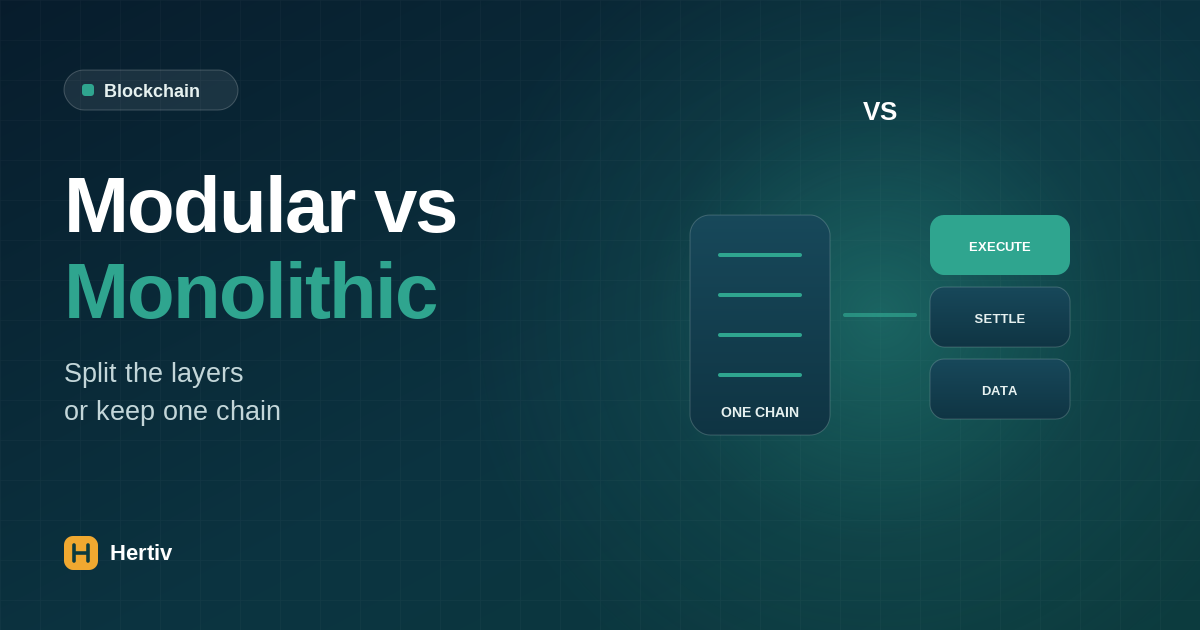
A monolithic blockchain does everything on one layer: execution, settlement, consensus and data availability. A modular blockchain splits those jobs across separate layers, so each can scale on its own. Monoliths are simpler and easier to audit; modular designs scale better and suit platforms with several applications.
What is the difference between modular and monolithic blockchains?
A monolithic blockchain is a chain that does everything itself: execution, settlement, consensus and data availability all run on the same layer. A modular blockchain splits those jobs across separate layers, so each layer can specialise in one task.
The difference is architectural. In a monolith, every node processes every transaction and stores the full state. In a modular design, an execution layer handles transactions, a settlement layer finalises them, and a data availability layer stores the data, with each layer able to scale on its own.
| Aspect | Monolithic | Modular |
|---|---|---|
| Execution | On the main chain | Separate execution layer |
| Data availability | On the main chain | Separate data layer |
| Scaling | Harder, whole chain scales together | Easier, layers scale separately |
| Security | One shared security model | Depends on each layer |
| Complexity | Lower, one system to run | Higher, more moving parts |
| Flexibility | Lower, rules are fixed | Higher, layers can be swapped |
Neither design is better in every case. The right choice depends on what the enterprise is building, how much throughput it needs, and how much complexity its team can operate.
How does a monolithic blockchain work?
A monolithic blockchain works by making every node do the same work: validate transactions, agree on order, execute smart contracts and store the resulting state. Each block is produced, checked and stored by the whole network.
This design is simple to reason about. There is one security model, one set of rules and one place where state lives. Developers deploy a contract and know exactly how it will run, and auditors can check the whole system in one place.
The cost is throughput. Because every node repeats the same work, the chain can only process as much as the slowest node allows. When demand rises, fees rise and confirmation slows, which is why monolithic chains often add scaling layers on top rather than changing the base design.
For an enterprise, a monolith suits a single application with predictable load and strict audit needs. A private or permissioned chain running one business process is a typical fit.
How does a modular blockchain work?
A modular blockchain works by separating the jobs of a chain into layers that pass work between them. An execution layer processes transactions, a settlement layer finalises the result, and a data availability layer makes the transaction data public so anyone can check it.
Each layer can scale on its own. The execution layer can add capacity without changing settlement, and the data layer can grow storage without slowing execution. New execution environments can be added as rollups that settle back to the same base layer.
The trade-off is complexity and trust. The layers must communicate correctly, and security depends on the weakest layer in the stack. A rollup that settles to a strong base layer inherits that security, but only if the bridge and the data layer behave as designed.
For an enterprise, a modular design suits platforms that expect several applications, changing load or multiple execution environments. If you are planning a chain that will host more than one product, enterprise blockchain teams usually start from a modular sketch.
Which architecture fits an enterprise project?
The architecture that fits depends on load, control and team skill. A single application with steady traffic and a small team usually fits a monolith. A platform with several applications and growing traffic usually fits a modular design.
Ask these questions before choosing:
- How many applications will run on the chain? One application favours a monolith; several favour modular.
- How much will load vary? Spiky or growing load favours layers that scale separately.
- Who operates it? A modular stack needs more operational skill across more components.
- What does the audit require? Regulated work may need one clear security model, which a monolith provides.
- How fast must it ship? A monolith is usually faster to build and test for a first version.
Many enterprises start monolithic and move parts of the workload to modular layers later, once they know which parts actually need to scale. That path is cheaper than building a full modular stack before the first user arrives.
Example: a trade finance platform choosing an architecture
Example (hypothetical): a trade finance platform expects 4 banks at launch and 20 banks within two years. Each bank submits about 50 documents a day, and the platform must keep a shared, auditable record of every document.
At launch, the load is 4 banks times 50 documents, which is 200 documents a day. A monolithic chain handles that easily, and one security model makes the audit straightforward. The team ships in four months.
At 20 banks, the load is 20 times 50, which is 1,000 documents a day, and the platform adds a second product for invoice financing. The team moves document execution to a rollup that settles on the original chain, while the base layer keeps the audit record. The monolith becomes the settlement layer, and the new product runs on its own execution layer.
The lesson is to match the architecture to the load you have, and to keep the settlement record in one place as the system grows.
What are the common mistakes?
The most common mistakes are choosing modular for fashion, underestimating operations, and splitting the system before the load justifies it.
- Going modular on day one. A full stack of layers for one application adds cost without benefit.
- Ignoring the data layer. If transaction data is not available, nobody can verify the chain.
- Trusting the bridge blindly. Bridges between layers are a frequent weak point and need their own review.
- Underestimating operations. More layers mean more monitoring, upgrades and incident paths.
- Mixing settlement layers. Settling the same asset on two base layers creates reconciliation problems.
How to plan the move from monolith to modular
Plan the move in stages, keeping the settlement record stable while execution moves to new layers.
- Measure the real load. Record transactions per day and peak rates for a month before deciding.
- Pick one workload to move first. Choose the part with the most variable load, not the most critical one.
- Choose the settlement layer. Decide which chain holds the final record and never changes.
- Add the execution layer. Deploy the rollup or sidechain and test it with real traffic in parallel.
- Prove the data is available. Check that anyone can fetch and verify the transaction data.
- Move traffic gradually. Shift a small share first, watch for failures, then increase the share.
If the move touches a live product, a blockchain consulting review of the layer plan usually catches the weak points before they reach production.
Key takeaways
- A monolith does execution, settlement and data availability on one layer; a modular chain splits them
- Monoliths are simpler to build, run and audit, but throughput is capped by the whole network
- Modular layers scale separately, which suits platforms with several applications or spiky load
- A modular stack is only as secure as its weakest layer, including the bridge and data layer
- Many enterprises start monolithic and move execution to rollups once load justifies it
- Keep the settlement record in one place as the system grows
Frequently asked questions
Is a modular blockchain more secure than a monolithic one?
Not by itself. A monolith has one security model to check, while a modular stack depends on every layer plus the bridge between them. A rollup that settles to a strong base layer inherits that security, but only if the data layer and the bridge behave as designed.
Which is cheaper to run?
A monolith is usually cheaper to build and operate at first, because there is one system to run. A modular stack costs more in operations and monitoring, but it can be cheaper at high load, since only the busy layer needs to scale.
Can a monolithic chain scale at all?
Yes, within limits. Teams raise throughput with faster hardware, better clients and scaling layers on top. The ceiling comes from every node repeating the same work, which is why high-traffic platforms usually add rollups rather than changing the base chain.
What is a rollup in a modular blockchain?
A rollup is an execution layer that processes transactions off the base chain and posts a summary back to it. The base chain settles the result and stores the data, so the rollup gains the base layer security while handling more transactions.
Do enterprises need a modular blockchain?
Only if they expect several applications, changing load or multiple execution environments on one platform. A single application with steady traffic is usually simpler and cheaper on a monolithic or permissioned chain.
How do I choose between the two?
Count the applications, measure the load and check the team's operating skill. One application and a small team point to a monolith; several applications and growing load point to modular. Start monolithic and move in stages if you are unsure.


