Modernizing Legacy Systems in Dubai: A Practical Guide
Modernizing a legacy system in Dubai means updating old software without stopping the business, while meeting UAE data rules. Start with one system, prove the value.
On this page
Short answer
A legacy system in Dubai is older software that still runs the business but is hard to change, expensive to maintain and risky to keep. Modernizing it means updating the system in stages, without stopping daily work, while meeting UAE data rules and the expectations of customers who want fast digital service.
What does modernizing a legacy system mean in Dubai?
Modernizing a legacy system means changing how old software is built and run so the business can keep using it safely. The system might be a core banking platform, a property management tool or an internal system that has grown over twenty years. It works, but every change takes weeks and only a few people understand the code.
In Dubai, the pressure to modernize comes from two sides. Customers expect the same fast digital service they get from new apps, and regulators expect data to be handled under UAE rules. A system that cannot offer either becomes a cost and a risk at the same time.
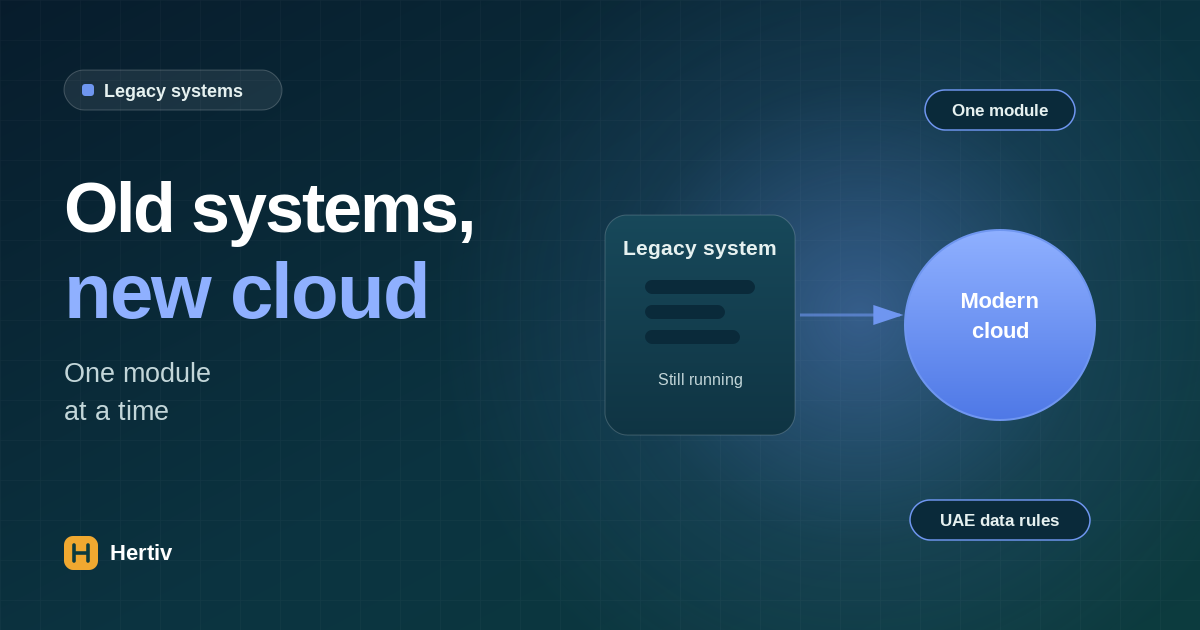
Modernization is not the same as replacement. Replacing a core system in one go is risky and expensive. Most Dubai teams modernize in stages: move one part to the cloud, replace one module, or wrap the old system in a modern interface while the core keeps running.
Why Dubai teams modernize now
The first driver is cost. Old systems run on hardware and licences that get more expensive every year, and the specialists who can maintain them are harder to find. Each year the system stays unchanged, the cost of the next change goes up.
The second driver is regulation. UAE data rules require personal data to be handled carefully, and some data must stay inside the country. An old system that stores data in an unknown location or without clear access controls is a compliance problem waiting to happen.
The third driver is the customer. Government services in Dubai are largely digital, and customers compare every business against that standard. A system that cannot support an app, an online payment or a same-day response loses business to one that can. The table below shows the main drivers and what they cost if ignored.
| Driver | What it means | Cost of waiting |
|---|---|---|
| Rising maintenance | Old hardware and licences cost more each year | Budget eaten by upkeep |
| UAE data rules | Personal data needs clear handling and location | Compliance risk |
| Customer expectations | Fast digital service is the norm | Lost customers |
| Security | Old systems miss patches and monitoring | Breach risk |
| Staffing | Few specialists know the old stack | Key-person risk |
| New products | Old systems block new features | Slow launches |
The main paths: rehost, replatform or rebuild
Rehosting means moving the system to the cloud without changing the code. It is the fastest path and it cuts hardware costs, but the system keeps its old limits. Choose it when the system works well and the main problem is the infrastructure around it.
Replatforming means moving the system and changing parts of it, such as the database or the way it connects to other systems. It takes longer than rehosting but removes some of the old limits. Choose it when the system is sound but one or two parts hold it back.
Rebuilding means writing a new system, usually one module at a time, while the old one keeps running. It is the slowest and most expensive path, but it is the right choice when the old system cannot meet current needs at all. Most teams rebuild the customer-facing parts first and leave the back-office core until later. Read how to modernize legacy software in general before choosing a path.
Data rules and compliance in the UAE
UAE data protection law sets rules for how personal data is collected, stored and shared. Before modernizing, map where personal data lives in the old system, who can access it and where it is stored. Data that must stay in the country should not move to a cloud region outside the UAE.
Some sectors have extra rules. Financial services, healthcare and government work each add their own requirements for data handling and audit trails. Check the rules for your sector before choosing a cloud provider or a data location.
Compliance is easier to build in during modernization than to add later. When you move a module to the cloud, set the access controls, logging and encryption at the same time. A module that launches without them will need rework, and rework after launch is always more expensive.
A 5-step plan that keeps the business running
The plan below keeps the old system running while the new parts are built. Each step produces something the business can use, so the project earns its keep as it goes.
- Map the system: list every module, every data store and every integration.
- Pick the first module: choose the part that causes the most pain or blocks the most revenue.
- Build the new module alongside the old one, with the same data flowing to both.
- Switch traffic gradually, starting with a small group of users, and watch for errors.
- Retire the old module only after the new one has run well for several weeks.
Budget for the overlap. Running two systems at once costs more than running one, and the overlap is where most projects run out of money. Plan for at least a few months of parallel running for each module.
Example (hypothetical): a Dubai retailer modernizes its stock system
A Dubai retailer runs a stock system built fifteen years ago. It tracks 8,000 products across 6 stores, but it cannot show live stock on the website, so online orders often fail when the item is not actually in the store.
The team picks the stock module first. They build a new stock service in the cloud and run it alongside the old system for 8 weeks. During that time, 4 of the 6 stores switch to the new service, while 2 stay on the old one as a safety net. Online order failures fall from 24 a week to 5 a week.
The numbers add up. The new service costs about $1,200 a month to run, while the old hardware and licence for the stock module cost about $2,000 a month. The team saves about $800 a month and, more importantly, the website can now show live stock. The remaining modules follow the same pattern over the next year.
Common mistakes in Dubai modernization projects
The most common mistake is trying to replace everything at once. A big-bang replacement stops the business if it fails, and it usually fails because nobody fully understands the old system. Modernize one module at a time and keep the old system running until the new one proves itself.
Another mistake is moving data to the cloud without checking where it lands. A cloud region outside the UAE can break data rules and force an expensive move later. Choose the region first, then build.
Finally, do not underestimate the people side. The staff who know the old system are the ones who can explain what it really does, including the undocumented rules that keep the business running. Involve them early, or the new system will miss behaviours that the business depends on.
Key takeaways
- Modernize in stages, not in one big replacement.
- Pick the module that causes the most pain first.
- Check UAE data rules before choosing a cloud region.
- Run old and new systems in parallel until the new one proves itself.
- Involve the staff who know the old system from day one.
Frequently asked questions
How much does it cost to modernize a legacy system in Dubai?
Costs vary widely by system size, so get a quote based on your modules and data. The main costs are the new build, the overlap period when both systems run, and the data migration. Budget for several months of parallel running for each module.
How long does modernization take?
A single module usually takes a few months from mapping to switchover. A full core system can take a year or more when done module by module. The staged approach takes longer in total but keeps the business running throughout.
Should we rehost, replatform or rebuild?
Rehost when the system works and only the infrastructure is the problem. Replatform when one or two parts hold it back. Rebuild when the system cannot meet current needs at all. Most teams rebuild customer-facing parts first.
Does UAE law require data to stay in the country?
UAE data protection law sets rules for personal data handling, and some data must stay inside the country. Map where your data lives before choosing a cloud region, and check the extra rules for your sector, such as finance or healthcare.
What is the biggest risk in a modernization project?
The biggest risk is replacing a system nobody fully understands. Undocumented rules in the old system can break the business if the new system misses them. Involve the staff who know the old system and run both systems in parallel.
Can we modernize without stopping the business?
Yes, if you modernize module by module and switch traffic gradually. Start with a small group of users, watch for errors and retire the old module only after the new one has run well for several weeks.


