How to Modernize Legacy Software Without a Full Rewrite
Legacy modernization means safely moving an old system to a maintainable, secure architecture in small steps, not rewriting everything at once. Here is a practical, low-risk approach.
On this page
Short answer
Modernize legacy software by first mapping the system and its business rules, then extracting high-value pieces behind APIs, wrapping or replacing them incrementally, and keeping the old system running until each new piece is proven in production.
What does legacy software modernization actually mean?
Legacy software modernization is the process of moving an existing system to a maintainable, secure and supportable architecture while preserving the business behaviour it already delivers. It is not the same as a rewrite: modernization keeps value in place and changes the system in controlled steps.
Legacy systems are usually defined by risk, not age. Common signals include:
- No safe way to change it. Small fixes require long regression cycles or manual testing.
- Knowledge concentration. One or two people understand core modules, and nobody else can safely modify them.
- Unsupported dependencies. Frameworks, databases or operating systems no longer receive security patches.
- Integration friction. Every new product feature needs custom point-to-point integration work.
- Rising run cost. Infrastructure and licensing grow because the system cannot be scaled down or consolidated.
Modernization can take several shapes: rehosting to newer infrastructure, replatforming onto managed services, refactoring internals, replacing modules with bought or built services, or retiring parts entirely. The right mix depends on which components carry business value and which carry risk. A CTO's first job is to separate those two questions before committing to a technical direction.
Why is a full rewrite usually the wrong first move?
A full rewrite is usually the wrong first move because it discards working business rules that are undocumented, takes longer than planned, and leaves you maintaining two systems at once. Most legacy behaviour lives in edge cases that only exist in the running code.
The failure pattern is well known: a team starts a clean replacement, discovers the old system handles years of exceptions nobody wrote down, and the project expands while the old system keeps changing. You end up with double maintenance and a delayed cutover.
Rewrites are justified in narrow cases:
- The old system is small and well understood.
- The underlying platform is being withdrawn and cannot be kept running.
- The business model itself is changing, so old rules no longer apply.
Otherwise, incremental modernization gives you value earlier and caps the risk per step. Each slice can be tested against live behaviour, and you can pause or redirect without losing everything. For most mid-market and enterprise teams, the goal is a sequence of small, reversible moves rather than one large irreversible one. That is also easier to fund in stages.
How do you start: assessment and inventory
Start by building an inventory of every component, its owner, its dependencies and the business processes it supports. You cannot sequence modernization work without knowing what talks to what and which parts matter most.
Practical steps:
- List all systems and interfaces. Include databases, scheduled jobs, batch files, integration endpoints and third-party services.
- Map data flows. Record where master data lives and which systems copy it. Duplicated data is a common source of migration surprises.
- Interview the people who run it. Operators and support staff know failure modes that architects do not.
- Score each component on business criticality, change frequency, security exposure and maintenance cost.
- Record the business rules you can find, and flag modules where rules are unclear.
If your team lacks the capacity to run this alongside delivery, a small embedded group can help. See software staff augmentation for how teams add focused capacity without a long hiring cycle.
What is the strangler pattern and why use it?
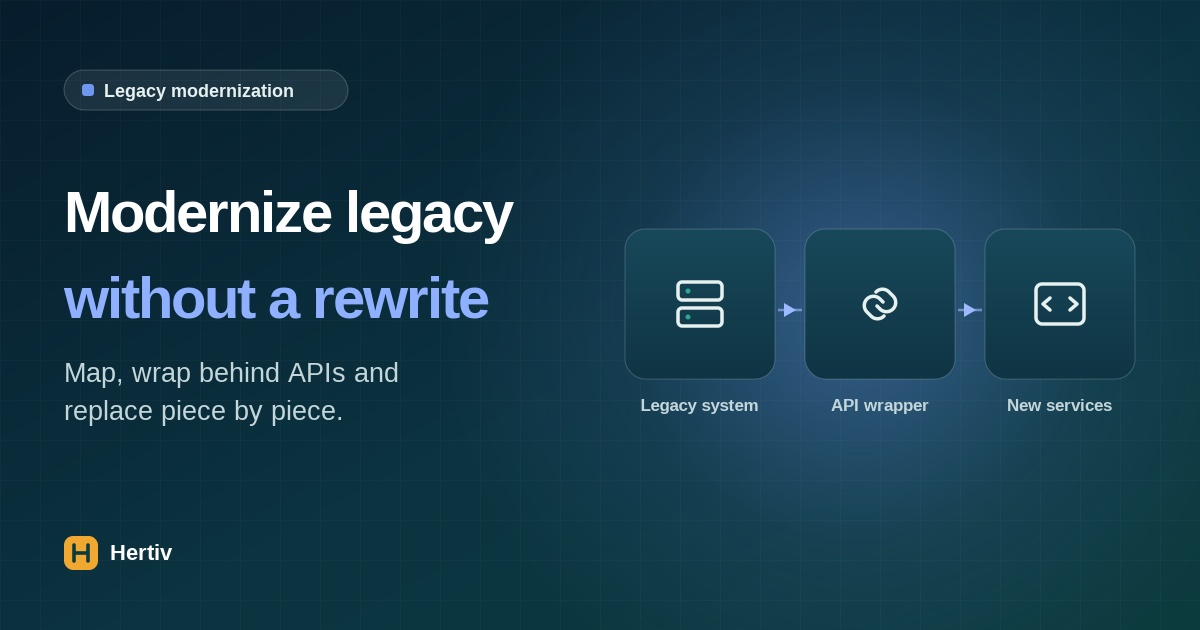
The strangler pattern means placing a routing layer in front of the legacy system and moving one capability at a time to a new implementation, so old and new run side by side until the old path is no longer needed. It is the most common low-risk approach to legacy modernization.
The mechanics are straightforward:
- Introduce a facade, API gateway or proxy that all callers use.
- Route most traffic to the legacy system initially.
- Build the new service for one bounded capability.
- Shift traffic gradually, often by percentage or by customer segment.
- Keep a fallback to the legacy path until you have confidence.
- Retire the old code path once it carries no traffic.
This approach works because it turns a large migration into a series of small ones, each with a rollback option. It also forces you to define clear interfaces, which makes the new services easier to test and reuse.
The main costs are the routing layer itself and the temporary duplication of logic. Keep the transitional period short for each slice, and track which slices are still in flight. Without that discipline, the hybrid state becomes permanent. Our software engineering services team often starts exactly here: a facade, one slice, and a measured cutover.
Which modernization approach fits your system?
The right approach depends on what is expensive to keep and what is valuable to change. Use a simple comparison to choose per component rather than picking one strategy for the whole estate.
| Approach | What it does | Best when | Typical effort |
|---|---|---|---|
| Rehost | Move to newer infrastructure with minimal code change | Platform is unsupported but logic is stable | Low |
| Replatform | Adopt managed databases, queues or runtimes | Ops burden is the main pain | Medium |
| Refactor | Restructure internals behind stable interfaces | Code is sound but hard to change | Medium to high |
| Strangler extraction | Replace capabilities one slice at a time | System is critical and cannot pause | Medium, spread over time |
| Replace with package | Buy a product for a commodity function | Function is non-differentiating | Medium |
| Retire | Remove unused modules and data | Usage is low or zero | Low |
Two workstreams sit underneath all of these: data migration and security review. Both are frequently underestimated. Data migration needs reconciliation checks and a rollback plan, and security review needs to cover the transitional architecture as well as the target state.
If the old system handles regulated or customer data, involve specialists early rather than after the new service is live. Our cybersecurity services cover that review step.
Example (hypothetical): a team splits a legacy billing system into five slices. Four move cleanly within two quarters; the fifth depends on a third-party feed that cannot be changed, so it stays on the old path and is documented as a known exception. The arithmetic is simple: five slices, four modernized, one retained with a clear owner and a review date.
How do you keep behaviour stable during the transition?
Keep behaviour stable by writing tests around the current system before changing it, running old and new paths in parallel, and comparing outputs until they match. This is where many modernization efforts quietly fail.
Key practices:
- Characterization tests. Capture the existing behaviour, including odd edge cases, as automated tests. They describe what the system does, not what it should do.
- Shadow traffic. Send real requests to the new service without affecting users, and compare results with the legacy output.
- Feature flags. Control which path serves live traffic, by cohort or percentage.
- Data reconciliation. After each migration step, check record counts and key totals between old and new stores.
- Clear rollback. Every slice needs a tested way to return to the old path.
Parallel running costs more during the transition, but it is far cheaper than a production incident on a core system. Plan for it in the timeline rather than treating it as optional.
How do you prioritise and sequence the work?
Prioritise by risk reduction and business value, and sequence so that each step makes the next one easier. The first slice should be small, visible and low-risk, not the hardest module in the system.
A workable sequence:
- Fix what blocks you. Address unsupported dependencies and security exposure first; these carry the highest downside.
- Pick the easiest meaningful slice. Prove the pattern, tooling and release process on something small.
- Move shared foundations. Identity, logging, configuration and deployment pipelines pay back across every later slice.
- Tackle high-value capabilities. Route the modules that slow down product delivery or cost the most to run.
- Leave stable, low-change components for last. Some may be cheaper to wrap than to rewrite.
Track outcomes rather than activity: deployment frequency, time to restore service, change failure rate, and the cost of running the system. These make progress visible to the board and help justify the next phase. Also record decisions and known exceptions, so that new engineers can follow the reasoning later.
If you need help structuring the plan around data and analytics dependencies, our data engineering services cover migration and pipeline work.
Common mistakes in legacy modernization
Most modernization setbacks come from organisational and sequencing errors rather than technical ones. Avoiding the following patterns improves your odds considerably.
- Starting with a rewrite by default. It removes your safety net before you have proven the new stack.
- Skipping the inventory. Teams discover critical dependencies mid-migration and lose weeks.
- Treating data migration as a detail. Data shape, quality and ownership deserve their own plan.
- No parallel running. Cutting over without comparison testing invites silent behaviour changes.
- Freezing the legacy system. If it cannot change at all during the transition, the business stalls; prefer small, controlled changes.
- Modernizing everything at once. A large in-flight programme is hard to steer and hard to fund.
- Ignoring the people who run the system. Operational knowledge is often the best documentation you have.
- No retirement step. Old paths linger for years, adding cost and confusion.
Key takeaways
- Start with a system inventory and dependency map before touching code.
- Prefer incremental extraction over a big-bang rewrite, which carries high failure risk.
- Use the strangler pattern: route traffic piece by piece to new services.
- Write characterization tests around existing behaviour before refactoring.
- Measure business outcomes (downtime, cycle time, change cost), not just code metrics.
- Budget for data migration and security review as first-class workstreams.
Frequently asked questions
How long does legacy software modernization take?
It depends on system size, dependency count and how much can run in parallel. A focused module extraction can take weeks, while modernizing a core platform typically spans several quarters. Sequencing in small slices lets you deliver value early instead of waiting for a single large cutover.
Should we rewrite or refactor our legacy system?
Refactor or extract by default; rewrite only when the platform is being withdrawn, the system is small and well understood, or the business rules themselves are changing. Rewrites discard undocumented behaviour and often take longer than planned, leaving two systems to maintain at once.
How do we handle data migration safely?
Plan it as a separate workstream with reconciliation checks between old and new stores, a tested rollback path, and a defined owner for data quality. Migrate in stages and compare key totals after each step. Treat migration as part of the slice design, not an afterthought once code is ready.
What is the strangler pattern in simple terms?
It places a routing layer in front of the legacy system and moves one capability at a time to a new service. Old and new run side by side until traffic no longer reaches the old path. Each slice can be tested and rolled back independently, which keeps risk low.
How do we keep the legacy system running during the transition?
Keep it live and maintained, but limit changes to small controlled updates. Use a facade to route traffic, run shadow comparisons, and keep rollback options for every slice. Freezing the system entirely usually stalls the business and creates pressure for a risky big-bang cutover.
What metrics show modernization is working?
Look at deployment frequency, lead time for changes, time to restore service and change failure rate, plus the running cost of the system. These reflect whether the system is becoming easier and safer to change, which is the real goal of modernization.


