How Scarcity Shapes Bitcoin's Value Model
Bitcoin's fixed supply makes scarcity models tempting: the stock-to-flow ratio rises as issuance falls. How it works, what halvings change, and what it leaves out.
On this page
Short answer
Scarcity models value bitcoin by its stock-to-flow ratio: the existing supply divided by new coins created each year. As halvings cut new issuance, the ratio rises, which the model reads as rising value. But the ratio measures supply only, so it says nothing about demand, regulation or competition, which also move price.
What does scarcity mean for bitcoin's value?
Scarcity in bitcoin means the supply is fixed by the protocol: no more than 21 million bitcoin will ever exist, and new coins enter circulation at a set, slowing rate. Scarcity models try to connect that fixed supply to value, on the idea that a harder-to-produce asset is worth more when demand stays the same.
That idea is simple, but the models built on it are not. They differ in what they measure, what they assume about demand, and how much they claim to predict. Understanding the model means understanding its limits as well as its logic.
The core measure is the stock-to-flow ratio: the existing supply (stock) divided by the new supply created each year (flow). A high ratio means the existing supply dwarfs new production, so new supply barely changes the total. Gold has a high ratio for the same reason; bitcoin's ratio rises over time because new issuance falls.
How does the stock-to-flow model work?
The stock-to-flow model works by comparing an asset's existing supply with its annual production, and then relating that ratio to the asset's value. The claim is that assets with a higher stock-to-flow ratio tend to be valued more highly, because their supply is harder to increase.
The model is usually drawn as a line on a chart: as the ratio rises, the modelled value rises with it. The appeal is that the ratio is known in advance for bitcoin, since the issuance schedule is written into the protocol and does not depend on any company's decisions.
But the ratio is only half of a market. A stock-to-flow model says nothing about demand on its own; it assumes demand is there. That is why the model can look convincing over a long period and still say little about what happens next month.
For the market side of the picture, crypto exchange development covers how trading venues bring buyers and sellers together, which is where demand actually shows up.
What do halvings change in the model?
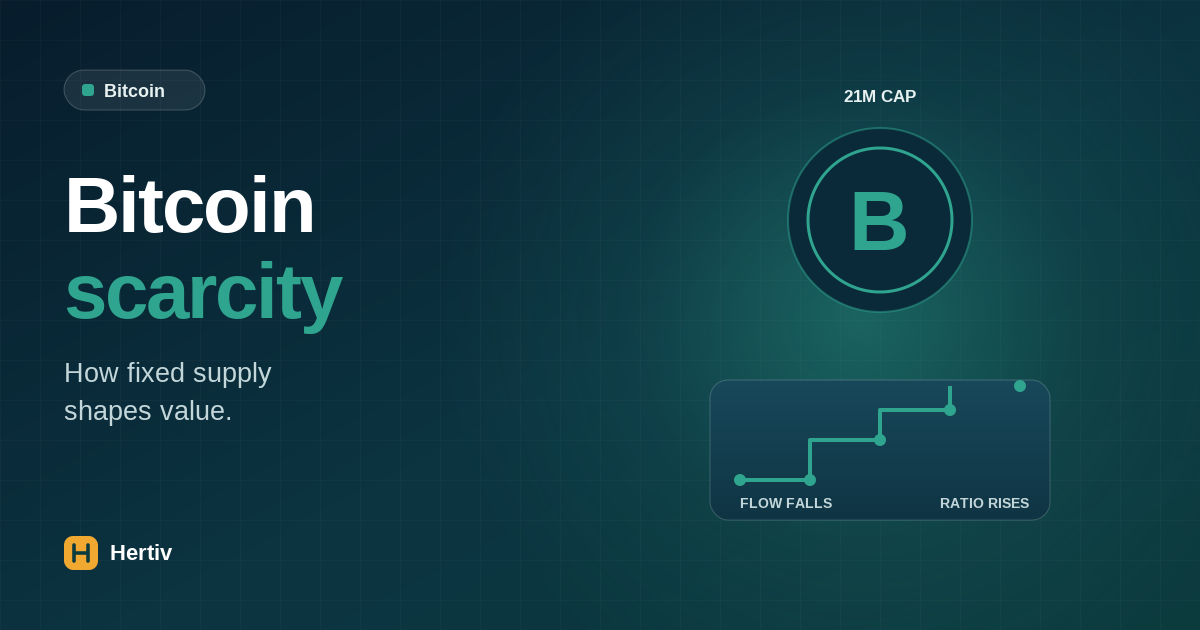
Halvings cut the rate at which new bitcoin is created roughly in half, about every four years. Each halving reduces the flow, so the stock-to-flow ratio jumps, and the model reads that jump as a rise in modelled value.
The effect is mechanical: if the existing supply is the same and the annual new supply halves, the ratio doubles. That is why halvings are treated as the model's main events, and why the model's chart is drawn in steps that follow the halving schedule.
What the model does not capture is how the market reacts to an event everyone knows is coming. A halving is public years in advance, so traders, miners and holders can position for it long before it happens. The model treats the halving as a fresh shock; the market often treats it as old news.
Miners also matter here. When issuance falls, miners earn fewer new coins, which changes the economics of mining and can affect how much bitcoin miners sell. That selling behaviour is a real market force that the ratio alone does not describe.
What does the model leave out?
The model leaves out demand, regulation, competition and macro conditions, which are the forces that move prices most of the time. A model of supply alone cannot explain why the same ratio produces different prices in different years.
- Demand. Demand comes from investors, users, funds and companies, and it rises and falls with sentiment, interest rates and alternatives. Supply models assume it away.
- Regulation. Rules about exchanges, custody and funds change who can buy and how easily, which moves demand without touching supply.
- Competition. Other crypto assets and new financial products compete for the same money, so bitcoin's value depends on its position relative to them.
- Past fit. A model that fits past prices well does not necessarily predict future ones, because the conditions that produced the fit keep changing.
The honest use of a scarcity model is as one input among several, not as a forecast. It answers the question "how scarce is this asset getting?" and leaves the question "how much will people pay for it?" to other evidence.
Example (hypothetical): a coin with a rising stock-to-flow ratio
Example (hypothetical): imagine a coin called Coin X with 1,000,000 coins in existence and 50,000 new coins created each year. Its stock-to-flow ratio is 1,000,000 divided by 50,000, which is 20. That means it would take 20 years of current production to match the existing supply.
Now suppose Coin X halves its issuance, so only 25,000 new coins are created each year. The ratio becomes 1,000,000 divided by 25,000, which is 40. The stock is unchanged, the flow has halved, and the ratio has doubled.
| Scenario | Stock | Annual flow | Stock-to-flow ratio |
|---|---|---|---|
| Before the halving | 1,000,000 coins | 50,000 coins | 20 |
| After the halving | 1,000,000 coins | 25,000 coins | 40 |
A stock-to-flow model would read that doubling as a rise in modelled value. But nothing in the arithmetic says what the price will be, because the price depends on how many people want to hold Coin X at the new ratio. If demand falls at the same time, the price can fall while the ratio rises.
That is the key lesson of the example: the ratio measures scarcity, not demand, and value needs both. The arithmetic is exact; the conclusion about price is not.
How do you use scarcity models without overtrusting them?
You use scarcity models as a way to think about supply, and you check them against demand evidence before acting on them. The model tells you how the supply side is changing; exchange volumes, fund flows and adoption data tell you about the demand side.
- Read the ratio, not just the price line. Know what the model actually measures.
- Check demand separately: who is buying, through which channels, and why.
- Look at the model's past errors, not just its past fits. A model that missed badly in some years deserves less trust.
- Consider what would break the model: a demand shock, a regulatory change, or a competing asset.
- Use ranges and scenarios instead of a single price number.
Scarcity is a real feature of bitcoin's design, and it is worth understanding. It is also only one feature. A valuation that rests on supply alone is a partial valuation, and partial valuations are the ones that surprise people.
For context on how bitcoin is held and traded, spot bitcoin ETFs explain one of the main demand channels.
Blockchain consulting covers how teams evaluate crypto assets more broadly.
What are the common mistakes?
The most common mistakes with scarcity models are treating a supply ratio as a price forecast, and ignoring everything the model leaves out.
- Reading the model as a price prediction. A rising ratio is not a promise of a rising price; demand has to show up too.
- Trusting past fit. A model that tracked past prices can still fail, because market conditions change.
- Ignoring demand. Supply is half the market. Any valuation that ignores demand is incomplete.
- Treating halvings as surprises. Halvings are public years in advance, so the market can price them in early.
- Comparing ratios across different assets. Two assets with the same ratio can have very different demand, so the ratio alone does not rank them.
Key takeaways
- Scarcity in bitcoin is fixed by the protocol: a 21 million cap and slowing issuance
- The stock-to-flow ratio compares existing supply with annual new supply
- Halvings double the ratio by halving new issuance, but the market knows they are coming
- The model ignores demand, regulation and competition, which also move price
- Use scarcity models to judge scarcity, not as a price forecast
Frequently asked questions
What is the stock-to-flow model for bitcoin?
The stock-to-flow model relates bitcoin's value to its scarcity, measured as the existing supply divided by the new supply created each year. A higher ratio means new production is small compared with what already exists. The model claims higher ratios go with higher values, but it measures supply only.
Does bitcoin really have a fixed supply?
Yes, by design. The protocol caps total supply at 21 million bitcoin, and new coins enter circulation at a set rate that falls over time through halvings. No central party can change the cap or the schedule without agreement across the network.
What is a bitcoin halving?
A halving is a scheduled event, roughly every four years, that cuts the rate of new bitcoin creation in half. It reduces the flow in the stock-to-flow ratio, so the ratio jumps. Halvings are public years in advance, so markets can position for them early.
Why do scarcity models sometimes fail?
They fail because they model supply only, while price also depends on demand, regulation, competition and macro conditions. A rising stock-to-flow ratio does not guarantee a rising price if demand falls at the same time.
Is stock-to-flow the best way to value bitcoin?
No single model values bitcoin well on its own. Stock-to-flow is useful for understanding how scarce the asset is getting, but a fuller view needs demand evidence, such as trading volumes, fund flows and adoption, alongside the supply picture.
Can scarcity models predict bitcoin's price?
No. They describe a relationship between scarcity and past prices, not a forecast. Use them to frame scenarios and ranges, and check them against demand data, rather than treating a modelled number as a price target.


