What Is the Mobile App Discovery Phase?
The discovery phase is the research and planning work done before a mobile app is designed or built. It answers what to build, who it is for and what it should cost.
On this page
Short answer
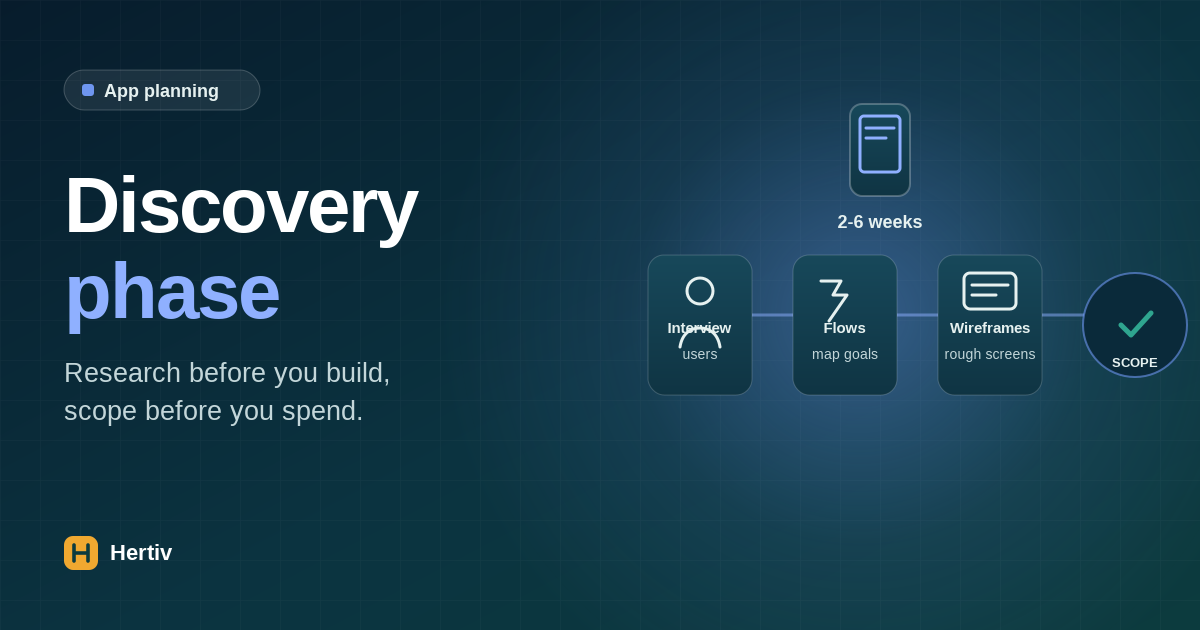
The mobile app discovery phase is the research and planning stage before design and development begins. The team interviews users, studies competitors, maps the core features and tests the riskiest assumptions, then produces a scope, wireframes and a cost estimate. Discovery usually takes two to six weeks and ends with a clear decision: build the app, change the scope, or stop.
What is the mobile app discovery phase?
The mobile app discovery phase is the research and planning work done before an app is designed or built. It answers three questions: who the app is for, what problem it solves, and what the first version should include. The phase ends with a scope, wireframes and a cost estimate that a team can commit to.
Discovery is not design and it is not development. No screens are finished and no code is written. The work is interviews, competitor checks, user flows and rough sketches, all aimed at removing the biggest unknowns before the expensive work starts.
A good discovery phase also produces a decision. The team may find the idea is weaker than assumed, the scope is too large for the budget, or a simpler product would serve users better. Finding that out in discovery costs a fraction of finding it out after months of building.
What happens during app discovery?
Discovery follows a simple pattern: learn about users, check what already exists, define the core features, and test the riskiest assumptions. Each activity answers a different question, and each one produces an output the team can use in the next step.
| Activity | What it answers | Output |
|---|---|---|
| User interviews | Who uses the app, and why | User needs and quotes |
| Competitor review | What already exists | Feature and gap list |
| User flows | How a user reaches a goal | Step-by-step flows |
| Wireframes | What each screen shows | Rough screen sketches |
| Technical check | What is hard to build | Risk and effort notes |
| Scope and estimate | What it costs to build | Feature list and budget |
The order matters. Interviews come first, because everything else depends on understanding the user. Wireframes come late, because drawing screens before knowing the problem wastes the team's time on details that may not survive the next interview.
What does discovery produce?
Discovery produces a small set of documents that the design and development teams can work from. The most useful are a user flow map, wireframes for the core screens, a prioritised feature list, a technical risk note and a cost estimate with the assumptions written down.
The feature list is the most important output. It separates what the first version must do from what can wait, and it gives each feature a reason: a user need, a business goal or a technical requirement. A feature with no reason attached is a candidate for the later list.
Wireframes from discovery are rough on purpose. They show layout, content and navigation, not colours or final design. Their job is to let the team and the client agree on what each screen does before a designer spends days polishing it.
The cost estimate that comes out of discovery is far more reliable than one made before it. It is based on real screens, real flows and a real feature list, so the team can say what is included and what would change the price. If you want the scope to hold, what an MVP is explains how to cut a first version down to the features that prove the idea.
How long does app discovery take?
Discovery for a typical mobile app takes two to six weeks. A simple app with one user type and a clear problem can be done in two weeks. A larger app with several user types, payments, or integrations with other systems usually needs four to six weeks.
The length depends on how many people need to be interviewed, how much is already known about the users, and how many decisions need a stakeholder to sign off. Teams that can book interviews quickly and make decisions in the same week move fastest.
A discovery phase that runs past six weeks without a scope is usually a sign of trouble: either the problem is still unclear, or nobody is willing to decide what the first version includes. In that case the team should stop gathering research and hold a scoping workshop to force the decisions.
Discovery is a small share of the total project. For most apps it takes between 5 and 10 percent of the total budget, and it saves far more than it costs by cutting features that users do not need and catching technical risks early.
How do you run a mobile app discovery phase?
You run discovery by working through the activities in order, with a clear owner and a deadline for each one. The plan below works for most first-version apps.
- Interview 8 to 12 users. Talk to real users, not colleagues. Ask about their current workaround, what frustrates them and what a good result looks like.
- Review 5 to 8 competitors. List their features, their pricing and their weak points, and note the gaps your app could fill.
- Map the core user flows. Draw the steps from opening the app to reaching the main goal, and cut any step that does not serve it.
- Sketch wireframes for the core screens. Keep them rough. Agree on layout and content before any visual design begins.
- Check the technical risks. Ask an engineer to flag integrations, permissions and data rules that could slow the build down.
- Write the scope and the estimate. List the first-version features, the ones that wait, and the cost with the assumptions stated.
Hold a short review at the end of each step, so the client or sponsor sees the work while it can still change. A discovery phase that is only reviewed at the end usually needs rework, because a wrong turn in step one shows up in every later step. For the build that follows, mobile app development covers how the scope turns into a working app.
Example (hypothetical): a four-week discovery for a booking app
Example (hypothetical): a small team wants to build a booking app for local sports facilities. Two people run discovery for four weeks: a product lead and a designer, each working 20 hours a week on the project, which gives 160 hours in total.
The hours split across the activities: user interviews take 21 hours, the competitor review takes 8 hours, user flows take 16 hours, wireframes take 40 hours, the technical check takes 15 hours, and the scope document and estimate take 60 hours. Added together, 21 + 8 + 16 + 40 + 15 + 60 equals 160 hours, which matches the four-week budget exactly.
The interviews are 12 sessions of 45 minutes each, which is 9 hours of talking, plus 12 hours to write up the notes. The team finds that users care most about seeing free slots without an account, so the first version drops the account requirement for browsing and keeps it only for booking.
At a hypothetical rate of 100 dollars an hour, the discovery phase costs 16,000 dollars. The estimate for the first version comes out at 90,000 dollars, and the team agrees to build it because the scope is clear, the risks are named and the users have confirmed the core need.
What are the common mistakes?
The most common mistakes are skipping user interviews, drawing screens too early, and treating the scope as a wish list.
- Skipping user interviews. Building from assumptions instead of interviews produces an app that solves a problem nobody has.
- Wireframes before research. Drawing screens before understanding the user locks the team into a design that the research would have changed.
- A wish-list scope. A first version that includes every idea cannot be built on time or on budget. Cut it to the features that prove the idea.
- No technical check. Discovering late that an integration is slow or a permission is hard to get can double the build time.
- Discovery with no decision. Research that ends without a scope, an estimate and a go or no-go call is a report, not a discovery phase.
- Interviewing colleagues only. Colleagues know the product too well. Their answers describe the product as it is, not the problem as users feel it.
When the scope is settled and the team is ready to plan the build, MVP development covers how a first version is scoped, built and tested with real users.
Key takeaways
- Discovery answers who the app is for, what it should do and what it costs
- Interviews come first; wireframes come late, once the problem is clear
- A good discovery phase ends with a scope, wireframes and a cost estimate
- Discovery usually takes two to six weeks and a small share of the budget
- Cut the first version to the features that prove the idea
- A discovery phase with no decision at the end is unfinished
Frequently asked questions
Is the discovery phase the same as design?
No. Discovery is research and planning: interviews, competitor checks, flows and rough wireframes. Design turns the agreed scope into finished screens with visual detail. Discovery decides what to build; design decides how it looks.
How much does app discovery cost?
It depends on the team, the app size and the hourly rate, and rates vary widely. For most apps discovery takes 5 to 10 percent of the total project budget. Ask the team for a fixed quote based on the activities planned, not an open-ended hourly rate.
Can I skip discovery for a simple app?
You can shorten it, but skipping it entirely is risky even for a simple app. A one-week version with a few interviews, a competitor check and rough wireframes still catches the worst assumptions before the build starts.
Who should be involved in discovery?
Real users, the product owner, a designer and an engineer. Users provide the needs, the owner makes scope decisions, the designer sketches the flows, and the engineer flags what is hard to build.
What if discovery shows the idea is weak?
That is a good outcome. It costs far less to learn in discovery than after months of building. The team can change the scope, pick a different problem, or stop the project and use the research on the next idea.
How is discovery different from an MVP?
Discovery is the planning work before building. An MVP is the first working version of the app, built from the discovery scope. Discovery decides what the MVP should include, and the MVP tests whether real users want it.


