What Does It Cost to Build a Mobile App in Australia?
Building a mobile app in Australia usually costs A$50,000 to A$250,000 for a first version. Learn what drives the price and how to budget it.
On this page
Short answer
Building a mobile app in Australia usually costs between A$50,000 and A$250,000 for a first version, depending on what the app does, how many platforms it covers and who builds it. A simple app with a few screens costs far less than a booking, payment or health app with accounts, notifications and integrations. The price is mostly team hours, so the scope and the hourly rate decide the total.
What does it cost to build a mobile app in Australia?
Building a mobile app in Australia usually costs between A$50,000 and A$250,000 for a first version. A simple app with a few screens, no accounts and no payments sits at the low end. An app with user accounts, payments, maps, notifications and a back-end admin panel sits at the high end, and complex apps can cost more.
The price is mostly team hours. Australian development rates are higher than offshore rates, so a local team costs more per hour but works in your time zone and knows local rules. Many teams mix local design and project management with offshore development to balance cost and control.
Three things drive the price most: scope, platforms and integrations. Scope is what the app does. Platforms are iOS, Android or both. Integrations are the outside services the app must connect to, such as payments, maps, booking systems or health records. Each integration adds hours for building, testing and maintenance.
| App type | Typical effort | What it includes |
|---|---|---|
| Simple information app | 400-700 hours | A few screens, no accounts |
| Booking or ordering app | 900-1,600 hours | Accounts, payments, notifications |
| Marketplace or health app | 1,600-3,000 hours | Two user types, admin panel, rules |
These are planning ranges, not quotes. Ask for a written estimate for your scope. For the web equivalent, web app development cost in Australia covers the same budgeting logic for browser apps.
What drives the cost up or down?
Five factors drive the cost of a mobile app in Australia more than anything else.
- Scope. Every screen, user type and feature adds hours. A second user type, such as a driver or a clinician, often doubles the work for that feature.
- Platforms. Building for iOS and Android natively costs more than one shared codebase, but a shared codebase can still need platform-specific work for payments and notifications.
- Design. Custom design, animations and accessibility work add hours, but they also decide whether people keep using the app.
- Integrations. Payments, maps, booking, health records and government services each need building, testing and error handling.
- Compliance. Health, finance and children's apps face extra rules in Australia, and the work to meet them is real and must be budgeted.
Local rules also shape the work. The Privacy Act and the Australian Privacy Principles apply to personal data, and health apps face extra handling rules. Payment apps must follow the payment provider's rules and local consumer law. A team that knows these rules will raise them early, which is cheaper than fixing them later.
What does a quote usually include?
A good quote lists what is included and what is not, so you can compare quotes fairly. Most Australian quotes cover design, development, testing and launch, but the details vary.
- Design. Screens, flows, branding and accessibility checks, usually as a fixed scope.
- Development. The app itself, the back end and the admin panel, priced by hours or by feature.
- Testing. Testing on real devices, across iOS and Android versions, including edge cases such as offline use.
- Launch. App store listings, review fixes and the first release, plus the store fees.
- Support. A period of bug fixes after launch, usually 30 to 90 days, and a rate for later work.
Watch for what is missing. App store fees, payment provider fees, hosting, analytics and ongoing maintenance are often left out of the build price. Ask for them in writing, so the first year of cost is visible before you sign.
How do Australian rates compare with offshore rates?
Australian development rates are higher than offshore rates, and the gap is the main reason teams mix local and offshore work. A senior Australian developer typically charges more per hour than an offshore developer, but works in your time zone, speaks the same business language and knows local rules.
The cheapest option is rarely the cheapest in the end. A low hourly rate with slow communication, rework and missed requirements can cost more than a higher rate with clear delivery. The right comparison is the total cost to launch a working app, not the hourly rate alone.
Many Australian projects use a mixed team: local design, project management and testing, with offshore development for well-specified features. This works when the scope is written down and the communication rhythm is fixed, such as a daily stand-up and a weekly demo. If you are weighing the build decision, how to validate an app idea helps you test demand before you spend on development.
How do you budget a mobile app in 5 steps?
Budgeting a mobile app is a planning exercise, not a guess. The steps below give a budget you can defend.
- List the first version only. Write down the features the first version must have, and move the rest to a later list. This is the single biggest cost control.
- Count the screens and integrations. Each screen and each outside service adds hours. Count them, and the estimate becomes concrete.
- Get three written estimates. Ask three teams to price the same written scope, so you compare like with like.
- Add a reserve of 10 to 15%. Real projects find surprises, such as a payment rule or a store rejection. A reserve keeps the launch on track.
- Budget the first year, not just the build. Add hosting, store fees, maintenance and a few updates, so the total is visible.
A common pattern is to spend about 70% of the budget on the build and keep the rest for fixes, changes and the first updates. If the build quote uses the whole budget, there is no room for the surprises that always arrive.
Example (hypothetical): a Brisbane clinic booking app
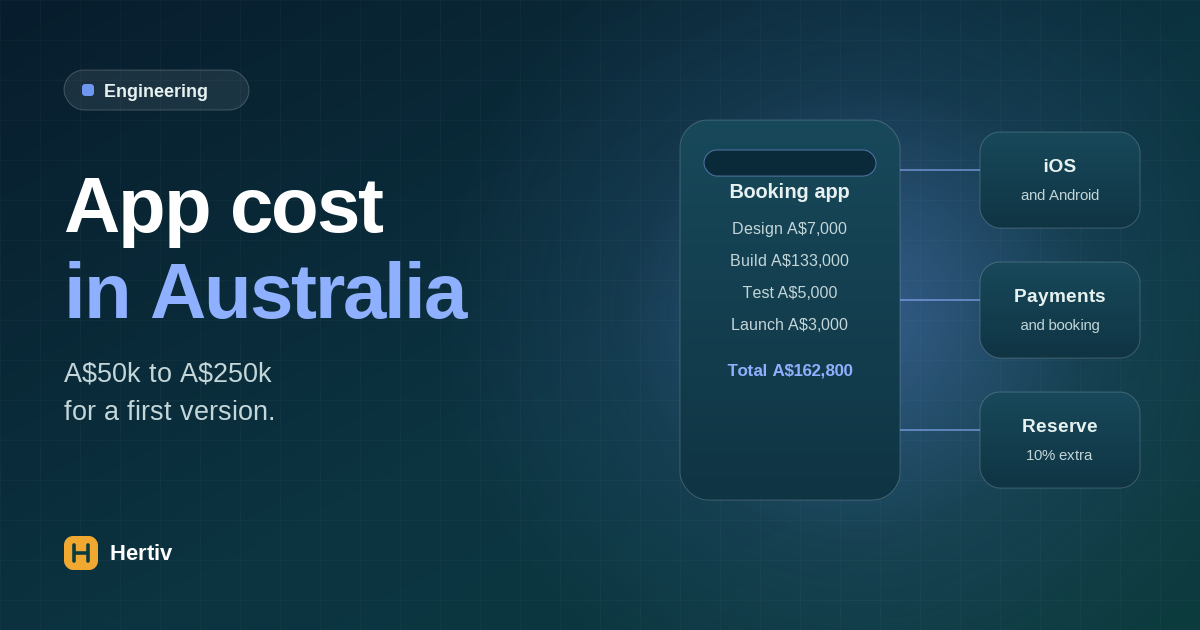
Example (hypothetical): a Brisbane clinic wants a booking app for patients, with accounts, appointment booking, reminders and a small admin panel for reception. The team estimates 1,400 hours at A$95 per hour, which is A$133,000 for development.
On top of that, the quote adds A$7,000 for design, A$5,000 for testing on real devices and A$3,000 for launch and store setup. The subtotal is A$148,000. A 10% reserve adds A$14,800, so the total budget is A$162,800.
The clinic also budgets A$800 per month for hosting, maintenance and small updates, which is A$9,600 for the first year. The first version launches in about five months, and the second version, with online payments, is planned for the following year once bookings prove the demand.
What are the common mistakes?
The most common mistakes when budgeting a mobile app in Australia are skipping the first-version list, comparing hourly rates instead of totals, and forgetting the first year of running costs.
- No first-version list. Without a written list, the scope grows during the build and the price follows it.
- Comparing hourly rates only. A low rate with slow delivery costs more than a higher rate with a fixed scope and a deadline.
- Forgetting compliance. Privacy, health and payment rules add real work. Raise them at the start, not during testing.
- No reserve. Without a 10 to 15% reserve, the first surprise becomes a cut to features or a delayed launch.
- Ignoring maintenance. An app that is never updated breaks as phones and stores change. Budget for it from day one.
Key takeaways
- A first version in Australia usually costs A$50,000 to A$250,000
- Scope, platforms and integrations drive the price more than anything else
- Compare three written estimates for the same scope, not hourly rates
- Add a 10 to 15% reserve and budget the first year of running costs
- Local rules on privacy, health and payments add real work, so raise them early
Frequently asked questions
Do I need iOS and Android, or is one enough?
It depends on your users. If most of your customers use iPhones, iOS alone can launch the product. If you need both, a shared codebase is usually cheaper than two native apps, but still needs platform-specific work for payments and notifications.
How long does it take to build a mobile app in Australia?
A simple first version takes about two to four months, a booking or ordering app takes four to seven months, and a complex app with two user types takes seven months or more. The timeline depends on scope, team size and how quickly you approve designs.
Is it cheaper to build offshore?
Offshore rates are lower per hour, but the total cost depends on communication, rework and time zone overlap. Many Australian projects mix local design and management with offshore development, which balances cost and control.
What are the ongoing costs after launch?
Ongoing costs include hosting, app store fees, payment provider fees, maintenance and updates. A common planning figure is 15 to 20% of the build cost per year, though the real figure depends on how often the app changes.
Do Australian privacy rules affect my app?
Yes, if the app collects personal data. The Privacy Act and the Australian Privacy Principles set rules for collection, storage and disclosure, and health apps face extra requirements. A local team should raise these during scoping.
How do I avoid the price growing during the build?
Write down the first version, get a fixed estimate for that scope, and agree in writing how changes are priced. A weekly demo and a fixed communication rhythm also catch scope growth early, before it becomes expensive.


