How to Reduce API Security Risks Before They Cost You
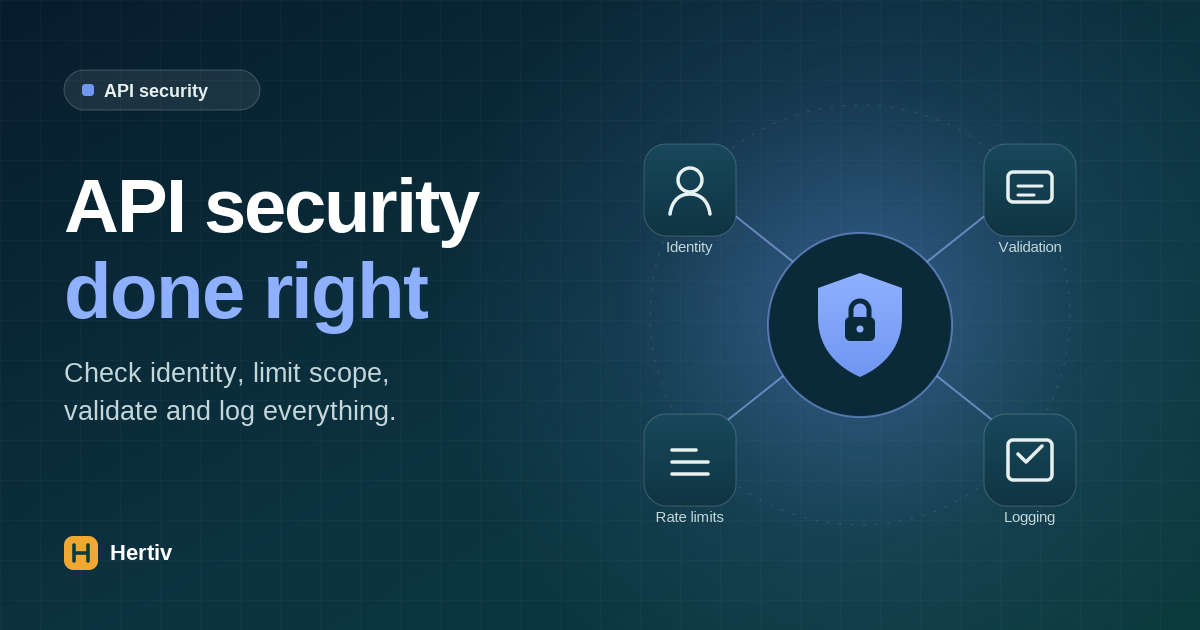
API security risks fall when you check who calls, what they can do and what they send. Authentication, scopes, validation, rate limits and logging cover most of it.
On this page
Short answer
API security risk is the chance that someone uses your API in a way you did not intend: reading data they should not see, changing data they should not change, or flooding it until it stops working. You reduce it by checking identity, limiting what each caller can do, validating every input, and logging what happens.
What are API security risks?
API security risks are the ways an application programming interface can be abused. An API is a door into your system, and every door needs a lock, a list of who may pass, and a record of who came through. Without those, anyone who finds the door can walk in.
The risks are practical, not theoretical. A leaked key, a missing permission check or an unvalidated input can expose customer data or let an attacker change records. Most breaches come from one of these simple gaps, not from an exotic attack.
| Risk | What goes wrong | First fix |
|---|---|---|
| Broken authentication | Anyone can call the API | Require a token on every call |
| Broken authorisation | Users see other users' data | Check ownership on every record |
| Excessive data | Responses leak fields nobody needs | Return only the fields asked for |
| Injection | Input runs as code or a query | Validate and escape all input |
| Rate abuse | One caller floods the API | Limit calls per key |
| No logging | Attacks go unnoticed | Log every call and error |
The table is a starting point, not a full audit. Fix the top rows first, because they cause most of the damage.
How do you fix authentication and authorisation?
Authentication answers who is calling; authorisation answers what they may do. Both must be checked on every request, not only at login, because a token can be stolen or a session can change hands.
Use short-lived tokens and rotate them, so a leaked token stops working quickly. Give each token a narrow scope, such as read-only access to one resource, instead of full access to everything. Never accept a user id from the request body as proof of identity; check it against the token.
The most common authorisation bug is checking that the user is logged in but not that the record belongs to them. Test it directly: log in as one user and try to read another user's record. If it works, the bug is live.
How do you validate input and limit abuse?
Validate every input against a strict rule: type, length, format and allowed values. Reject anything that does not fit instead of trying to clean it up, because cleaning rules are easy to get wrong. Parameterised queries stop injection in databases, and output encoding stops injected scripts in responses.
Rate limits stop one caller from flooding the API. Set a limit per key and per address, and return a clear error when it is hit, so honest users know to slow down. Add a slower limit for expensive calls, such as search or export, because those cost the most to run.
For the testing side of this work, API testing covers the checks that catch these gaps before launch.
What should you log and monitor?
Log every call with the time, the caller, the endpoint and the result, and keep the logs somewhere the attacker cannot delete them. Logs are how you find out what happened after an incident, and without them you are guessing.
Monitor for the patterns that signal abuse: many failed logins, calls from new locations, sudden spikes in one endpoint, and repeated errors on the same record. Set alerts for those patterns so a person sees them within minutes, not at the next weekly review.
Keep the API surface small as well. Every endpoint is a door; retire the ones nobody uses, because an unused endpoint is still a door an attacker can try.
How do you protect data in transit and at rest?
Use HTTPS for every call, with no plain HTTP fallback, so data cannot be read or changed on the way. Check that your certificates renew on time, because an expired certificate breaks the API for everyone at once.
Store secrets, such as database passwords and signing keys, in a secrets manager rather than in code or config files. Encrypt sensitive fields at rest, and return only the fields the caller needs, because data that never leaves the server cannot leak.
For the wider security picture, cybersecurity services covers the reviews and testing that find gaps across the whole system.
Example (hypothetical): a booking API finds its gaps
Example (hypothetical): a booking app finds that any logged-in user can read any other user's bookings by changing the booking id in the request. The team adds an ownership check, and the same request now returns an error. The fix takes two days.
The team then adds rate limits of 100 calls a minute per key and logs every failed authorisation. In the first week, the logs show 40 blocked attempts a day from a small set of addresses, which the team blocks. The cost of the fix is a week of work; the cost of the breach it prevented is a customer list in the wrong hands.
How teams organise this kind of work is covered in what DevOps is, which explains how security checks fit into the release process.
How do you handle third-party APIs and keys?
Third-party APIs add risk you do not control, because a key you give to a vendor can leak from their side too. Give each vendor its own key with the narrowest scope it needs, and set an expiry date so keys do not live forever. Rotate keys on a schedule, and have a plan for replacing one quickly if it leaks.
Never put a key in code, in a chat message or in a shared document. Store keys in a secrets manager and load them at runtime, so a leaked copy of the code does not hand over the keys. Check your code history too: a key committed by accident stays in the history even after you delete it from the file.
When you call a vendor API, validate its responses just as you validate user input. A vendor can send bad data by mistake or after a breach, and your system should reject a response that does not fit the expected format instead of trusting it.
What are the common mistakes?
Most API security failures come from skipping a basic check or trusting the client too much.
- Checking login but not checking who owns the record
- Accepting a user id from the request instead of the token
- Returning full records when the caller needs two fields
- No rate limit on expensive endpoints
- Logging tokens and passwords alongside the request
- Leaving old, unused endpoints live
- Testing only the happy path, never the abuse cases
Key takeaways
- Check identity and ownership on every request, not only at login.
- Validate every input against a strict rule and reject what does not fit.
- Return only the fields the caller needs; data that never leaves cannot leak.
- Rate-limit expensive endpoints and log every call and error.
- Never log secrets, and retire endpoints nobody uses.
- Test as an attacker would: wrong user, huge input, no token, flood.
Frequently asked questions
What is the biggest API security risk?
Broken authorisation is the most common and the most damaging. An API that checks login but not ownership lets any user read or change another user's records by changing an id in the request. Test it directly with two accounts.
Do I need authentication on internal APIs?
Yes. Internal APIs are reached by more people and systems than teams expect, and a breach of one service can reach the rest. Give each service its own credential with a narrow scope.
How do rate limits help security?
They stop one caller from flooding the API, whether by accident or on purpose. A limit per key and per address keeps a single bad actor from taking the service down for everyone else.
Should I log every API call?
Log the time, caller, endpoint and result for every call, and keep logs where an attacker cannot delete them. Do not log passwords, tokens or card numbers, because a log full of secrets is a second breach.
How often should API security be reviewed?
Review it on every release that adds an endpoint or changes permissions, and run a full check at least twice a year. New endpoints are the most common source of new gaps.
Is HTTPS enough for API security?
No. HTTPS protects data in transit, but it does nothing about who may call, what they may see or how much they may ask for. Authentication, authorisation, validation and logging do that work.


