MENA Startup Ecosystem Trends Worth Watching
The MENA startup scene now runs on local funds, government programmes and paying customers. These eight trends show where founders are building next.
On this page
Short answer
The MENA startup ecosystem is shaped by fintech and payments, AI products built for Arabic, government-backed funds and hubs, healthtech, logistics, agritech, climate tech and B2B software for small firms. The Gulf states lead on funding and hubs, while Egypt, Jordan and Morocco add large talent pools and local markets.
Which MENA startup trends matter right now?
The MENA startup scene has moved from a handful of success stories to a working ecosystem: local funds, government programmes, accelerators and customers who pay online. The trends below are the ones founders and investors keep running into, in the Gulf states and in Egypt, Jordan and Morocco.
| Trend | Where it shows up | What it means for founders |
|---|---|---|
| Fintech and payments | Saudi Arabia, UAE, Egypt | Local payment habits are the product, not an add-on |
| AI products for Arabic | Across the region | Arabic language support is a real edge over global tools |
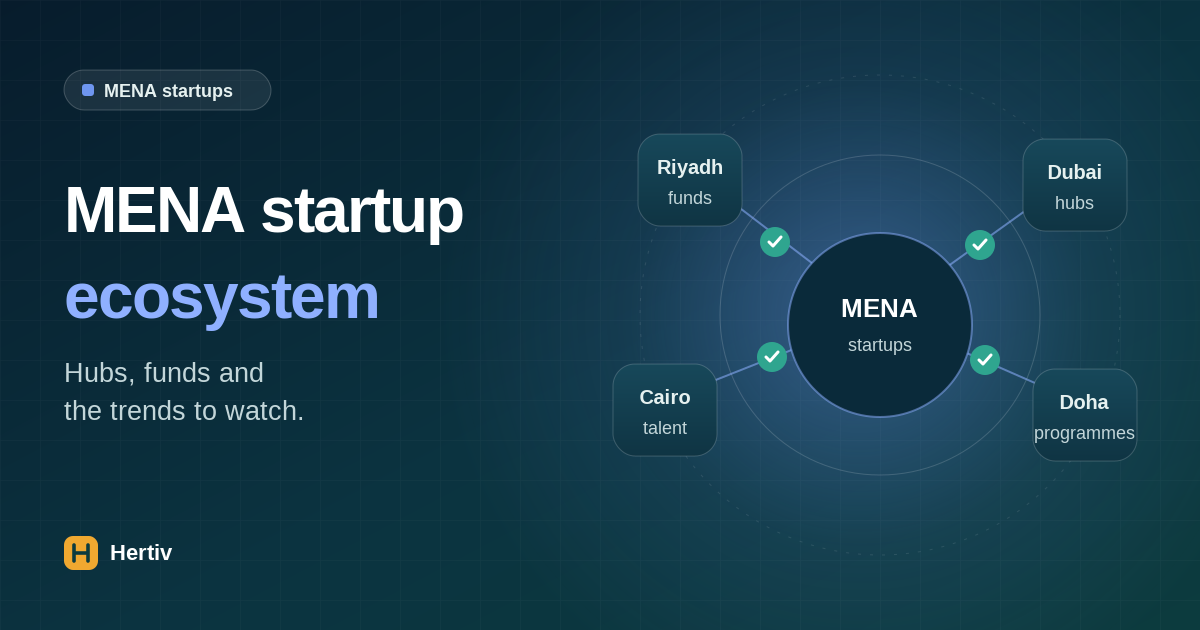
| Government funds and hubs | Riyadh, Dubai, Abu Dhabi, Doha | Grants and programmes lower the cost of starting |
| Healthtech | UAE, Saudi Arabia, Egypt | Remote care and booking fit how people already use phones |
| Logistics and delivery | Saudi Arabia, Egypt, UAE | E-commerce growth keeps delivery and warehousing busy |
| Agritech and food | Egypt, Morocco, Jordan, Gulf | Water and food security make farm tech a policy priority |
| Climate and clean energy | UAE, Saudi Arabia, Morocco | Solar and efficiency projects need software and data |
| B2B software for small firms | Across the region | Small firms are moving from paper to software |
Read the table as a map, not a ranking. A trend that fits your market and your skills beats a hotter trend in a market you do not know.
Fintech, payments and AI products
1. Fintech and payments: best for founders who know local money flows
Payments are the oldest and deepest startup trend in MENA, because paying online, sending money home and getting a small business loan still work differently here than in Europe or the US. Founders who understand local habits, like cash on delivery or instalment payments, build products global firms miss.
The work now is less about new wallets and more about the pipes behind them: fraud checks, reconciliation for merchants, and payroll for small firms. Those are quieter businesses, but they sit closer to the money.
- Pros: large unmet demand; regulators in the Gulf have clear licensing paths; merchants pay for tools that save them time.
- Cons: licensing takes time and money; trust is slow to earn in money products; each country has its own rules.
2. AI products built for Arabic: best for teams with language and data skills
Most global AI tools were built for English first, so Arabic support is often an afterthought. That gap is a real opening: support agents, document tools and voice products that handle Arabic dialects well can win customers that global tools serve badly.
The hard part is data. Good Arabic training and test data is scarcer than English data, so teams that collect and clean their own domain data have an edge that is hard to copy.
- Pros: a clear gap global tools leave open; government and enterprise buyers want Arabic-first products; talent in the region knows the language.
- Cons: Arabic data is harder to gather; evaluation needs native speakers; buyers expect the product to handle dialects, not just formal Arabic.
Hubs, funds and healthtech
3. Government-backed funds and hubs: best for founders who plan around programmes
Governments across the Gulf run funds, accelerators and free zones that lower the cost of starting a company, and national plans in Saudi Arabia and the UAE name startups as part of the economy. A founder who maps the programmes before incorporating can save months of paperwork and real money.
The risk is building for the programme instead of the customer. Grants and demo days are useful, but they do not prove anyone will pay. Treat programmes as fuel, not as the business.
- Pros: grants, visas and office space lower startup costs; programmes connect founders to corporates and investors; hubs in Riyadh, Dubai and Abu Dhabi attract talent.
- Cons: paperwork and eligibility rules take time; programme money can mask a weak product; rules differ by city and free zone.
4. Healthtech and digital care: best for teams that know local care
Booking a doctor, getting a prescription refilled and seeing a specialist by video are now normal in much of the region, and healthtech startups serve that shift. The products that work best fit local habits: family bookings, pharmacy delivery and Arabic-speaking care teams.
Health data rules are strict, so teams need to plan for consent, storage and access from day one. A product that treats compliance as an afterthought will stall at the first hospital or insurer conversation.
- Pros: patients already book and pay by phone; insurers and hospitals are buying software; family-centred care fits local habits.
- Cons: health data rules are strict and vary by country; sales cycles with hospitals are long; trust takes years to build.
Logistics, food and climate
5. Logistics and delivery: best for operators who know the streets
E-commerce growth keeps delivery, warehousing and last-mile logistics busy across the region, and the operators who win are the ones who know the streets, the addresses and the cash habits of each city. Software that plans routes, tracks drivers and handles cash on delivery is the quiet backbone of that growth.
Margins are thin, so the winners run tight operations. A logistics startup that cannot measure cost per delivery will lose to one that can, even with a better app.
- Pros: e-commerce keeps demand growing; cash on delivery creates room for smart payment handling; fleet and warehouse software is a repeat purchase.
- Cons: thin margins punish sloppy operations; fuel and labour costs move fast; scaling across borders means new rules each time.
6. Agritech and food systems: best for founders close to farms
Water scarcity and food security are policy priorities across MENA, so farm technology gets attention from governments and buyers alike. Irrigation sensors, greenhouse controls, cold chain tracking and farm marketplaces all solve problems that farmers feel every season.
The sales cycle is the hard part. Farmers buy on proof, not on slides, so a pilot on a real farm with measured results matters more than a polished pitch deck.
- Pros: policy support for water and food projects; clear, measurable problems; buyers include governments and large food firms.
- Cons: long sales cycles with farmers; pilots need real field work; hardware adds cost and maintenance.
Climate tech and B2B software
7. Climate and clean energy: best for teams with energy and data skills
Solar power, energy efficiency and carbon tracking are growing across the Gulf and North Africa, and each project needs software: monitoring panels, managing grids, tracking emissions and reporting to regulators. The hardware gets the headlines, but the software decides whether a project runs well.
Most buyers are large firms or governments, so sales cycles are long and procurement is formal. Startups that win here usually start with one buyer and one clear use case, then grow from there.
- Pros: large projects with real budgets; policy support in the UAE, Saudi Arabia and Morocco; software is a small share of project cost.
- Cons: long sales cycles with big buyers; procurement rules are formal; hardware partners set the pace.
8. B2B software for small firms: best for founders who sell to owners
Millions of small firms across MENA still run on paper, spreadsheets and chat apps. Simple software for invoicing, stock, staff scheduling and customer messages is finding buyers, because owners feel the pain every day and the price is low enough to try.
The trick is distribution. Small firms do not read tech blogs, so the startups that win sell through accountants, suppliers and community groups, not through ads alone.
- Pros: a huge number of potential buyers; low prices make trying easy; owners renew tools that save them an hour a day.
- Cons: buyers are price-sensitive; support needs Arabic and local habits; distribution is slow without partners.
How to choose
Eight trends is too many to chase at once. Five steps narrow the list to the one that fits you, your market and your runway.
- Start with the market you know. A trend in a country you understand beats a hotter trend in one you do not.
- Talk to ten buyers before building. Ask what they pay for today and what they would pay to fix.
- Check the rules early. Licensing, data and payment rules differ by country, and they set your timeline.
- Map the programmes. Funds, hubs and visas can cut months off your start, but only if you qualify.
- Pick one trend and one city. Win in one market first, then carry what you learned across the border.
Step two is the cheapest test in the list. Ten buyer conversations cost a week and can save a year of building the wrong product.
Common mistakes
The most common mistake is copying a model from the US or Europe without changing it for local habits. Cash on delivery, family decisions and Arabic-first support are not details in MENA; they are the product.
- Copying a foreign model unchanged. Local payment, language and buying habits decide whether it works.
- Building for the grant, not the customer. Programme money ends; paying customers do not.
- Ignoring the rules. Licensing and data rules set the timeline, so check them before building.
- Launching in five countries at once. One market, won properly, beats five markets half entered.
- Skipping buyer conversations. Ten talks with buyers beat ten months of building on a guess.
A focused start also keeps costs down. If you are weighing how to staff the first build, see how SaaS startups choose between hiring, outsourcing and AI before you commit to a team.
Key takeaways
- Fintech and Arabic-first AI are the deepest openings in MENA.
- Government funds and hubs cut startup costs but are not the business.
- Healthtech, logistics and agritech win by fitting local habits.
- Climate tech and B2B software for small firms are steady, not flashy.
- Pick one trend and one city, and talk to ten buyers first.
Frequently asked questions
Which MENA countries have the strongest startup ecosystems?
The UAE and Saudi Arabia lead on funding, hubs and programmes, with Riyadh, Dubai and Abu Dhabi as the main centres. Egypt adds a large market and talent pool, while Jordan and Morocco contribute skilled teams and growing local scenes.
What sectors attract the most MENA startups?
Fintech and payments, AI products for Arabic, healthtech, logistics, agritech, climate tech and B2B software for small firms. Each sector fits a real local need, from payment habits to water scarcity to small firms moving off paper.
Do MENA startups need government programmes to succeed?
No, but programmes help. Grants, visas and hub space lower the cost of starting, and they connect founders to corporates and investors. The business still needs paying customers; programme money alone does not prove a product works.
Is Arabic language support important for MENA startups?
Yes, for most consumer and small-business products. Arabic-first support, dialects and voice handling are often the difference between a product people use and one they abandon for a local alternative.
What is the biggest mistake MENA founders make?
Copying a foreign model without changing it for local habits. Payment methods, family decision-making and language are core to the product in MENA, not details to add later. A model that works in London can fail in Riyadh if it assumes card payments, English support and solo buying decisions.
How should a founder pick a MENA market to enter?
Start with the market you know best, talk to ten buyers there, check the licensing and data rules, and win in one city before expanding. One market won properly beats five markets entered halfway.


