SaaS Startup: Hire, Outsource or Use AI?
A SaaS startup can hire staff, outsource the build or use AI tools to do the work. Each route fits a different budget, timeline and level of control.
On this page
Short answer
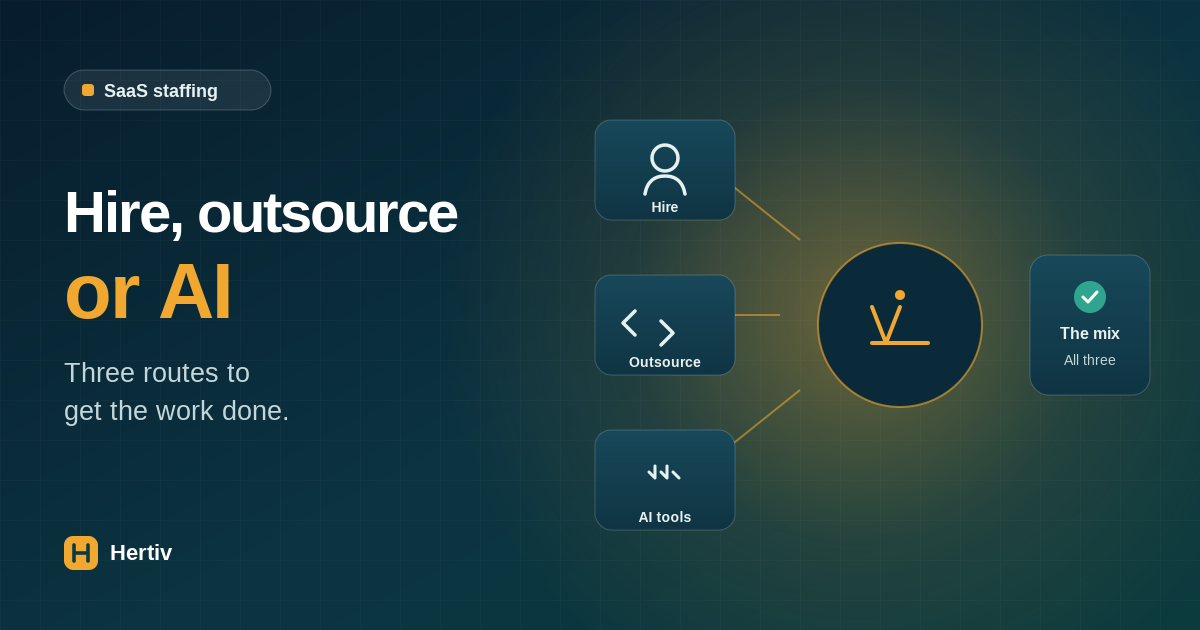
A SaaS startup should hire when the work is core to the product and needs daily judgement, outsource when it needs a finished build fast without growing headcount, and use AI tools when the work is repetitive and checkable. Most startups mix all three: a small in-house team for the product, an outsourced team for a defined build, and AI tools for support, drafting and testing.
What do hire, outsource and AI mean for a SaaS startup?
Hiring, outsourcing and using AI are three ways for a SaaS startup to get work done, and they differ in cost, speed and control. Hiring means employing people who work for the company every day. Outsourcing means paying an outside team to build or run a defined piece of work. Using AI means letting a model do repetitive, checkable work, with a person reviewing the output.
None of the three is right for everything. The product itself usually needs people who understand it deeply. A defined build, such as a mobile app or a migration, can go to an outside team. Repetitive work, such as answering common support questions or drafting first versions of content, can go to AI tools with a human in the loop.
| Route | Cost pattern | Speed | Control |
|---|---|---|---|
| Hire in-house | Salary plus benefits, ongoing | Slow to start, fast later | High |
| Outsource | Fixed or monthly fee, ends with the build | Fast to start | Medium |
| Use AI tools | Subscription plus review time | Immediate | Medium, with review |
The question is not which route is best in general, but which route fits each piece of work. A startup that hires for everything runs out of money; a startup that outsources everything loses control of its product. For the wider comparison of in-house and outsourced work, outsourcing vs in-house development covers the trade-offs in more detail.
When hiring wins
Hiring wins when the work is core to the product, needs daily judgement, and will still matter in two years. The product roadmap, the architecture, the customer relationships and the data model are all core work. People who own those decisions need to be inside the company, not on a contract that ends.
Hiring also wins when the work is ambiguous. A new feature that nobody has built before needs conversation, trial and revision, and that is slow and expensive across a contract boundary. An in-house team can change direction in a day; an outsourced team needs a change request.
The cost of hiring is real: salary, benefits, recruiting and onboarding, plus the months before a new hire is fully productive. But for core work the alternative is worse. An outsourced team that owns your roadmap will make decisions you cannot see, and an AI tool cannot own a decision at all. Hire for the work that defines the product.
Start small: one senior engineer, one product person and one person on customer success is often enough to carry a SaaS product to its first paying customers. Add roles when the workload proves they are needed, not before.
When outsourcing wins
Outsourcing wins when the work is a defined build with a clear end, and when you need it faster than hiring allows. A mobile app, a redesign, a migration or a first version of a feature are all good candidates: the scope can be written down, the result can be tested, and the work ends when it ships.
Outsourcing also wins when you need a skill you do not have and will not need again soon. A security audit, a payment integration or a data migration are one-off jobs. Hiring a full-time specialist for each one would be wasteful, and a good outside team has done the same job many times before.
The risks are real and manageable. The outside team needs a clear scope, milestones and a definition of done, or the cost grows without the value growing. You also need someone in-house who can read the code and judge the quality. Without that person, you cannot tell good work from bad, and you will find out too late.
For a defined build, what is staff augmentation explains the middle route: outside people working inside your team, under your direction, for a fixed period.
When AI tools win
AI tools win when the work is repetitive, high-volume and checkable. Answering common support questions, drafting first versions of content, summarising calls, triaging tickets and writing test cases are all work where a model can do the first pass and a person can check the result in seconds.
The economics are simple: the tool costs a subscription, and the review costs a few minutes of staff time per task. Compared with hiring a person for the same work, the saving is large, as long as the review step actually happens. A tool whose output nobody checks will eventually produce a wrong answer that reaches a customer.
AI tools do not win when the work needs judgement, trust or a relationship. A sales call, a pricing decision, a security review and a customer apology all need a person. The model can draft the follow-up email, but it cannot own the relationship.
The practical rule is to automate the first draft, not the decision. Let the tool draft, summarise and sort, and let a person decide, approve and send. That keeps the speed without giving up the judgement that customers pay for. If you are building AI into the product itself, how to build AI covers the same decisions at team level.
How to decide in 5 steps
Deciding between hiring, outsourcing and AI is a short exercise if you work from the task rather than from a preference. Most startups have a preference for one route, and the exercise exists to test it.
- List the work. Write down the tasks the startup needs done in the next quarter, with who does them today.
- Sort by core or not. Core work defines the product and needs daily judgement. Everything else is a candidate for outsourcing or AI.
- Check the volume. High-volume repetitive work suits AI tools. One-off specialist work suits an outside team.
- Price the three routes. Salary plus benefits, the outsourced quote, and the tool subscription plus review time. Compare the same scope in each.
- Pick the mix, not one route. A small in-house team for the core, an outside team for a defined build, and AI tools for the repetitive work is the usual answer.
Revisit the decision every quarter. As the product grows, work that was outsourced becomes core, and work that was manual becomes worth automating. The mix should change with the company.
Example (hypothetical): a 6-person SaaS startup plans its next quarter
Example (hypothetical): a 6-person SaaS startup needs to handle 120 support tickets a week. The founders compare three routes for that work alone.
Hiring one support person costs 40 hours a week at $30 an hour, or $1,200 a week. Outsourcing the same work costs $900 a week on a monthly contract. Using an AI tool costs $200 a week for the subscription, plus 10 hours of staff review at $30 an hour, or $300, for a total of $500 a week.
The AI route is the cheapest for this work, because the tickets are repetitive and the answers are checkable. The startup keeps the saving only if the review step happens: 10 hours of review a week is real time, and skipping it would let wrong answers reach customers. The founders hire for the product roadmap, outsource the mobile app build, and use the AI tool for support, which is the mix the numbers point to.
What are the common mistakes?
The most common mistakes are choosing one route for everything, skipping the review step for AI tools, and outsourcing without anyone in-house who can judge the work.
- One route for everything. Hiring for every task burns money; outsourcing every task loses control of the product.
- Skipping AI review. A tool whose output nobody checks will eventually send a wrong answer to a customer.
- No in-house reviewer for outsourced work. Without someone who can read the code, you cannot judge quality.
- Hiring before the workload proves it. A role hired on a guess becomes a cost the startup cannot carry.
- Vague outsourcing scope. A contract with no milestones and no definition of done grows in cost without growing in value.
- Automating the decision, not the draft. Let AI draft and sort; let people decide and approve.
For the middle route between hiring and outsourcing, staff augmentation brings outside people into your team for a fixed period.
Key takeaways
- Hire for core work that needs daily judgement
- Outsource defined builds with a clear scope and end date
- Use AI tools for repetitive, checkable work with a human review step
- Most startups need a mix of all three, not one route
- Revisit the mix every quarter as the product grows
Frequently asked questions
Should a SaaS startup hire or outsource development?
Hire when the work is core to the product and needs daily judgement, and outsource when it is a defined build with a clear end. Most startups do both: a small in-house team owns the product and roadmap, while an outside team builds a defined feature or app. The mix depends on budget, timeline and how much control the work needs.
Can AI tools replace hiring for a SaaS startup?
AI tools can replace repetitive, checkable work such as answering common support questions, drafting content and triaging tickets, but they cannot replace judgement, relationships or product decisions. The usual pattern is to let the tool draft and sort, and let a person decide, approve and send.
What work should a SaaS startup never outsource?
Never outsource the product roadmap, the architecture, the customer relationships or the data model. Those decisions define the product, and they need people inside the company who own them. A defined build, a migration or a one-off specialist job are safe to outsource with a clear scope.
How much does it cost to hire vs outsource for a SaaS startup?
Hiring costs salary plus benefits and onboarding, and it is ongoing. Outsourcing costs a fixed or monthly fee that ends with the build. AI tools cost a subscription plus the review time. Compare the same scope in each route, and check current listings and vendor pages for rates in your region.
When should a startup stop outsourcing and hire?
When the outsourced work becomes core to the product, when the team spends more time managing the contract than building, or when the same work repeats every month. At that point the knowledge is worth keeping in-house, and hiring costs less than the contract over time.
What is staff augmentation for a SaaS startup?
Staff augmentation means bringing outside developers into your team for a fixed period, under your direction, without hiring them full-time. It suits a startup that needs extra hands for a release but wants to keep control of the product and the code.


