LLMs for Synthesizing Training Data: How It Works
LLMs can synthesize training data by writing new examples from a small set of seed tasks, which teams then filter, check and mix with real data before training.
On this page
Short answer
Using an LLM to synthesize training data means asking a capable language model to write new training examples from a small set of human-written seed tasks, then filtering the output and mixing it with real data. It works well when real labelled data is scarce, but the generated data carries the teacher model's errors and biases, so it needs human checks before it is used to train a model.
What does it mean for an LLM to synthesize training data?
Using an LLM to synthesize training data means asking a capable language model to write new training examples, instead of collecting and labelling real ones by hand. You start with a small set of human-written examples, called seed tasks, and the model writes new instructions, questions or documents in the same style, together with the answers.
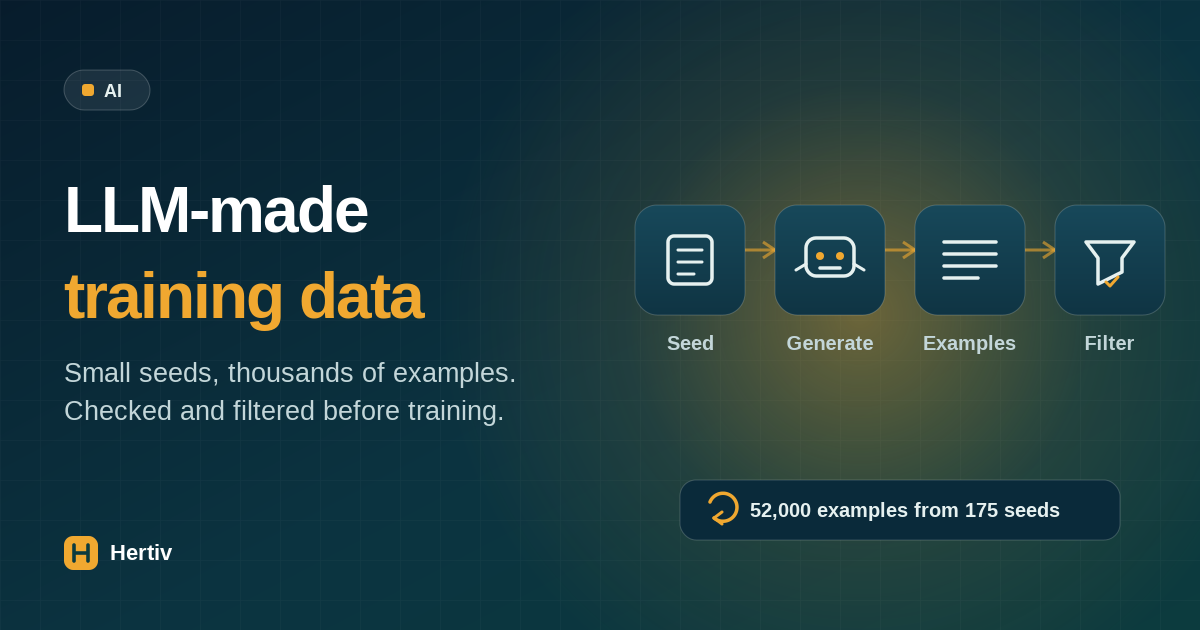
The idea became widely known through the Self-Instruct method, in which a model is given a few seed tasks and asked to invent new ones, and through Stanford's Alpaca project, which expanded 175 human-written seed tasks into 52,000 instruction examples using text-davinci-003, at a generation cost of under 500 dollars. The resulting data was then used to fine-tune a smaller model.
The generated examples are not real user data. They are imitations of the patterns in the seed tasks and in the teacher model's own training, which is both the strength and the risk: you can create a large dataset quickly, but every error the teacher makes can be copied into thousands of examples.
How does LLM-generated training data work?
LLM-generated training data works in four steps: seed, generate, filter and train. First, a person writes a few dozen to a few hundred seed examples that show the task, the format and the tone. The seeds matter more than anything else, because the model copies their style and their mistakes.
Second, the model generates new examples in batches, with a prompt that includes a few seeds and asks for new, varied examples in the same format. Third, the output is filtered: exact duplicates are removed, examples too close to the seeds are dropped, and any output that breaks the format is thrown away.
Fourth, the cleaned data trains the target model, often mixed with real labelled data. The mix matters: real data anchors the model in how people actually write, while generated data adds coverage of cases that are rare in the real set.
| Method | How it works | Best when |
|---|---|---|
| Seed-based generation | Model invents examples from seeds | You need varied examples fast |
| Self-Instruct | Model writes instructions and answers | Building instruction-following models |
| Distillation | Small model learns from a large model | You need a cheap copy of a big model |
| Paraphrase and rewrite | Model restates real examples | You have some real data already |
| Edge-case generation | Model writes rare cases on purpose | Real data misses hard cases |
Generation is the easy part. The work that decides whether the data is useful is the filtering and checking that comes after it. For the general background on machine-made data, see what is synthetic data.
When is LLM-generated data a good fit?
LLM-generated data is a good fit when real labelled data is scarce, expensive or blocked by privacy rules, and when the task is one the teacher model already handles well. Support ticket routing, document classification and simple question answering are common cases, because the teacher model can write realistic examples and the answers are easy to check.
It also fits when you need coverage of rare cases. Real data follows the usual pattern, so a model trained only on it may never see the unusual request. Asking the teacher model to write the rare cases on purpose, such as angry customers, mixed-language messages or edge-case forms, fills gaps that real data leaves open.
It is a poor fit when the task needs facts the teacher model does not know, or when the data must be exactly right, such as medical or legal records. In those cases the generated examples will contain confident errors, and a model trained on them will repeat those errors.
It is also a poor fit when the teacher model's licence forbids using its output to train another model, so check the terms before you start.
How do you check the quality of generated data?
You check the quality of generated data by reviewing a sample by hand, measuring duplicates and overlap, and testing the trained model on real held-out data. None of these steps can be skipped, because each one catches a different kind of failure.
Start with a human sample: read a few hundred generated examples and mark which ones are wrong, unclear or off-topic. If more than a small share fail, fix the prompt or the seeds before generating more. Then check for duplicates and near-duplicates with a simple similarity measure, since a dataset that repeats the same example a thousand times teaches the model nothing new.
Next, check for leakage: generated examples that are copied from the test set, or that contain the answer in the question, will make the model look better than it is.
Finally, train on the data and test on real examples the model has never seen. If accuracy on real data does not improve, the generated data is not helping, however clean it looks. A practical guide to putting generated data into a pipeline is how to implement synthetic data.
What can go wrong with LLM-made training data?
Several things can go wrong with LLM-made training data, and most of them are quiet: the model trains, the scores look fine, and the problems only show up in real use. The first is error copying. If the teacher model gets a fact wrong, or writes a plausible but wrong answer, that error is repeated across the dataset and the student model learns it as truth.
The second is bias and narrow style. Generated examples tend to follow the teacher model's habits, so the dataset can over-represent one phrasing, one kind of customer or one point of view. A model trained on it may then fail on people who write differently. The third is leakage and memorisation: the teacher may reproduce text from its own training data, including text that belongs in your test set, which inflates your scores.
The fourth is licence and privacy risk. Some model providers forbid using their output to train a competing model, and a teacher model can leak personal details from its training data into the generated examples. Both need a check before the data is used. Tools that generate or manage synthetic data are compared in top synthetic data tools.
Example (hypothetical): building a support classifier
Example (hypothetical): a small software company wants a model that routes support tickets into billing, technical or account topics, but it has only 200 labelled tickets. The team writes 60 seed examples, 20 for each topic, and asks a large model to generate 10,000 new tickets with labels.
A reviewer reads a sample of 500 generated tickets and finds 40 that are wrong or unclear, which is 8 percent of the sample. The team fixes the prompt, regenerates the bad cases and drops the 40, leaving 9,960 examples. They mix these with the 200 real tickets and train the classifier.
They test on 200 real tickets the model has never seen. It routes 164 correctly, which is 82 percent, against 128 out of 200, or 64 percent, for a model trained on the 200 real tickets alone. The generated data added 18 percentage points, but the team keeps the human review step, because the 8 percent error rate in the raw output would have taught the model the wrong labels.
What are the common mistakes?
The most common mistakes are generating too much data before checking any of it, trusting the teacher model too far, and testing on generated data. Each one is easy to make when generation is cheap, and each one quietly weakens the final model.
- Generate first, check later. A bad prompt can produce 100,000 useless examples in an afternoon. Review a small sample before scaling up.
- Trusting the teacher. The teacher model's errors become the student's training data. Treat every generated answer as a draft, not a fact.
- Testing on generated data. A test set made by the same generator will flatter the model. Test on real, human-written examples.
- Ignoring duplicates. A dataset that repeats the same example teaches the model to memorise it. Remove exact and near duplicates.
- Skipping the licence check. Some providers forbid training on their model's output. Check the terms before you build on generated data.
The rule behind all of these is simple: generated data is a starting point, not a finished dataset. It works when a person designs the seeds, checks a sample, filters the output and tests on real data, as part of a wider AI governance routine that records where training data came from.
Key takeaways
- An LLM can turn a few dozen seed examples into thousands of training examples, but it copies the teacher model's errors too
- Generation is the easy part; filtering, deduplication and human review decide whether the data is useful
- Generated data works best when real labelled data is scarce and the task is one the teacher model handles well
- Always test a model trained on generated data against real, human-written examples it has never seen
- Check the teacher model's licence before using its output to train another model
Frequently asked questions
What is LLM-synthesized training data?
It is training data written by a large language model instead of collected and labelled by people. You give the model a small set of seed examples, it writes new examples in the same style, and you filter the output before using it to train a smaller model.
How is LLM-generated data different from synthetic data?
It is one way of making synthetic data. Synthetic data is the general idea of machine-made data, while LLM synthesis is the specific method of asking a language model to write the examples from seed tasks.
How much seed data do you need?
A few dozen to a few hundred well-written examples is usually enough to start. The seeds set the format, tone and difficulty, so they matter more than the number of generated examples that follow.
Can generated data replace real labelled data?
No, it should sit alongside real data. Real data anchors the model in how people actually write, while generated data adds coverage of rare cases. A model trained only on generated data will repeat the teacher model's errors.
How do you stop generated data from leaking into the test set?
Keep the test set separate from the start, use only real human-written examples for testing, and check that no generated example is a near copy of a test example. A test set built by the same generator will flatter the model.
Is it legal to train a model on another model's output?
It depends on the provider's terms. Some providers forbid using their output to train a competing model, while others allow it. Check the terms of the model you use before building a dataset from its output.


