LLM vs LAM: What Is the Difference?
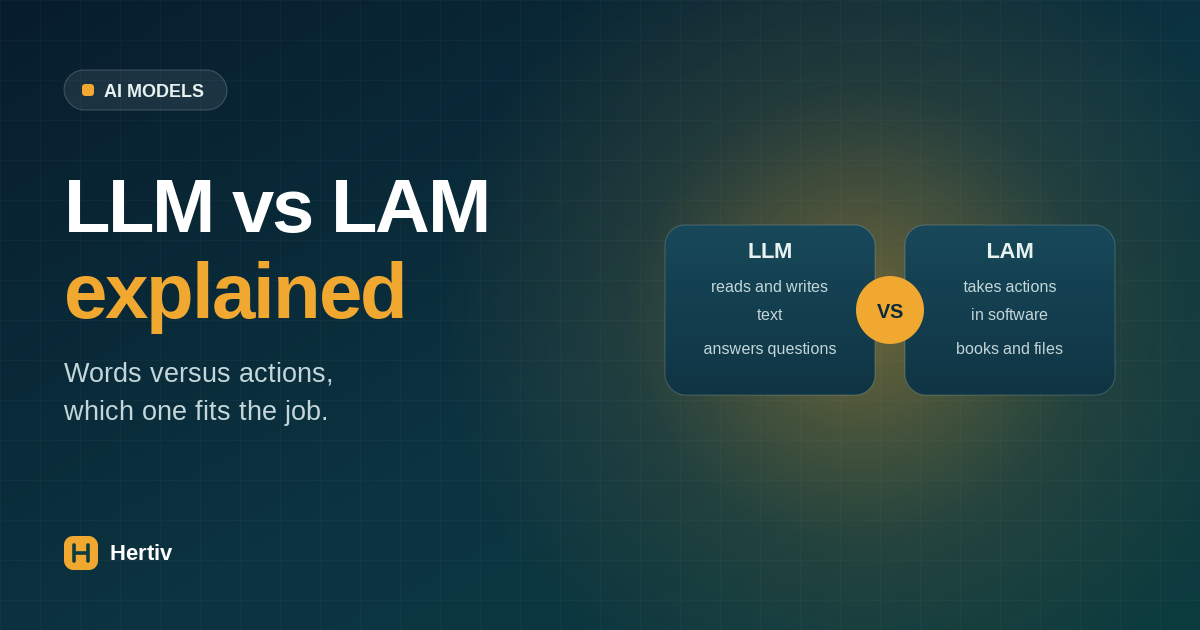
An LLM reads and writes text; a LAM takes actions in software, such as booking or filing. An LLM answers questions, while a LAM carries out the steps that follow.
On this page
Short answer
An LLM, or large language model, reads and writes text. A LAM, or large action model, takes actions in software, such as booking a meeting, filing a form or updating a record. An LLM can draft the email that asks for a booking; a LAM can make the booking itself. The difference is what each is allowed to do: words for one, actions in real systems for the other.
What is an LLM?
An LLM is a large language model: a model trained on huge amounts of text so that it can read a prompt and write a sensible reply. It answers questions, drafts documents, summarises long texts and writes code. It works by predicting the next words, and it is good at tasks where the output is text.
An LLM does not act on its own. It can suggest the next step, write the email, or fill in the form as text, but a person or another piece of software must take that text and do something with it. That limit is also a safety feature: nothing changes in a real system until someone decides to act.
LLMs are the model behind chatbots, copilots and writing tools. They are at their best when the task is understanding and producing language, and when a human checks the result before it is used. For how teams give LLMs access to their own data, see what retrieval augmented generation is.
What is a LAM?
A LAM is a large action model: a model trained to take actions in software, not just to write text. It reads a goal, such as book a flight or file an expense, and carries out the steps in the app: opening the right screens, filling in the fields, and confirming the result. The output is a change in a real system, not a paragraph.
A LAM is built on top of an LLM, but it is trained differently. It learns from examples of people doing tasks in software, so it knows which buttons to press and in what order. It also needs tools: a way to see the screen or the app's data, and a way to act, such as an API or a browser. Without those tools, a LAM cannot do anything.
LAMs are new, and the name is used loosely. Some products called LAMs are really an LLM with a set of tools and a script that runs the steps. The honest test is whether the model decides the steps itself, or whether a person wrote the steps and the model only fills in the details.
How do LLMs and LAMs compare?
LLMs and LAMs differ in what they produce, what they need, and what can go wrong.
| LLM | LAM | |
|---|---|---|
| Output | Text | Actions in software |
| Needs | A prompt and context | Tools, access and permissions |
| Best for | Answering, drafting, summarising | Repeating multi-step tasks |
| Main risk | Wrong or made-up text | Wrong action in a real system |
| Human role | Checks the text | Approves or reviews the action |
| Maturity | Widely used today | Early, mostly in pilots |
The risk is the key difference. A wrong sentence can be deleted; a wrong booking, payment or deletion cannot. That is why LAMs need stricter rules about what they may do alone and what needs a human to approve first. A LAM that can book a meeting is useful; a LAM that can pay an invoice without approval is a risk.
When should you use each?
Use an LLM when the task ends with words: answering a question, drafting a reply, summarising a document, or writing code. The human reads the result and decides what to do with it. This covers most of the AI work teams do today, and it is where LLMs are proven.
Use a LAM when the task is a repeated multi-step action in software, such as filing the same kind of form every week, updating records from emails, or booking travel that follows fixed rules. The LAM is worth it only when the steps are clear, the data is clean, and the cost of a mistake is low or covered by a check.
Most teams should start with an LLM and add actions later. Give the LLM tools one at a time, such as a search tool first, then a read-only lookup, and only then a tool that changes data. Each step up in power needs a new check. For how teams test models before giving them more power, see how to test AI models.
Example (hypothetical): a support team tries both
Example (hypothetical): a support team handles 100 refund requests a week. With an LLM, an agent reads each request, and the LLM drafts the reply and the refund form. The agent checks the draft and submits the form, which takes 4 minutes per request. That is 100 x 4 = 400 minutes, or about 7 hours a week.
With a LAM, the model reads the request, checks the order, fills in the refund form and submits it, then drafts the reply for the agent to send. The agent spends 1 minute checking each case, so the team spends 100 x 1 = 100 minutes, or about 2 hours a week. The LAM saves about 5 hours a week.
The saving only holds because the team set a limit: the LAM may refund up to $50 on its own, and anything larger goes to a person. In the first month, 12 of the 100 weekly requests were over $50 and went to a human. The team kept the speed and kept the risk small, which is the point of the limit.
What are the common mistakes?
The most common LLM vs LAM mistakes are giving a LAM too much power too soon, skipping the approval step, and treating a LAM as a finished product when it is still a pilot.
- Too much power too soon. A LAM that can pay, delete or send without limits will eventually do the wrong thing. Start with read-only tools.
- No approval step. Actions that cost money or change records need a human to approve, or at least a clear limit such as $50.
- No undo. If a LAM files the wrong form, the team needs a way to reverse it. Test the undo before the launch.
- Calling an LLM with tools a LAM. An LLM with a search tool is still an LLM. A LAM decides the steps itself, and that is a bigger claim.
- Skipping the test set. A LAM that works on ten demo tasks may fail on the eleventh. Keep a test set of real tasks and run it after every change.
How do you decide which one to build?
Decide with five questions, and build only what the answers support.
- Does the task end with words or with an action? Words point to an LLM; a repeated action points to a LAM.
- How much does a mistake cost? If a mistake costs money or data, keep a human in the loop and set a limit.
- Are the steps fixed? A LAM needs steps that are the same most of the time. If every case is different, an LLM plus a person is better.
- Do you have the tools? A LAM needs safe access to the systems it will change. Without that, it cannot act.
- Can you test it on real tasks? If you cannot build a test set of real cases, do not give the model power over real systems.
For most teams, the answer is an LLM now and a LAM later, for one narrow task with a money limit. That is also how a proof of concept should be scoped: one task, one limit, one test set. For the scoping pattern, see how to build an AI proof of concept.
Key takeaways
- An LLM produces text; a LAM produces actions in real software
- A LAM is an LLM plus tools, permissions and a model trained on task steps
- A wrong sentence can be deleted; a wrong action needs an undo and a limit
- Start with an LLM, add read-only tools, then one action with a money limit
- Most LAM products today are still pilots, not proven replacements for staff
Frequently asked questions
What does LAM stand for?
LAM stands for large action model: a model built to take actions in software, such as booking, filing or updating a record, rather than only writing text. It is built on top of a large language model, but it is trained on examples of people doing tasks, so it learns which steps to take and in what order.
Is a LAM better than an LLM?
It is not better in general; it does a different job. An LLM is better at answering, drafting and summarising, where the output is text and a human checks it. A LAM is better at repeated multi-step actions in software, where the steps are fixed and the cost of a mistake is low or covered by a check.
Can an LLM act like a LAM?
Partly. An LLM given tools, such as a search tool or a database lookup, can do simple actions. The difference is that a LAM is trained to plan and carry out a whole task on its own, while an LLM with tools usually follows steps a person wrote. Many products called LAMs are really an LLM with tools.
Are LAMs safe to use in a business?
They can be, with limits. Give the model read-only tools first, set a money limit for actions, and require a human to approve anything that costs money or changes records. Also test the undo: if the model files the wrong form, the team must be able to reverse it. Without those limits, a LAM is a risk.
What is an example of a LAM task?
Filing the same kind of expense form every week, updating records from emails, or booking travel that follows fixed rules. The task works as a LAM task when the steps are the same most of the time, the data is clean, and the cost of a mistake is low or covered by a check.
Do I need a LAM, or will an LLM do?
For most teams, an LLM will do. If the task ends with words that a person reads and acts on, an LLM is enough. A LAM is worth building only when the same multi-step action repeats often, the steps are fixed, and the time saved is worth the extra testing and the risk of a wrong action.


