LLM Parameters Explained: What the Numbers Mean
LLM parameters are the numbers a model adjusts during training. More parameters usually mean more capability, but training data and fine-tuning matter just as much.
On this page
Short answer
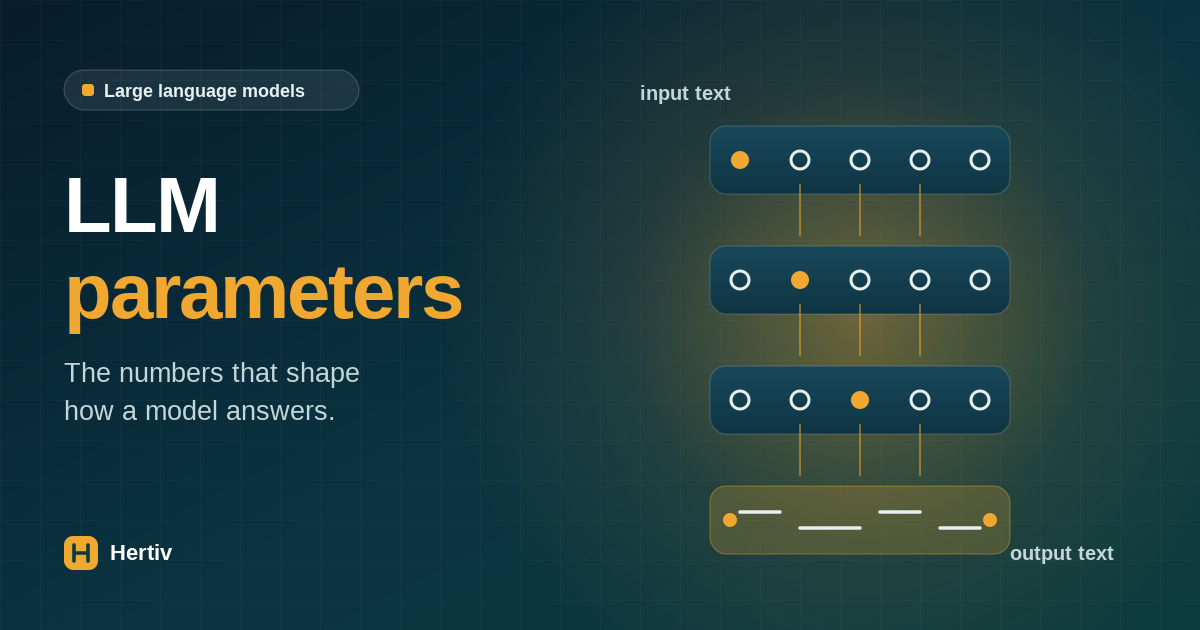
LLM parameters are the adjustable numbers inside a large language model, learned during training, that decide how it turns input text into output text. A model with more parameters can hold more patterns from its training data, which is why parameter count is often quoted as a rough measure of a model's size and capability.
What are LLM parameters?
LLM parameters are the weights a language model learns during training. Each parameter is a single number, and together they shape how the model responds: which words are likely next, which facts it recalls, and how it follows instructions. When a model is described as having 8 billion parameters, that means 8 billion such numbers were set during training.
Parameters are not facts stored in a list. They are patterns the model found in its training text: grammar, common phrases, reasoning steps, and associations between ideas. A larger count lets the model hold more of these patterns at once, which is why bigger models usually handle harder tasks better.
| Model | Parameters | What it is known for |
|---|---|---|
| Llama 3 8B | 8 billion | Small model that runs on one machine |
| Llama 3 70B | 70 billion | Strong general model, needs several GPUs |
| GPT-3 | 175 billion | Early large model that showed scale works |
| Mistral 7B | 7 billion | Small model with strong results for its size |
Parameter counts are public for open models such as Llama 3 and Mistral. For closed models, vendors often do not publish the number, so you judge them by measured results instead. If you are new to how these models work, what machine learning is explains the basic idea first.
How are parameters learned during training?
Parameters are learned by showing the model huge amounts of text and adjusting the numbers so its predictions get better. The model reads a passage, guesses the next word, compares its guess with the real text, and nudges each parameter a little in the direction that would have made the guess right. Repeated billions of times, those small nudges add up to a model that writes fluent text.
Training happens in passes over the data, and the order matters: early passes teach grammar and common patterns, later passes sharpen the details. The training data itself matters as much as the count. A model trained on clean, varied text will outperform a bigger model trained on noisy or narrow text.
Once training finishes, the parameters are frozen. The model does not keep learning from your prompts in normal use; what you type changes its short-term context, not its weights. Changing the weights again is what fine-tuning does, and it is a separate step.
What does parameter count tell you, and what does it not?
Parameter count tells you roughly how much the model can hold and how much computing it needs to run. It does not tell you whether the model is good at your task. A 70-billion-parameter model trained on general text can lose to an 8-billion-parameter model that was fine-tuned on your documents, because the smaller model knows your domain and the bigger one does not.
Count also says nothing about data quality, instruction following, or safety behaviour. Two models with the same count can behave very differently if one was trained on carefully chosen data and the other on whatever was easiest to collect. Benchmarks and a test on your own data are better guides than the number alone.
A useful rule: treat parameter count as a starting filter, not a decision. Shortlist two or three sizes, then test each on real examples from your work and pick the smallest one that passes. The LLM development guide covers how to run that comparison.
How do parameters affect cost and speed?
More parameters mean more memory and more computing per answer. A common rule of thumb is that each parameter needs about two bytes of memory when the model runs, so an 8-billion-parameter model needs roughly 16 GB and a 70-billion-parameter model needs roughly 140 GB. That is why small models run on one machine and large ones need several graphics cards.
Speed follows the same pattern. A small model answers faster and costs less per request, which matters when you serve thousands of users. A large model answers more slowly and costs more, so it only earns its place when the task actually needs its extra ability.
| Model size | Memory, roughly | Speed | Best for |
|---|---|---|---|
| Under 10 billion | Under 25 GB | Fast | Chat, classification, simple drafting |
| 10 to 70 billion | 25 to 150 GB | Medium | Harder reasoning, long documents |
| Over 70 billion | Over 150 GB | Slower | Top capability where cost is secondary |
Most production systems mix sizes: a small model handles the routine cases and a large one takes the hard ones. That split keeps costs down without giving up quality where it counts.
What changes when you fine-tune a model?
Fine-tuning changes a small part of a model's parameters using your own examples. Instead of retraining billions of numbers from scratch, you show the model a few hundred or thousand examples of the behaviour you want, and it adjusts the weights that matter most for those examples. The rest of the model stays as it was.
This works well for tone, format and domain knowledge: support answers that cite your help centre, summaries in your house style, or classification into your own categories. It works badly when the model lacks the underlying knowledge, because fine-tuning teaches behaviour, not new facts. For that, retrieval over your own documents is the better tool.
Fine-tuning also costs less than most teams expect and more than the training run itself suggests, because you need an evaluation set to prove the tuned model is actually better. Build that set first, tune second. LLM fine-tuning explains the process in more detail.
Example (hypothetical): picking a model size for a support team
Example (hypothetical): a support team handles 10,000 customer messages a month. Each message averages 400 tokens of text, so the team processes about 4,000,000 tokens a month in total. The team wants a model to draft replies that agents then check.
They test two sizes. The 8-billion-parameter model drafts 8,000 of the 10,000 messages well enough for agents to send after a quick check, and the remaining 2,000 go to the 70-billion-parameter model. That split means 3,200,000 tokens run on the small model and 800,000 on the large one, so most of the work runs fast and cheap while the hard cases still get the stronger model.
The lesson is to route by difficulty, not by habit. If they had sent all 4,000,000 tokens to the large model, the bill and the wait would both have been higher for no better result on the easy 8,000 messages.
What are the common mistakes?
The most common mistakes are choosing by parameter count alone, skipping the test on your own data, and fine-tuning before trying retrieval. Each one wastes time or money that a short evaluation would have saved.
- Picking the biggest model by default. A large model is slower and pricier; test whether a smaller one passes first.
- Judging by benchmarks only. Vendor benchmarks rarely match your documents or your tasks.
- Fine-tuning before retrieval. If the model needs your facts, give it your documents first.
- Ignoring memory needs. A model that does not fit your hardware cannot run at all.
- Forgetting the evaluation set. Without fixed test cases, you cannot tell whether a change helped.
Key takeaways
- Parameters are the learned numbers that shape how a model responds
- More parameters usually mean more capability, but training data matters as much
- A small fine-tuned model can beat a big general model on your task
- Each parameter needs about two bytes of memory when the model runs
- Test on your own data and pick the smallest model that passes
Frequently asked questions
How many parameters does a typical LLM have?
Small open models have around 7 to 8 billion parameters, mid-size models around 70 billion, and the largest public models around 175 billion or more. Closed vendors often do not publish the number, so you judge those models by measured results on your own tasks instead.
Do more parameters always mean a better model?
No. More parameters usually help, but training data quality, the amount of training, and fine-tuning matter just as much. A well-trained 8-billion-parameter model can outperform a poorly trained 70-billion-parameter model, and a fine-tuned small model often wins on narrow tasks.
What is the difference between parameters and tokens?
Parameters are the model's learned numbers, fixed after training. Tokens are the pieces of text the model reads and writes, such as words or parts of words. A prompt of 400 tokens is the input; the parameters decide how the model responds to it.
Can parameters change after training?
Yes, through fine-tuning, which adjusts a small part of the parameters using your own examples. Normal use does not change them: your prompts affect the short-term context only. Full retraining from scratch is a much bigger job and is rarely needed.
How much memory does an LLM need to run?
A common rule of thumb is about two bytes per parameter, so an 8-billion-parameter model needs roughly 16 GB and a 70-billion-parameter model needs roughly 140 GB. The exact figure depends on the precision used, but the rule is close enough for planning hardware.
Should I fine-tune or use retrieval?
Use retrieval first when the model needs your facts, because it is cheaper and easier to update. Fine-tune when you need consistent tone, format or behaviour across many outputs. Many production systems use both: retrieval for facts and fine-tuning for style.


