What Does LLM Development Cost?
A custom language model can cost a few thousand dollars or several million, depending on the route. Here is what drives the bill, from data work to hosting.
On this page
Short answer
LLM development cost is the total spend to design, train or adapt, test and run a language model, and it ranges from a few thousand dollars for a small fine-tune to millions for a model trained from scratch. The biggest drivers are the route, the model size, the data work, and the cost of running it afterwards.
What is LLM development cost?
LLM development cost is the total spend to design, train or adapt, test and run a language model, from the first data work to the monthly hosting bill. It ranges from a few thousand dollars for a small fine-tune to millions for a model trained from scratch.
The number surprises most teams because the training run is rarely the biggest line. Data preparation, evaluation, safety checks and hosting usually cost more over the first year than the training itself. A model that is cheap to train but expensive to run can cost more in six months than a pricier build that runs lean.
There is no single price because there is no single kind of LLM project. Adapting an existing model for customer support is a different job from training a model on a company's own documents, and both are different from calling a hosted model through an API. The route you pick decides most of the cost.
What drives the cost?
Five factors drive almost all of the cost, and they pull in different directions. A bigger model costs more to train and to run, while better data costs more up front but often means a smaller model is enough.
| Cost driver | What it covers | How it scales |
|---|---|---|
| Route | API, fine-tune or train from scratch | Training from scratch is the most expensive |
| Model size | Number of parameters | Cost rises with size, for training and hosting |
| Data work | Collecting, cleaning, labelling data | Grows with data volume and quality needs |
| Team | Engineers, data staff, reviewers | Months of specialist time |
| Hosting | GPUs, storage, monitoring | Monthly, and it never stops |
Data work is the line teams most often underestimate. Raw documents need cleaning, duplicates need removing, and sensitive details need taking out before training. For a support model, that can mean reading thousands of old tickets and deciding which answers were actually good.
Evaluation is another quiet cost. A model needs test sets, human reviewers and repeated checks before it can answer customers, and those checks continue after launch. A team that skips evaluation usually finds the problems in production, where they cost far more to fix.
Which route fits your budget?
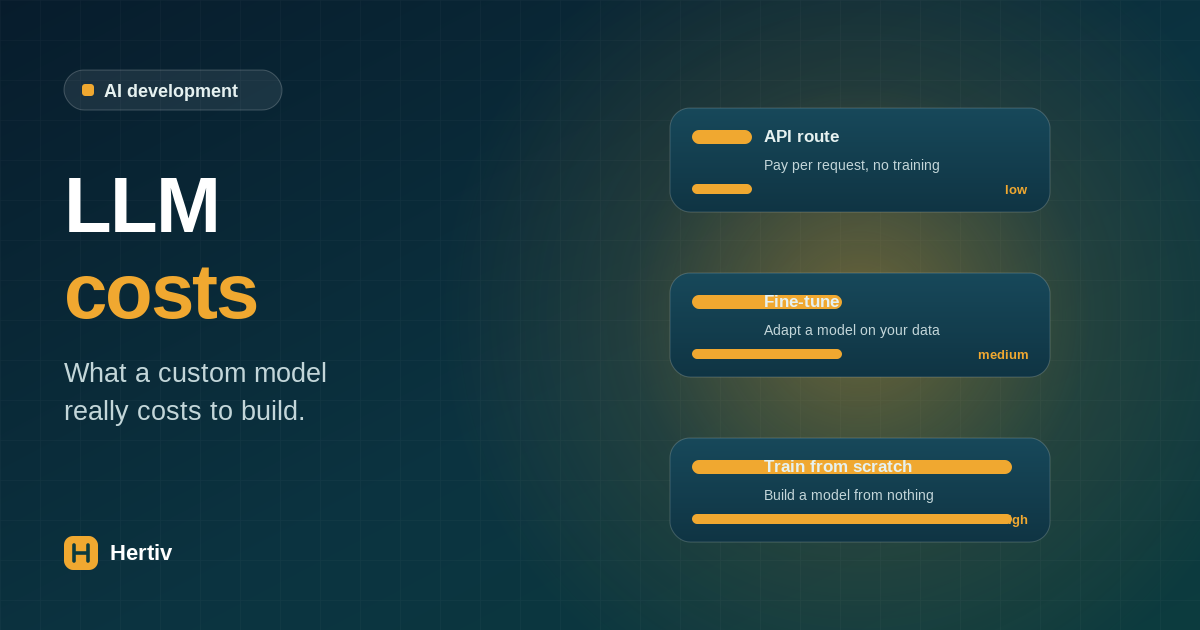
There are three routes, and the choice is the single biggest cost decision. Calling a hosted model through an API is the cheapest way to start, fine-tuning an open model sits in the middle, and training from scratch is the most expensive by a wide margin.
The API route means no training at all: you send prompts to a provider's model and pay per use. It is the right choice when the task is common, the data is not sensitive, and you need something working in weeks. The trade-off is that you pay for every request forever, and you cannot change how the model behaves beyond the prompt.
Fine-tuning takes an existing open model and trains it further on your data, so it learns your tone, your products and your edge cases. It suits teams with a clear task, a few thousand good examples and data they cannot send to a provider. The bill is mostly data work and a short training run, not months of compute.
Training from scratch means building a model on your own data from nothing. Almost no company needs this, and the ones that do are usually model providers themselves. If a vendor tells you that you need a model trained from scratch, ask what a fine-tune would miss, and ask for the answer in writing.
What does the team and timeline look like?
A fine-tuning project usually needs a small team for two to three months: one machine learning engineer, one data engineer and a domain expert who can judge whether the model's answers are right. A training-from-scratch project needs a much larger team for a year or more.
The timeline has four phases. Data work comes first and takes the longest, often half the project. Training is the shortest phase for a fine-tune, sometimes just a few days of compute. Evaluation and safety checks follow, and deployment comes last, with monitoring and a plan for retraining.
The domain expert is the role teams forget to budget for. A support model needs someone who knows which answers are correct, and a legal model needs a lawyer to review outputs. Without that person, the engineers are guessing, and the model learns the guesses.
Teams that want a quick proof of concept often start with the API route and a small test set, then decide whether fine-tuning is worth it. That path is covered in our guide to how to build an AI proof of concept, and it keeps the early spend small while the value is still unproven.
What does it cost to run the model afterwards?
Running a model is a monthly cost that never stops, and it is easy to underestimate. The bill covers GPU time, storage, monitoring and the staff time to watch quality and retrain when answers drift.
A fine-tuned model usually runs on one or two GPUs, and the cost depends on how many requests it handles and how fast it must answer. A model that answers in seconds costs more than one that can answer in minutes, because it needs dedicated capacity instead of sharing it.
Self-hosting gives control over data and cost, but it means your team owns uptime, scaling and security. Using a hosted service moves that work to the provider, at a higher per-request price. The right choice depends on request volume: low volume favours hosting, high volume favours self-hosting, and the crossover is worth calculating before you commit.
Our guide to self-hosting LLM costs breaks down the hardware, storage and staffing lines in detail, which helps when the hosting quote arrives and you need to check what it actually includes.
Example (hypothetical): a fine-tuned support model
Example (hypothetical): a company wants a support model fine-tuned on its own help articles and 50,000 old support tickets, so it can draft replies for agents. The plan is a six-week project.
The arithmetic is straightforward. Data preparation takes 120 hours at $60 an hour, which is $7,200. The fine-tuning run uses 8 GPUs for 40 hours at $3 per GPU-hour, which is $960. Evaluation takes 40 hours of reviewer time at $60 an hour, which is $2,400. The total build cost is $10,560.
Hosting adds $800 a month for one GPU and storage. Over the first year, the project costs $10,560 plus $9,600 of hosting, or $20,160 in total. That is far less than a training-from-scratch project, and it is the reason most teams choose fine-tuning.
The numbers also show where the money really goes: data and evaluation cost $9,600, while the training run itself costs $960. A team that budgets only for compute will run out of money long before the model is ready to use.
What are the common mistakes?
The most common mistake is choosing the route before understanding the task. Teams that train a model from scratch for a job a hosted API could do waste months and most of their budget. Start with the cheapest route that can answer the task, and move up only when it fails.
The second mistake is budgeting for training and forgetting hosting. A model that costs $10,000 to build and $2,000 a month to run costs $34,000 in its first year, not $10,000. The hosting line should be in the first budget, not discovered in month three.
The third mistake is skipping evaluation. A model that was never tested on real questions will give confident wrong answers to customers, and the damage to trust costs more than the evaluation would have. Every release needs a test set and a human reviewer.
Finally, many teams train on data they have not cleaned. Duplicates, outdated answers and sensitive details in the training data come back as model behaviour, and they are hard to remove afterwards. Cleaning data is slow work, but it is cheaper than retraining.
Key takeaways
- Fine-tuning is the cheapest serious route for most teams; training from scratch is rarely needed.
- Data work and evaluation usually cost more than the training run itself.
- Budget hosting from day one: it is a monthly cost that never stops.
- Start with the cheapest route that can answer the task, then move up only if it fails.
- Every release needs a test set and a human reviewer before it reaches customers.
Frequently asked questions
How much does it cost to fine-tune an LLM?
A small fine-tune usually costs a few thousand dollars for data work and a short training run, plus monthly hosting. The exact number depends on data volume and model size, but most small projects land between $5,000 and $50,000 for the first build.
Is it cheaper to use an API or host my own model?
An API is cheaper at low volume because you pay per request and own no hardware. Self-hosting becomes cheaper at high volume, when the fixed GPU cost is less than the per-request fees. Work out the crossover volume before you choose.
What is the most expensive part of LLM development?
Data preparation and evaluation are usually the most expensive parts, because they take weeks of human time. The training run itself is often the smallest line, especially for a fine-tune that runs for a few days.
Do I need a team of specialists to build an LLM?
A fine-tune needs one machine learning engineer, one data engineer and a domain expert who can judge answer quality. Training from scratch needs a much larger team, which is one more reason most companies avoid it.
How long does an LLM project take?
A fine-tune with clean data takes two to three months from data work to launch. Data preparation is usually the longest phase, taking about half the project, while the training run itself can take only a few days.
Can I build an LLM without any training?
Yes, by calling a hosted model through an API and shaping its behaviour with prompts. That route needs no training, no GPUs and no data work, and it is the right start when the task is common and the data is not sensitive.


