LLM as a Judge: How It Works and When to Trust It
LLM as a judge means using a model to score other models' answers. It is fast and cheap at scale, but only trustworthy when calibrated against human scores.
On this page
Short answer
LLM as a judge is the practice of using a large language model to score or compare the outputs of another model, usually against a written rubric. It works well for ranking drafts, checking style and format, and catching obvious failures at scale, but it needs calibration against human scores and it cannot replace human review for high-stakes or factual judgements.
What is LLM as a judge?
LLM as a judge is the practice of using a large language model to evaluate the outputs of another model, instead of a person reading every answer. You give the judge model the question, the answer to score, and a rubric that says what good looks like, and it returns a score or a ranking.
Teams use it when human review cannot keep up: thousands of generated answers, daily model updates, or A/B tests between two prompts. A person might review 50 answers in an hour; a judge model can score thousands in the same time, at a fraction of the cost.
It is one evaluation method among several. Public benchmarks test a model on fixed questions, and human review tests it on real cases; a judge model sits between them, giving fast, repeatable scores on your own data. How it fits with other methods is covered in LLM model evaluation.
How does judge scoring work?
Judge scoring works by turning the evaluation into a task the model can do well: read an answer and score it against clear criteria. The judge is given the original question, the answer, and a rubric with a scale, for example 1 to 5 for helpfulness, accuracy and tone.
| Judge method | What it returns | Best for | Weak point |
|---|---|---|---|
| Single score | One number per answer | Tracking quality over time | Scores drift between runs |
| Pairwise comparison | Which of two answers is better | Choosing between prompts | Twice the cost per test |
| Rubric checklist | Pass or fail per criterion | Format and policy checks | Needs a precise rubric |
| Reference grading | Match to a known good answer | Factual and extraction tasks | Needs good references |
Pairwise comparison is usually the most reliable: asking which of two answers is better is easier for a model than giving an absolute score, and it avoids the problem of scores drifting between runs. The trade-off is cost, since each comparison needs two answers judged.
Where does a judge fit, and where does it not?
A judge fits where the criteria are clear and the cost of a wrong score is low. It works well for ranking drafts, checking tone and format, spotting answers that ignore the instructions, and comparing two prompts on the same test set.
It does not fit where the judgement needs real-world knowledge or high stakes. A judge model cannot verify a medical claim, a legal citation or a financial figure unless it is given the source to check against, and it should never be the only check on answers that reach customers with legal or safety consequences.
Use human review for the cases that matter most: a sample of the judge's scores, every answer in a sensitive category, and any test where the judge and the human disagree. The judge handles volume; people handle judgement. For the wider evaluation picture, see what is LLM evaluation.
How do you calibrate and validate a judge?
Calibrate the judge before trusting its scores. Take a set of answers that people have already scored, run the judge on the same set, and compare. If the judge agrees with people on most cases, it is usable for that task; if it disagrees often, the rubric or the judge needs work.
Measure agreement, not just the average score. Two judges can give the same average while disagreeing on every individual answer. Check how often the judge and the human pick the same winner in pairwise tests, and look at the cases where they disagree to find the pattern.
Re-check the calibration when the judge model changes, the rubric changes, or the task changes. A judge calibrated on support answers is not automatically valid for legal drafting. Keep a fixed human-scored set and re-run it whenever something changes, so drift shows up before it affects decisions.
What can go wrong with a judge?
Several biases can distort a judge's scores, and they are easy to miss if the scores are never compared with human scores. The most common ones are consistent enough that teams should check for them explicitly.
- Verbosity bias. Judges often prefer longer answers, even when the extra words add nothing.
- Position bias. In pairwise tests, the answer shown first wins more often, so swap the order and average the result.
- Self-preference. A judge may favour answers written in the style of its own model family.
- Style over substance. A confident, well-formatted answer can score higher than a correct but plain one.
- Rubric drift. A vague rubric lets the judge invent its own criteria, so scores vary between runs.
The fix for most of these is the same: a precise rubric, pairwise comparison with swapped order, and regular checks against human scores. If the judge's scores cannot be reproduced, they cannot be trusted.
How do you set up a judge in practice?
Set up a judge in steps, starting small and checking against human scores at each step.
- Define the rubric. Write down what good looks like for this task, with a scale and examples of each level.
- Build a test set. Collect real questions and answers, including the hard cases, not just the easy ones.
- Get human scores. Have people score a sample of the test set first, so the judge has something to be measured against.
- Run the judge. Score the same set with the judge model and compare agreement with the human scores.
- Fix the gaps. If agreement is low, tighten the rubric, add examples, or switch the judge method before trusting the scores.
Keep the judge model separate from the model being tested where possible, and log every prompt, rubric version and score so a result can be reproduced later. If the evaluation sits inside a wider governance effort, AI governance covers the controls that belong around it.
Example: judging 200 support drafts
Example (hypothetical): a support team wants to compare two prompts for drafting replies. They collect 200 real customer questions and generate a draft answer with each prompt, giving 400 drafts in total. A judge model scores each draft on a 1 to 5 scale for helpfulness and correctness.
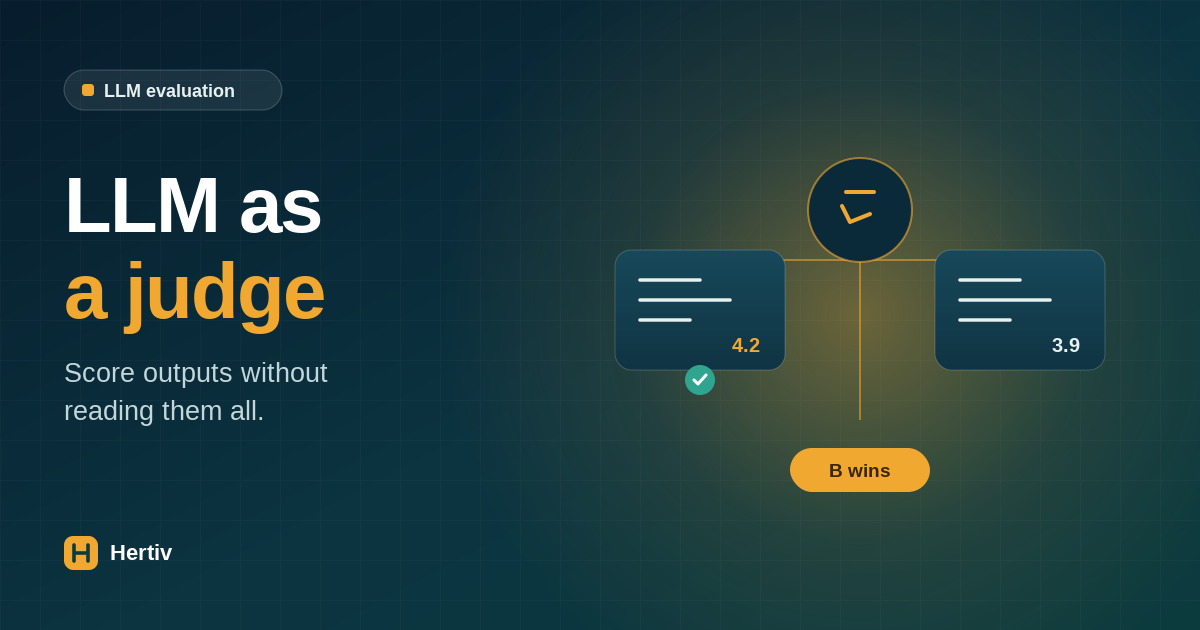
The judge scores prompt A at an average of 3.9 and prompt B at 4.2, so the team checks the result against human scores. Three reviewers score a sample of 60 drafts, and they agree with the judge on 49 of them, which is about 82% agreement. That is good enough to trust the ranking, but not good enough to trust individual scores.
Looking at the 11 disagreements, the team finds the judge marked 8 drafts as correct that humans marked wrong, because the drafts quoted a policy that had changed. The fix is to give the judge the current policy text with each question, and to keep human review for any draft the judge scores below 3. The judge handles the volume; people handle the cases that matter.
What are the common mistakes?
The most common LLM-as-a-judge mistakes are trusting uncalibrated scores, using the same model to write and judge, and letting the rubric stay vague.
- No calibration. Scores that were never compared with human scores are guesses, not measurements.
- Same model writes and judges. The judge favours its own style, so the test is rigged from the start.
- Vague rubric. Without a precise rubric, the judge invents criteria and scores drift between runs.
- Judging facts without sources. A judge cannot verify claims unless it is given the source to check.
- Ignoring disagreement. The cases where judge and human disagree are the most useful ones, and skipping them hides the judge's weak points.
Key takeaways
- A judge model scores outputs against a written rubric, at a speed humans cannot match
- Pairwise comparison is usually more reliable than a single absolute score
- Calibrate against human scores before trusting the judge on any task
- Check for verbosity, position and self-preference bias
- Keep human review for high-stakes answers and for the cases where judge and human disagree
Frequently asked questions
What is LLM as a judge?
LLM as a judge is the practice of using a large language model to score or compare the outputs of another model. The judge is given the question, the answer and a rubric defining good, and it returns a score or a ranking. It is used when human review cannot keep up with the volume of answers to check.
Is LLM as a judge reliable?
It is reliable for ranking and for clear-cut criteria once it has been calibrated against human scores on the same task. It is less reliable for absolute scores, for factual claims without a source to check, and for high-stakes judgements. Always measure agreement with human scores before trusting it.
What is the difference between LLM as a judge and LLM evaluation?
LLM evaluation is the wider practice of testing a model, including benchmarks, test sets and human review. LLM as a judge is one method inside it: using a model to do the scoring. A judge is a tool for evaluation, not a replacement for the whole evaluation process.
Can the same model judge its own outputs?
It can, but the results are biased: a judge tends to favour answers in its own style, so the test is not fair. Use a different model as the judge where possible, and always check the scores against human scores on a sample.
How do you write a good rubric for a judge?
Write down the criteria that matter for the task, with a scale and an example of each level. Keep each criterion concrete, such as whether the answer cites the right policy, rather than vague, such as whether it is good. Test the rubric on a small set and tighten it where the judge and humans disagree.
When should you not use LLM as a judge?
Do not use it as the only check for answers with legal, medical or financial consequences, for factual claims where no source is given to the judge, or for tasks where the criteria cannot be written down clearly. In those cases, human review is the right method.


