LlamaIndex Competitors: 8 RAG Frameworks Compared
LlamaIndex competitors worth comparing: LangChain, Haystack, LangGraph, Semantic Kernel, Dify, Flowise, RAGFlow and Embedchain, with what each is best for.
On this page
Short answer
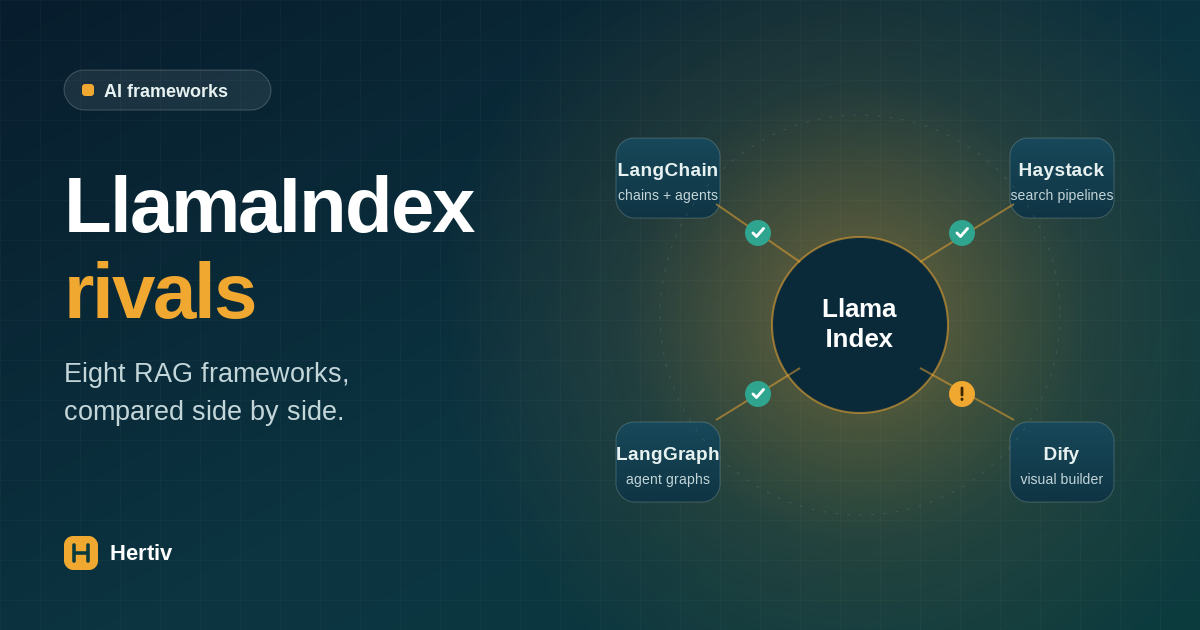
The LlamaIndex competitors worth comparing are LangChain, Haystack, LangGraph, Semantic Kernel, Dify, Flowise, RAGFlow and Embedchain. LlamaIndex is built for retrieval over your own documents, so the right alternative depends on whether you need agents, a visual builder, a managed platform or a self-hosted pipeline.
Which LlamaIndex competitors are worth comparing?
The LlamaIndex competitors worth comparing are the ones that also turn your documents into answers a model can use: LangChain, Haystack, LangGraph, Semantic Kernel, Dify, Flowise, RAGFlow and Embedchain. LlamaIndex is strong at indexing and retrieval, so a rival only makes sense if it does something LlamaIndex does not do well for your team.
Use the table to shortlist, then read the sections below for the trade-offs. Each entry lists what the tool is best for and what to watch out for.
| Framework | Best for | Open or hosted | Starting point |
|---|---|---|---|
| LangChain | General LLM apps and chains | Open source | Python or TypeScript |
| Haystack | Search-first RAG pipelines | Open source | Python pipelines |
| LangGraph | Multi-step agents with state | Open source | Graph of steps |
| Semantic Kernel | .NET and enterprise apps | Open source | C# or Python SDK |
| Dify | Managed no-code AI apps | Hosted or self-hosted | Visual builder |
| Flowise | Visual LLM flows | Open source | Drag-and-drop canvas |
| RAGFlow | Document-heavy RAG | Open source | Deep document parsing |
| Embedchain | Small bots over your data | Open source | Few lines of code |
Pick one row to test against your own documents. A framework that looks good in a demo can still fail on your PDFs, your table layouts or your permission rules.
LangChain and Haystack
1. LangChain: best for general LLM apps and chains
LangChain is the most widely used framework for chaining model calls, tools and memory into an application. It covers retrieval, agents, prompt templates and integrations with most vector stores and model providers, so a team that outgrows a pure retrieval setup rarely needs to leave it.
Its breadth is also its cost: the API surface is large, and a simple retrieval app can feel heavier than the same app in LlamaIndex. Teams that only need document question-answering often find LlamaIndex simpler to read and maintain.
Pros
- Widest set of integrations and examples
- Covers agents, memory and tools in one place
- Large community and hiring pool
Cons
- Large API surface to learn
- Simple RAG apps can feel overbuilt
- Frequent releases need version pinning
2. Haystack: best for search-first RAG pipelines
Haystack is built around search pipelines: document stores, retrievers, rankers and readers composed into a clear flow. If your product is a search box over technical documents, Haystack's pipeline model maps to the problem directly, and its evaluation tools help you measure retrieval quality before you tune prompts.
Compared with LlamaIndex, Haystack gives you more control over the retrieval stage and less help with indexing tricks such as hierarchies and summaries. Choose it when ranking quality matters more than index variety.
Pros
- Clear pipeline model for retrieval
- Strong evaluation tooling
- Good for search-heavy products
Cons
- Less help with index design
- Smaller community than LangChain
- Agent support is thinner
LangGraph and Semantic Kernel
3. LangGraph: best for multi-step agents with state
LangGraph models an agent as a graph of steps with explicit state, loops and human approval points. That fits work where the agent must plan, call tools, check results and retry, such as research tasks or multi-document drafting, where a straight chain would hide the control flow.
It is a step up in complexity from LlamaIndex. Use it when your retrieval app has grown into an agent with branches and retries, not when you only need to answer questions over documents. A comparison of LlamaIndex and LangChain shows where the two families split.
Pros
- Explicit state, loops and approval gates
- Good for multi-step agent work
- Shares the LangChain ecosystem
Cons
- More to learn than a simple chain
- Overkill for plain document Q&A
- Debugging a graph takes practice
4. Semantic Kernel: best for .NET and enterprise apps
Semantic Kernel is Microsoft's SDK for adding models, plugins and memory to applications, with first-class C# support alongside Python. Teams building on .NET or Azure find it fits their stack without a language switch, and its planner and plugin model maps well to enterprise systems with existing APIs.
For retrieval-heavy work it is thinner than LlamaIndex: you write more of the indexing and chunking logic yourself. Pick it for stack fit and enterprise integration, not for the deepest retrieval toolkit.
Pros
- First-class C# and .NET support
- Plugin model fits enterprise APIs
- Backed by Microsoft
Cons
- Less retrieval depth than LlamaIndex
- Smaller open-source community
- Docs assume Azure familiarity
Dify and Flowise
5. Dify: best for managed no-code AI apps
Dify is a platform for building AI apps in a visual builder, with hosted or self-hosted deployment, built-in knowledge bases and workflow orchestration. It suits teams that want a working assistant without writing a framework app, and product teams that want non-engineers to edit prompts and flows.
The trade-off is control: when you need custom retrieval logic, unusual chunking or deep integration with internal systems, a code framework gives you more room. Dify is the fastest route to a working demo; LlamaIndex is the more flexible route to a custom product.
Pros
- Visual builder, fast to first demo
- Hosted or self-hosted
- Non-engineers can edit flows
Cons
- Less control over retrieval detail
- Custom logic needs workarounds
- Managed pricing grows with use; see vendor site
6. Flowise: best for visual LLM flows
Flowise lets you build LLM chains and agents by dragging nodes onto a canvas, then exposes the result as an API or embeddable chat. It is a good fit for prototypes and for small teams that want to show a working flow before committing to code.
For production retrieval over large document sets, the visual approach gets harder to version, test and review than code. Treat Flowise as a prototyping and demo tool, and move to a code framework when the flow becomes a product.
Pros
- Fast visual prototyping
- Easy to demo to stakeholders
- Open source and self-hostable
Cons
- Hard to version and test at scale
- Thin retrieval tooling
- Needs code for serious production use
RAGFlow and Embedchain
7. RAGFlow: best for document-heavy RAG
RAGFlow focuses on document understanding: it parses PDFs, tables and scanned pages with layout awareness, then builds retrieval on top. If your documents are contracts, reports or forms where tables and structure carry the meaning, its parsing depth is the feature that matters most.
It is narrower than LlamaIndex outside document parsing, and its agent and tooling support is lighter. Choose it when document quality is the bottleneck, not when you need a general agent framework. A look at open-source LlamaIndex alternatives covers more self-hosted options.
Pros
- Deep, layout-aware document parsing
- Handles tables and scanned pages
- Open source and self-hostable
Cons
- Narrower outside document parsing
- Lighter agent support
- Smaller community
8. Embedchain: best for small bots over your data
Embedchain is a small library for turning a folder of files, a website or a database into a chatbot with a few lines of code. It suits a first experiment or an internal bot where the data set is small and the team wants results in an afternoon.
It is not a platform for a production product: there is little help with evaluation, permissions, chunking strategy or scaling. Use it to test whether retrieval helps at all, then move to LlamaIndex or Haystack when the bot becomes a product.
Pros
- Fastest route to a first bot
- Tiny API to learn
- Good for experiments
Cons
- Thin evaluation and scaling support
- Little help with permissions
- Not built for production products
How to choose a LlamaIndex competitor
Choose by the job, not by the brand. Start from what your product must do with your documents, then check each framework against that list.
- Write down the job: document Q&A, search, an agent, or a managed app for non-engineers.
- Test two finalists on the same 20 real questions from your own documents, with the same model.
- Score retrieval quality first, before prompt quality: if the wrong chunks arrive, no prompt fixes it.
- Check the hard constraints: language, hosting, permissions, and whether the framework fits your stack.
- Pick the one whose code your team can read and debug in six months, then commit to it.
Example (hypothetical): a support team tests LlamaIndex and Haystack on 20 past tickets. LlamaIndex answers 14 well and Haystack answers 15, but the team already runs Python services and finds Haystack's pipeline easier to debug, so they pick Haystack. The one-answer gap mattered less than the debugging cost over a year. A guide to building a domain-specific LLM covers the evaluation step in more depth.
Common mistakes when switching RAG frameworks
Most switches fail for the same reasons: the team compares demos instead of their own documents, and treats the framework as the fix for a data problem.
- Judging on a vendor demo instead of your own documents and questions
- Switching frameworks when the real problem is dirty or duplicated source documents
- Comparing frameworks with different models, chunk sizes or prompts, so the test measures the setup, not the framework
- Picking an agent framework for a plain retrieval job, and paying the complexity cost every week
- Ignoring permissions: retrieval that ignores document access rules leaks content to the wrong people
- Skipping evaluation, so nobody can tell whether the switch helped or hurt
The framework is the smallest part of a working RAG product. Clean documents, a fixed evaluation set and clear permission rules matter more than which of these eight you pick. If you want help choosing, RAG development covers the design and evaluation work.
Key takeaways
- LlamaIndex is strongest at retrieval; rivals win on agents, visual building or search pipelines.
- LangChain is the broadest choice, Haystack the most search-focused, LangGraph the most agentic.
- Dify and Flowise are fastest to a demo; code frameworks are easier to maintain in production.
- Test two finalists on the same 20 real questions before committing.
- Clean documents and an evaluation set matter more than the framework you pick.
Frequently asked questions
What is the closest LlamaIndex competitor?
LangChain is the closest general competitor, with the widest integrations and agent support. Haystack is closer if your product is search-first, and LangGraph is closer if you need multi-step agents with explicit state.
Is LangChain better than LlamaIndex?
Neither is better in general. LangChain covers more kinds of LLM apps, while LlamaIndex goes deeper on indexing and retrieval. Pick LangChain for breadth and agents, LlamaIndex for document retrieval depth.
Can I use LlamaIndex with LangChain together?
Yes, teams often combine them: LlamaIndex for retrieval and LangChain or LangGraph for agents and tool use. The two are libraries, not platforms, so mixing them is normal when each does one job well.
Which LlamaIndex competitor is best for .NET teams?
Semantic Kernel is the natural fit for .NET teams, with first-class C# support and a plugin model for enterprise APIs. LlamaIndex and LangChain are Python-first, so a .NET team would pay a stack cost to adopt them.
Do I need a framework at all for a small RAG bot?
For a small experiment, a tiny library such as Embedchain or a few direct calls to a vector store and a model are enough. A framework earns its place when the bot needs evaluation, permissions, scaling or agent behaviour.
How do I test RAG frameworks fairly?
Use the same model, the same documents and the same 20 real questions for each finalist, and score which answers are grounded in the retrieved text. Keep chunk size and prompts fixed, or the test measures your setup instead of the framework.


