Llama vs GPT: Which Model Fits Your Project?
Llama is Meta's open-weight family you run yourself, while GPT is OpenAI's hosted family you call through an API. It depends on control, cost and setup effort.
On this page
Short answer
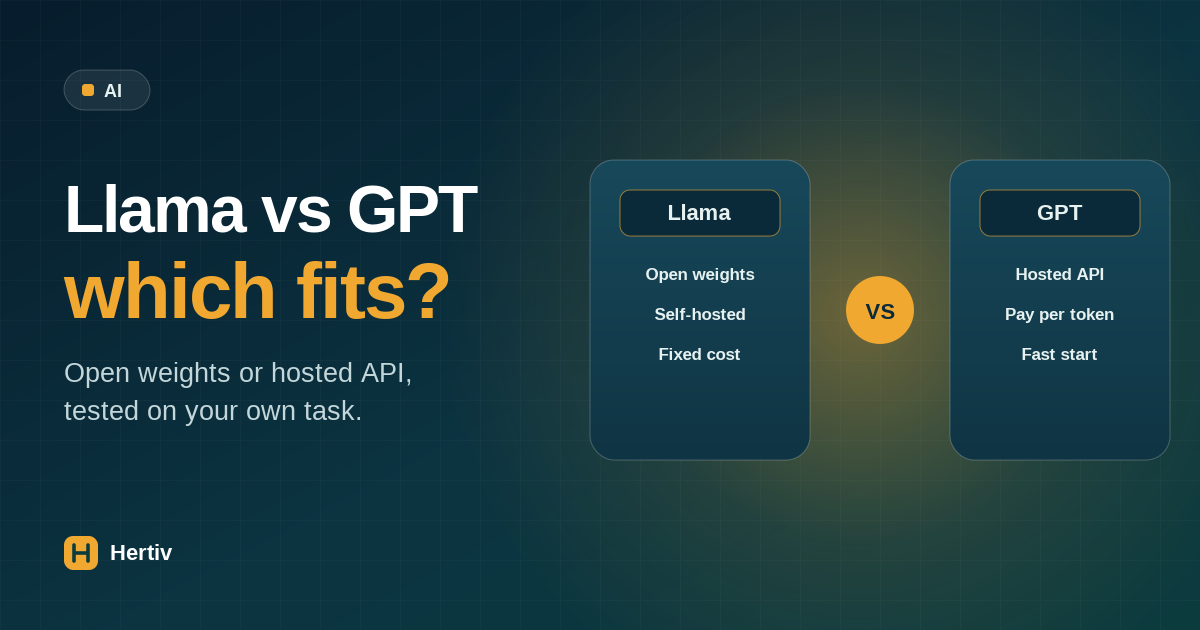
Llama is Meta's family of open-weight language models that a team can download and run on its own hardware, while GPT is OpenAI's family of hosted language models that a team calls through an API. The choice comes down to control, cost and how much infrastructure the team wants to run.
What are Llama and GPT?
Llama is Meta's family of open-weight language models that a team can download and run on its own hardware, while GPT is OpenAI's family of hosted language models that a team calls through an API. Both are general-purpose language models, but they are sold and run in different ways.
Llama models come in several sizes, from small models that run on a single server to large models that need a cluster. A team picks a size, hosts it, and controls the data, the prompts and the updates. GPT models run on OpenAI's infrastructure, so a team sends text to the API and gets text back, without running any model itself.
The comparison below covers the differences that matter for a build decision:
| Factor | Llama | GPT |
|---|---|---|
| How you run it | Download weights, host yourself | Call the OpenAI API |
| Data control | Data stays on your servers | Data goes to OpenAI, per its terms |
| Customisation | Fine-tune the weights freely | Fine-tuning is limited to what the API offers |
| Setup effort | High: servers, drivers, serving stack | Low: an API key and a client |
| Cost shape | Fixed server costs, no per-token bill | Pay per token used |
| Updates | You choose when to change model | OpenAI updates models on its schedule |
Neither model is better in general. The right one depends on the workload, the data rules and the team's appetite for running infrastructure. For teams weighing the options, LLM development covers the build and hosting choices.
How do Llama and GPT differ in practice?
In practice, the difference shows up in three places: where the data goes, who controls the model, and how the bill arrives. Llama keeps data on the team's own servers, lets the team change the weights, and costs a fixed amount for hardware. GPT sends data to an API, limits changes to what the API allows, and bills per token.
Quality also differs by task, but not in a fixed way. GPT models are usually stronger out of the box on general chat and reasoning, while a Llama model tuned on a team's own data can beat a general model on that team's narrow task. The only reliable way to know is to test both on the team's own examples.
Latency is another practical difference. A hosted API adds network time and shared capacity, while a self-hosted model runs close to the application but needs enough hardware to stay fast under load. A team that needs predictable latency should test both under real traffic, not on a single prompt.
The licence matters too. Llama weights come with a licence that limits some commercial uses, so a team should read it before building a product on top. GPT use is governed by the API terms, which the team accepts when it signs up.
When does Llama fit better?
Llama fits better when data must stay inside the team's own systems, when the team needs to fine-tune deeply, or when usage is high and steady enough that fixed server costs beat per-token billing.
Typical cases include internal tools that read company documents, products in regulated industries where data cannot leave the building, and high-volume tasks such as classifying thousands of messages a day. In these cases, the setup effort pays off because the team controls the data, the model and the cost.
Llama also fits when the team wants to avoid being tied to one vendor. The weights can move between servers and providers, so the team is not locked into a single API. That freedom has a price: the team owns the serving stack, the updates and the failures.
A team should pick Llama only if it has someone to run the infrastructure. Without that, the model sits idle while the team fights drivers and serving bugs. The self-hosting LLMs cost guide breaks down what that infrastructure actually costs.
When does GPT fit better?
GPT fits better when the team wants to ship fast, when usage is uneven, or when the task needs the strongest general model available without running any infrastructure.
Typical cases include a first proof of concept, a customer-facing chat feature, and tools that draft or summarise text where the team can review the output. The API is ready in minutes, and the team pays only for what it uses, so a small pilot costs little.
GPT also fits when the team needs features the API provides, such as built-in tools, structured output or managed fine-tuning. Building those on top of a self-hosted model takes time, and for a first version the API is usually the faster path.
The risk is dependence. Prices, limits and model versions change on the provider's schedule, so a team should keep its prompts and evaluation set portable. That way, switching models later is a test, not a rebuild. See the OpenAI vs Claude vs Gemini comparison for how the hosted options compare.
What about cost and hosting?
Cost depends on volume. A hosted API bills per token, so a small or spiky workload is cheap and a large steady workload gets expensive. A self-hosted model costs a fixed amount for servers, so a large steady workload can be cheaper once the servers are busy.
Example (hypothetical): a support team drafts replies for 1,000 tickets a day. Each ticket uses about 10,000 input tokens and 2,000 output tokens, so the day uses 10 million input tokens and 2 million output tokens. At assumed rates of 50 cents per million input tokens and 2 dollars per million output tokens, the day costs 5 dollars plus 4 dollars, which is 9 dollars a day, or about 270 dollars a month.
The same workload on a self-hosted Llama model needs a server that costs about 400 dollars a month at an assumed price, plus about 1,600 dollars of setup work at 80 dollars an hour for 20 hours.
The first month costs about 2,000 dollars, then about 400 dollars a month after that. The hosted API is cheaper for the first few months, and the self-hosted model wins only when volume stays high for a long time.
These are planning figures with assumed rates, not quotes. Check the vendor site for current API prices and server costs before budgeting. The LLM API cost calculator helps estimate the API side.
How do you choose?
Choose by testing both on the team's own task, not by reading benchmarks. A small evaluation set of real examples will show which model fits better than any general ranking.
- Write down the data rules. If data cannot leave your systems, the hosted option is out and the choice is made.
- Build a test set. Collect 50 to 100 real examples with known good answers.
- Test the hosted model first. It takes an afternoon and shows what good looks like.
- Test a self-hosted model on the same set. Compare quality, speed and cost on identical examples.
- Decide on total cost. Add setup, running and maintenance time, not just the token bill.
Keep the test set after the decision. It becomes the evaluation set for every later change, whether that is a new prompt, a new model version or a switch between hosted and self-hosted.
What are the common mistakes?
The most common mistakes when choosing between Llama and GPT are picking on benchmarks, ignoring the data rules, and underestimating the work of running a model.
- Choosing on benchmarks. Public benchmarks rarely match a team's own task, so test on real examples.
- Ignoring the data rules. Sending data to an API that should stay internal is a compliance problem, not a technical one.
- Underestimating hosting. Self-hosting needs drivers, serving, monitoring and updates, not just a download.
- Locking prompts to one model. Prompts tuned for one model may behave differently on another, so keep them portable.
- Skipping the evaluation set. Without one, every model change becomes a matter of opinion.
- Forgetting the licence. Open weights still have licence terms, so read them before shipping a product.
Key takeaways
- Llama is open-weight and self-hosted; GPT is hosted and called through an API
- Data rules decide first: if data cannot leave your systems, self-hosting wins
- GPT is faster to start and cheaper at low volume; Llama wins at high steady volume
- Test both on your own examples before choosing, not on public benchmarks
- Keep prompts and the evaluation set portable so switching models stays cheap
Frequently asked questions
Which is better, Llama or GPT?
Neither is better in general. GPT is usually stronger out of the box and faster to start, while Llama gives the team control over data, weights and cost. The right choice depends on the data rules, the volume and how much infrastructure the team wants to run.
Can I use Llama for free?
The model weights are available to download, but running them is not free: the team pays for servers, storage and the time to run them. Check the licence terms before building a commercial product, because some uses are limited.
Does GPT send my data to OpenAI?
Yes, API calls send the prompt and the context to OpenAI's servers. The terms describe how that data is handled, so a team with strict data rules should read them and check whether they fit before sending sensitive content.
Can I fine-tune both Llama and GPT?
Yes, but in different ways. Llama weights can be fine-tuned freely on the team's own hardware. GPT fine-tuning is done through the API with the options OpenAI provides, which is simpler but less flexible.
Which is cheaper for a small project?
A hosted API is usually cheaper for a small or uneven workload, because the team pays only for what it uses. Self-hosting needs a server whether it is busy or idle, so it only pays off when volume is high and steady.
Can I switch from GPT to Llama later?
Yes, if the prompts and the evaluation set are kept portable. A team that tests both on the same examples can switch without rebuilding the product, though prompts may need small changes to work well on the new model.


