Liquidity Pool Best Practices for Teams That Run One
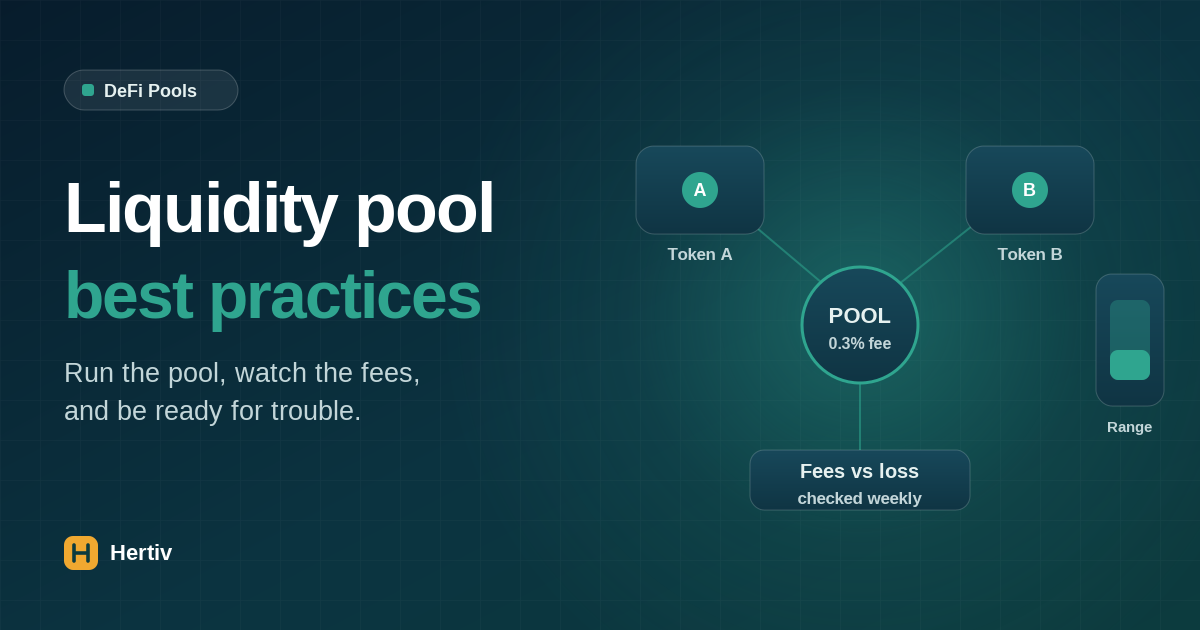
Running a liquidity pool well means choosing the right design, watching fees against losses, and having a plan for emergencies.
On this page
Short answer
Running a liquidity pool well means choosing the right pool design and fee tier, watching fee income against impermanent loss, and having a tested plan for emergencies. Teams that do this keep trading smooth and protect the funds they put in.
What does running a liquidity pool well mean?
Running a liquidity pool well means managing a live pool after it is deployed, not just building it. A liquidity pool is a smart contract that holds two tokens so traders can swap between them without a central exchange. The team that runs it must keep the pool funded, priced fairly and safe.
Three things decide whether a pool works. First, the pool design must fit the token pair: stable pairs need tight ranges, while volatile pairs need wide ones. Second, the fees earned must be worth the risk of impermanent loss. Third, the team must be ready for problems such as a price crash, a bug or a sudden drain of funds.
Good practice is mostly routine. The team checks the pool each day, tracks fees and losses, adjusts ranges when prices move and tests its emergency plan. A liquidity pool that is left alone after launch tends to drift into a bad range and earn less than the team expects.
Which pool design and fee tier fit your token?
Pool design and fee tier should match how the token pair behaves. A design that fits a stablecoin pair will fail for a new volatile token, and a fee tier that is too high will push traders to another pool.
| Pair type | Pool design | Fee tier | Why it fits |
|---|---|---|---|
| Stablecoin pair | Tight concentrated range | 0.01% to 0.05% | Prices barely move, so volume is high |
| Major token pair | Wide concentrated range | 0.05% to 0.3% | Steady volume with moderate moves |
| New volatile token | Full range | 0.3% to 1% | Price swings are large and frequent |
| Correlated assets | Moderate range | 0.05% to 0.3% | Prices move together most of the time |
Concentrated ranges earn more fees per dollar of liquidity, because the funds sit where trading actually happens. The trade-off is that the team must move the range when the price leaves it, or the funds stop earning.
Full-range pools need no range management, which suits a small team or a new token with wild price moves. The cost is lower fee income per dollar, since the funds are spread across every possible price.
How do you manage concentrated liquidity ranges?
Concentrated liquidity works only while the price stays inside the chosen range. The team should set a range wide enough to survive normal daily moves, but narrow enough to earn useful fees. A range that is too tight needs constant adjustment.
Check the position at least once a day. When the price nears the edge of the range, plan the next range in advance instead of reacting in a rush. Moving a range during a sharp move can lock in a loss, so the team should decide its rules before the move happens.
Use more than one position for a large pool. Splitting funds across two or three ranges means one range going out of range does not stop all fee income. It also lets the team test a narrower range with a small share of funds.
Keep a record of every range change: the old range, the new range, the price at the time and the reason. This log shows whether the team's range choices are helping or hurting, and it makes the next decision easier.
How do you track impermanent loss and fee income?
Impermanent loss is the gap between holding two tokens and putting them in a pool. When one token rises faster than the other, the pool sells the winner and buys the loser, so the provider ends with less than if they had simply held both tokens.
Track both sides every week. Add up the fees earned and compare them with the loss from price moves. A pool is doing its job when fees beat the loss over a full month, not just on a good day.
Watch the loss in token terms, not only in dollars. A pool can look profitable in dollars while losing tokens, which matters if the team plans to hold those tokens for the long term.
Set a limit in advance. For example, the team can agree to exit or rethink the pool if the loss passes a set amount, such as 5% of the deposited value over a month. A written limit stops the team from holding on too long out of hope.
Some pools offer extra rewards on top of trading fees. Count those rewards as income, but do not let them hide a bad pool. Implementing a liquidity pool is only the start; the weekly check is what keeps it worth running.
How do you handle emergencies and upgrades?
Emergencies in a pool happen fast, so the plan must exist before the problem. The team should name who can act, what they can do and how members are told, and then test the plan on a test network.
- Name an emergency contact. One person owns the response, with a backup if they are away.
- Set pause rules. Write down which events trigger a pause, such as a suspected bug, a price feed failure or a sudden drain.
- Limit who can act. Emergency powers should sit with a small multi-signature wallet, not one key, and every use should be logged.
- Plan the restart. Decide how the pool is checked, refilled and reopened after a pause, and who signs off on it.
- Test the full drill. Run the pause and restart on a test network at least twice a year, and fix any step that is slow or unclear.
Upgrades need the same care. Never change a live pool contract without a test run and a rollback plan. If the contract cannot be upgraded, the team should plan how to move funds to a new pool safely.
Example (hypothetical): a token team runs a $200,000 pool
Example (hypothetical): a token team puts $200,000 into a pool for its new token paired with a major stablecoin. The team holds 10% of the pool, worth $20,000, and the rest comes from other providers.
The pool charges a 0.3% fee. On a normal day, traders swap $60,000 through the pool, so the pool earns $180 in fees that day. The team's 10% share is $18 a day, or about $126 in a week.
In the first month the token price rises 20% against the stablecoin. The team's share is worth $21,000 in the pool, but holding the same tokens outside the pool would have been worth $22,000. The gap is about $1,000, which is the impermanent loss.
Fees for the month come to about $540 for the team's share, since $18 a day times 30 days is $540. Fees of $540 against a loss of $1,000 means the pool cost the team about $460 that month, so the team widens the range and raises the fee tier at the next review.
The team also keeps $5,000 in reserve outside the pool. When the price moves fast, the reserve lets the team add liquidity or rebalance without selling other holdings in a hurry.
What are the common mistakes?
The most common mistake is setting a range that is too tight. A tight range earns high fees for a day or two, then the price leaves it and the funds sit idle. A wider range earns less per day but keeps earning.
A second mistake is ignoring impermanent loss. Teams that only watch fee income think a pool is working, while the loss quietly eats the gain. Track both numbers every week and compare them.
A third mistake is putting all funds in one pool or one range. A single pool is a single point of failure: a bug, a price crash or a drain hits everything at once. Split funds across pools or ranges where it makes sense.
A fourth mistake is having no emergency plan. When a pool is drained or a price feed fails, minutes matter. Teams without a named contact and a pause plan lose far more than teams that have practised the drill.
Finally, do not chase the highest fee tier. A 1% fee on a pair that traders can swap elsewhere for 0.05% will simply send volume to the cheaper pool. Liquidity matters because traders go where trading is cheapest and deepest, so fees should match the market, not the team's hopes.
Key takeaways
- Running a pool is daily management, not a one-time launch.
- Match the range and fee tier to how the token pair actually moves.
- Compare fees against impermanent loss every week, not just on good days.
- Keep a written emergency plan with a named contact and a tested pause.
- Split funds across ranges so one bad move does not stop all income.
Frequently asked questions
What is a liquidity pool?
A liquidity pool is a smart contract that holds two tokens so traders can swap between them without a central exchange. Providers add both tokens and earn a share of the trading fees in return.
What is impermanent loss?
Impermanent loss is the gap between holding two tokens and putting them in a pool. When one token rises faster than the other, the pool sells the winner, so the provider ends with less than if they had simply held both tokens.
Which fee tier should a new pool use?
It depends on the pair. Stablecoin pairs suit 0.01% to 0.05%, major token pairs suit 0.05% to 0.3%, and new volatile tokens often need 0.3% to 1% to cover the higher risk. Check what similar pools charge first.
How often should a team check its pool?
At least once a day for range positions, and once a week for a full review of fees against impermanent loss. Fast-moving markets may need more frequent checks, but the rules for acting should be decided in advance.
Can a liquidity pool be paused in an emergency?
Yes, if the contract was built with a pause function and the team has a written plan. The pause should be controlled by a small multi-signature wallet, and every use should be logged and reviewed afterwards.
Should a team put all its funds in one pool?
No. Splitting funds across pools or ranges limits the damage from a single bug, price crash or drain, and it keeps some fee income flowing while one position is out of range.


