What Is Lending Analytics, and How Does It Work?
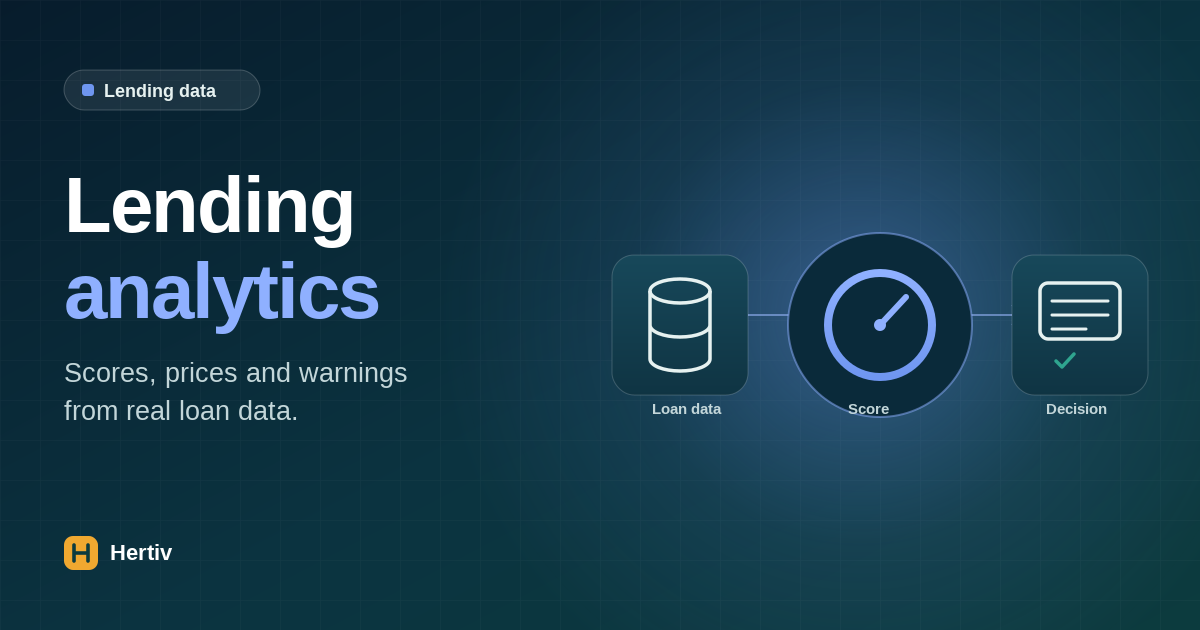
Lending analytics turns loan data into decisions: who to lend to, at what price, and how to collect. It covers scoring, pricing, fraud checks and monitoring.
On this page
Short answer
Lending analytics is the use of loan and borrower data to make better lending decisions. It covers credit scoring, loan pricing, fraud detection, collections and portfolio monitoring. A lender feeds it application data, repayment history, bank transactions and market signals, and it returns scores, prices and early warnings that humans review before acting.
What is lending analytics?
Lending analytics is the practice of using data to decide who gets a loan, at what price, and how the loan is managed afterwards. It replaces gut feeling and fixed rules with scores and signals that are tested against real repayment history.
The work falls into four parts. Credit scoring estimates the chance a borrower will repay. Pricing sets the interest rate and fees for the risk taken. Fraud checks look for applications that do not match reality. Portfolio monitoring watches the whole loan book for early signs of trouble.
A lender that uses analytics still makes the final decision. The analytics produce a score, a suggested price and a warning flag; a person or a policy then decides what to do with them. The value is consistency: every application is judged by the same rules, and those rules are tested against what actually happened.
Lending analytics suits any lender with enough history to learn from, from a bank to a small online lender. The methods are the same; the data and the scale differ. For the broader picture of data-driven decisions, predictive analytics covers the underlying techniques.
What data does lending analytics use?
Lending analytics uses application data, repayment history, bank transactions and external signals. The quality of the decisions depends on the quality of this data, so most of the work is in gathering and cleaning it.
| Data type | Examples | What it shows |
|---|---|---|
| Application | Income, job, loan amount | Ability to repay |
| Repayment history | Past loans, late payments | Willingness to repay |
| Bank transactions | Cash flow, spending | Real financial behaviour |
| Credit bureau | Scores, defaults, enquiries | History with other lenders |
| Fraud signals | Device, identity checks | Application honesty |
| Market data | Rates, unemployment | Conditions for the portfolio |
Bank transaction data has become more important as open banking spreads, because it shows real cash flow rather than stated income. A borrower who says they earn a steady salary but whose account shows irregular deposits is a different risk from one whose deposits match the claim.
Data must be handled with care. Lending decisions are regulated in most countries, and borrowers have rights over how their data is used. A lender needs clear consent, a lawful basis for each data source and a way to explain a decision to a borrower who asks. Data quality and legal compliance are part of the analytics work, not an afterthought.
How does lending analytics improve credit decisions?
Lending analytics improves credit decisions by scoring every application the same way and by learning from past outcomes. A scorecard assigns points to each factor, such as income stability, past defaults and loan size, and adds them into a single score. Applications above a threshold are approved; those below it are declined or sent for manual review.
The scorecard is built from history. The lender looks at past loans, sees which ones were repaid and which defaulted, and finds the factors that separated the two groups. The scorecard is then tested on loans it has never seen, to check that it predicts rather than memorises.
Machine learning models can do the same job with more factors and more complex patterns, but they are harder to explain. A lender that must explain a decline to a borrower or a regulator often prefers a scorecard, because each point can be traced to a specific factor. The choice between a simple scorecard and a complex model is a trade-off between accuracy and explainability.
Whatever the method, the decision must be monitored. A scorecard built on last year's data may fail when the economy changes, so lenders re-test their models regularly and watch for drift. A model that is never checked will quietly go stale.
How does it help pricing, collections and fraud checks?
Lending analytics helps pricing by matching the interest rate to the risk. A low-risk borrower gets a lower rate; a high-risk borrower gets a higher rate or a smaller loan. This is called risk-based pricing, and it lets a lender serve more borrowers without taking on losses it cannot afford.
For collections, analytics predicts which borrowers are likely to miss a payment and when. A borrower who misses one payment but has a strong history may only need a reminder. A borrower whose cash flow has dropped may need a restructured plan. Contacting the right borrowers at the right time recovers more money than contacting everyone the same way.
For fraud, analytics looks for patterns that do not match reality: an identity used for many applications, a device linked to past fraud, or an income figure that does not match the bank data. These checks run before the loan is approved, because stopping a fraudulent loan is far cheaper than chasing it afterwards.
All three uses share one requirement: the analytics must be fast enough to run during the application. A credit decision that takes a week is useless for an online lender whose borrowers expect an answer in minutes. For teams automating these workflows, automating lending operations shows how the pieces fit together.
How to start a lending analytics programme
Start a lending analytics programme with one decision, clean data and a human in the loop, then expand step by step.
- Pick one decision. Credit scoring for new applications is the usual first choice, because it is well understood and easy to measure.
- Gather the history. Collect past applications with their outcomes: repaid, late or defaulted. Without outcomes, there is nothing to learn from.
- Build a simple scorecard. Start with a handful of factors that make sense to the credit team. A simple model that everyone understands beats a complex one nobody trusts.
- Test on unseen loans. Hold back a sample of past loans and check the scorecard against them. If it cannot predict those, it will not predict new ones.
- Run it alongside the old process. Score new applications with the model but keep the existing decision process. Compare the two for a month before switching.
- Monitor and retrain. Track how the model performs on new loans and retrain it when the economy or the borrower mix changes.
The parallel run in step five is the step most teams skip, and it is the one that prevents the most damage. A model that looks good on history can still fail on new applications, and the parallel run catches that before real money is at stake.
Example (hypothetical): a small lender cuts missed payments
Example (hypothetical): a small online lender holds 10,000 active loans. In a typical month, 400 borrowers miss a payment, which is 4% of the book. The collections team contacts all 400 the same way, and 200 of them pay within two weeks.
The lender builds a simple model that scores each borrower on cash flow, past late payments and loan age. The model flags 150 borrowers as high risk of missing the next payment. Of those, 120 do miss it, and 30 do not. The model also misses 280 borrowers who go on to miss a payment, because 400 minus 120 is 280.
The collections team changes its approach. It contacts the 150 flagged borrowers early, before the payment date, with a reminder and an offer to adjust the date. Of the 120 who would have missed, 60 now pay on time. That is 60 fewer missed payments in the month, or 15% of the 400.
The lender keeps the model running and checks it every month. The point is not that the model is perfect; it is that early contact with the right borrowers beats contacting everyone after the fact.
What are the common mistakes?
The most common mistakes are building on dirty data, trusting the model too far and forgetting the legal duties that come with lending decisions.
- Dirty data. A scorecard built on incomplete or miscoded history will learn the wrong lessons. Clean the data before modelling.
- No holdout test. A model tested only on the data it was built from will look better than it is. Always test on loans it has never seen.
- Over-automation. A model should recommend, not decide alone, until it has proven itself in a parallel run.
- Ignoring drift. A model built in a good economy may fail in a bad one. Monitor performance and retrain when conditions change.
- Unexplainable declines. If a borrower asks why they were declined, the lender must be able to explain. A model nobody can explain is a legal risk.
- Biased inputs. A factor that tracks a protected characteristic can produce unfair decisions. Check inputs for bias before launch.
Key takeaways
- Lending analytics covers credit scoring, pricing, fraud checks and portfolio monitoring
- Decisions improve when they are tested against real repayment history, not gut feeling
- A simple, explainable scorecard beats a complex model nobody can explain to a borrower
- Run a new model alongside the old process for a month before switching
- Monitor models for drift and retrain when the economy or borrower mix changes
Frequently asked questions
What is the difference between lending analytics and credit scoring?
Credit scoring is one part of lending analytics: estimating the chance a borrower will repay. Lending analytics is broader and also covers pricing, fraud detection, collections and monitoring the whole loan book. Scoring answers one question; analytics covers the full lending lifecycle.
Do small lenders need lending analytics?
Yes, if they have enough loan history to learn from. The methods are the same at any size; only the data volume differs. A small lender can start with a simple scorecard on a spreadsheet and move to more advanced tools as the book grows.
How much history do you need to build a credit scorecard?
It depends on the number of loans and the default rate, but a common starting point is several hundred loans with known outcomes, including some defaults. Without defaults in the history, the model cannot learn what a risky borrower looks like.
Can lending analytics replace human underwriters?
No. Analytics produces scores and flags that humans review, especially for large or unusual loans. The model handles the routine cases consistently, and people handle the exceptions, the appeals and the cases where the data is incomplete.
What regulations apply to lending analytics?
Lending decisions are regulated in most countries, with rules on data use, consent, fairness and the right to an explanation. The exact rules differ by country and by lender type, so check the local regulator's guidance before using a new data source or model.
How do you know if a lending model is still working?
Track its predictions against real outcomes every month: how many flagged borrowers actually missed a payment, and how many missed payments were not flagged. If accuracy falls, or if the borrower mix changes, retrain the model on recent data.


