How to Automate Lending Operations with AI Agents
AI agents can check documents, verify income and prepare lending decisions, while humans keep the final call. Here is how to automate it safely.
On this page
Short answer
Automating lending operations with AI agents means giving agents clear jobs such as checking documents, verifying income and preparing decisions, while humans keep the final say on credit. Start with one mechanical job, prove the agent handles it accurately, and add the next job only when the first is trusted.
What does it mean to automate lending operations with AI agents?
Automating lending operations with AI agents means giving software agents clear jobs inside the lending process, such as checking documents, scoring applications, drafting decisions and chasing missing information, while humans keep the final say on credit decisions. The agents work inside the lender's systems and follow rules the lender sets.
An AI agent is different from a fixed workflow. A workflow follows the same steps every time, while an agent reads the case in front of it, picks the right tools for that case, and works through the steps in order. For example, an agent handling a loan application can read a payslip, check it against the stated income, look up the employer's details, and flag anything that does not match.
Lending operations cover the work between a customer applying and the money being paid out: collecting documents, verifying identity and income, checking credit, assessing affordability, preparing the offer, and setting up repayments. Most of that work is reading, checking and copying information between systems, which is where agents save the most time. AI agents for finance teams covers the wider pattern across banking and lending.
Where do AI agents help in a lending operation?
AI agents help most where the work is repetitive, document-heavy and rule-based, and least where judgement about a borrower's situation matters. The table below shows where teams usually start.
| Lending task | What the agent does | Human still does |
|---|---|---|
| Document collection | Requests missing documents and checks what arrived | Decides what to do with unusual documents |
| Income verification | Reads payslips and bank statements, checks the figures | Reviews cases where the figures do not match |
| Credit checks | Pulls bureau data and flags adverse history | Judges whether the history matters for this loan |
| Affordability checks | Builds the income and spending picture from the data | Sets the policy and the cut-off points |
| Customer messages | Answers status questions and explains next steps | Handles complaints and sensitive conversations |
| Post-offer admin | Prepares agreements and schedules repayments | Signs off the final offer and the terms |
Teams that start with document collection usually see results fastest, because the work is the most mechanical. Credit decisions come later, once the team trusts the agents on the simpler jobs and has the checks in place to catch their mistakes.
What data and systems do the agents need?
Agents need access to the same data a lending officer uses: the application, identity documents, income proof, bank statements, credit bureau reports and the lender's own policy rules. Without that access they can only guess, and guessing in lending is not acceptable.
That means connecting the agent to the loan origination system, the document store, the credit bureau and the customer messaging channel, with clear rules about what each agent may read and what it may change. An agent that only reads documents is low risk; an agent that can update a loan record or send a message to a customer needs tighter limits and a full audit trail.
Data quality decides whether the project works. If income figures are stored in different formats, if documents arrive as poor scans, or if the policy rules live only in people's heads, the agents will struggle. Most successful teams spend the first weeks cleaning up the data and writing the policy down before they build any agents. AI agent development covers the build choices for this kind of system.
How to automate lending operations in six steps
You automate lending operations by starting with one small, well-defined job, proving the agent handles it safely, and then adding the next job. A lender that tries to automate the whole process at once usually ends up with a system nobody trusts.
- Pick one job and write down how it works today. Document collection or income verification are good first jobs, because the steps are clear and the result is easy to check.
- Write the policy as rules the agent can follow. State what counts as acceptable proof, what to do when a document is unclear, and when the agent must stop and ask a human.
- Connect the agent to the systems it needs. Give it read access first, and only add write access once the team is confident it behaves correctly.
- Run it alongside humans on real cases. Let the agent prepare the work and let a person check every result for several weeks, measuring accuracy and time saved.
- Add a human review step for edge cases. Route anything the agent is unsure about, anything involving a vulnerable customer, and any large loan to a person.
- Expand one job at a time. Add the next job only when the first one is stable, measured and trusted by the team using it.
Each step has a clear test: if the agent's accuracy falls or the team stops trusting its output, pause and fix that job before adding another. A small proof of concept with a fixed test set is the cheapest way to find out whether the idea works. How to build an AI proof of concept explains how to run one.
Example (hypothetical): a lender automates document checks
Example (hypothetical): a small lender receives 200 loan applications a month. Each application needs three documents checked: identity, proof of income and a bank statement. A lending officer spends about 30 minutes checking one application, so 200 applications take 100 hours a month.
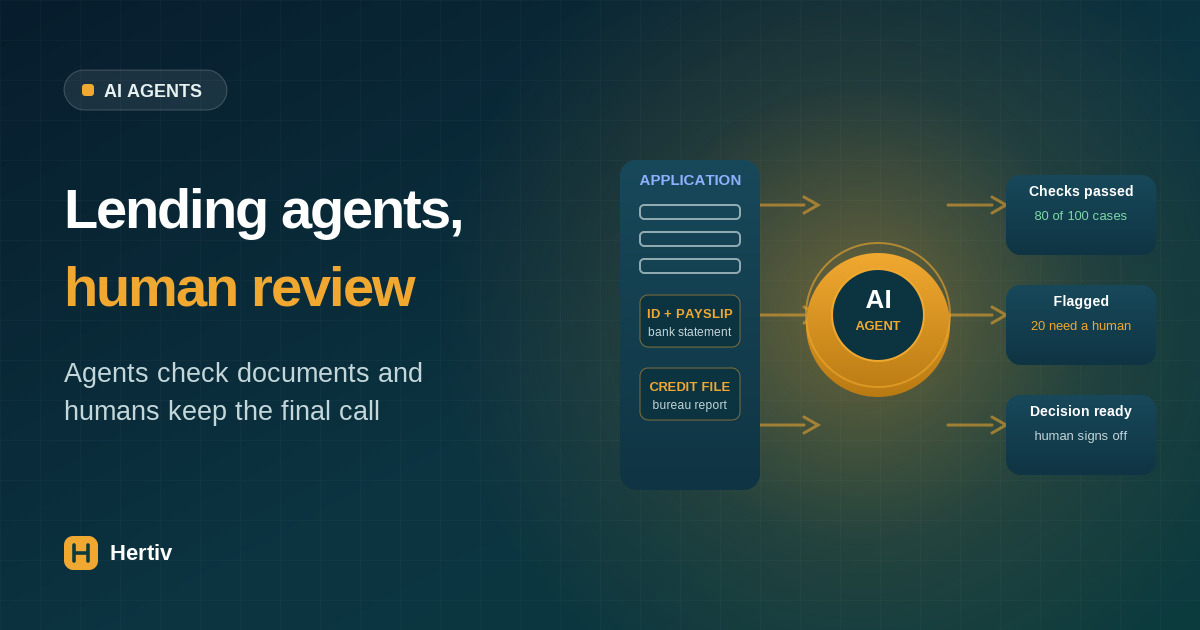
The lender builds an agent that reads the three documents, checks the name and income figures against the application, and flags any mismatch. In a pilot on 100 applications, the agent handles 80 correctly on its own, and 20 need a human because a document is unclear or a figure does not match.
If the agent saves 30 minutes on each of the 80 straightforward cases, that is 40 hours saved a month, and the officers spend their time on the 20 flagged cases instead. The lender keeps a human review on every case the agent flags, and checks a sample of the agent's clear cases each week to make sure its accuracy stays high.
What are the risks and limits?
The main risk is an agent making a wrong call that a human would have caught, such as accepting a forged document or misreading an income figure. That is why the agent should prepare work and flag doubts, while humans keep the final decision on anything that affects whether a loan is offered.
Regulation is the second limit. Lenders must be able to explain why an application was accepted or declined, and an agent that cannot show its reasoning creates a compliance problem. Keep a full record of what the agent read, what it decided and why, so any decision can be reviewed later.
Customer vulnerability is the third. An agent that treats every applicant the same way can miss signs that a customer is in difficulty or does not understand the product. Build in a route to a human for any customer who seems confused, stressed or in financial trouble, and test that route regularly. How to build custom AI agents covers the design patterns for safe handover to humans.
What are the common mistakes?
The most common mistakes are automating the credit decision first, skipping the policy work, and removing humans too early. Each of these is easy to make and hard to undo once customers are affected.
- Automating the decision first. Start with document checks and admin, not with the call on whether to lend.
- No written policy. An agent cannot follow rules that only exist in people's heads.
- Removing humans too early. Keep human review until the agent's accuracy is measured and stable.
- Weak audit trails. If you cannot show what the agent did and why, you cannot defend the decision.
- Ignoring vulnerable customers. Agents need a clear route to a human for anyone who needs extra care.
- Measuring speed only. Faster decisions that are wrong cost more than slow decisions that are right.
Automation works when it makes the boring parts of lending faster and leaves the judgement to people. AI and blockchain for finance and banking covers the wider use of these tools in the sector.
Key takeaways
- AI agents suit repetitive, document-heavy lending work; humans keep credit decisions
- Start with document collection or income checks, not with the lending decision
- Write the policy as clear rules before building any agents
- Keep an audit trail so every decision can be explained and reviewed
- Route edge cases and vulnerable customers to a human, every time
- Measure accuracy as well as speed, and pause if trust falls
Frequently asked questions
What is an AI agent in lending?
An AI agent in lending is software that reads a case, picks the right tools for it and works through the steps, such as reading a payslip, checking it against the stated income and flagging mismatches. Unlike a fixed workflow, it adapts its steps to the case in front of it, but it still follows rules the lender sets.
Which lending task should be automated first?
Document collection or income verification, because the steps are clear, the result is easy to check and the risk is low. Credit decisions come later, once the team trusts the agents on simpler jobs and has checks in place to catch mistakes.
Do AI agents decide whether to lend money?
They should not decide alone. Agents can prepare the work, check the documents and draft a recommendation, but a human should keep the final decision on whether to offer a loan, especially for large amounts or unusual cases.
What data do lending agents need?
The same data a lending officer uses: the application, identity documents, income proof, bank statements, credit bureau reports and the lender's policy rules. Without that access they can only guess, and the policy must be written down as rules the agent can follow.
How do lenders check that agents are accurate?
By running the agent alongside humans on real cases for several weeks, checking every result, and measuring how often it is right. After launch, keep a human review on flagged cases and check a sample of the agent's clear cases each week.
What happens if an agent makes a mistake?
The lender needs a full record of what the agent read, what it decided and why, so the mistake can be found and fixed. That audit trail is also what lets the lender explain a decision to a regulator or a customer.


