How to Launch a Security Token Offering That Works
A security token offering turns a regulated asset into tradable tokens. Here is the launch sequence — and the mistakes to avoid.
On this page
Short answer
A successful security token offering starts with a clear legal structure and a regulated asset, then moves through token design, a compliant platform, investor onboarding and a listing plan. Most launches fail on paperwork, unclear rights or weak demand, not on the token technology itself. Plan the legal and investor work first, and treat the token as the last step, not the first.
What is a security token offering?
A security token offering (STO) is a regulated sale of tokens that represent ownership or rights in an asset, such as shares in a company, a loan, or a share of a property fund. The token is a digital record of a security, not a new kind of asset, so securities law applies to it in full.
That legal status is the whole difference from an initial coin offering. An ICO sold utility tokens with few investor protections, while an STO sells a regulated instrument with defined rights, disclosure duties and transfer limits. Buyers get the rights written into the token, and issuers get the obligations that come with selling a security.
| Feature | STO | ICO | IPO |
|---|---|---|---|
| What is sold | Regulated security token | Utility token | Shares in a public company |
| Investor rights | Defined in the token | Often unclear | Defined by listing rules |
| Transfer limits | Yes, built into the token | Usually none | Market rules apply |
| Typical buyer | Verified investors | Anyone | Anyone through a broker |
An STO fits issuers who want to raise money from a wider investor base without a full public listing. Property funds, private companies and funds use it to split large assets into smaller pieces that verified investors can buy and trade. See what a security token offering is for the full explainer.
What do you need before you launch an STO?
You need four things before any token is minted: an asset with clear ownership, a legal structure that can issue a security, a jurisdiction whose rules you can follow, and a written description of what token holders actually get. Without these, the token has nothing behind it.
- The asset. Proof of ownership, a valuation, and a clear answer to what the token holder owns.
- The structure. A company or fund that can legally issue a security and receive investor money.
- The jurisdiction. One set of rules you can follow, with counsel who knows it.
- The rights. Dividends, voting, redemption and transfer rules, written down before the token is designed.
- The team. Legal counsel, an auditor and a platform operator who have done this before.
Start with counsel, not with code. A lawyer confirms whether your token is a security in each jurisdiction where you plan to sell it, what exemptions apply, and what you must disclose. That advice shapes the token design, the investor checks and the marketing — all of which are cheaper to fix on paper than after launch.
Budget for the legal work as a line item, not an afterthought. Issuers who treat compliance as paperwork to finish at the end usually discover a problem that forces a redesign of the token or a delay to the raise. The rules differ by market; see security token offerings in Europe for one region's picture.
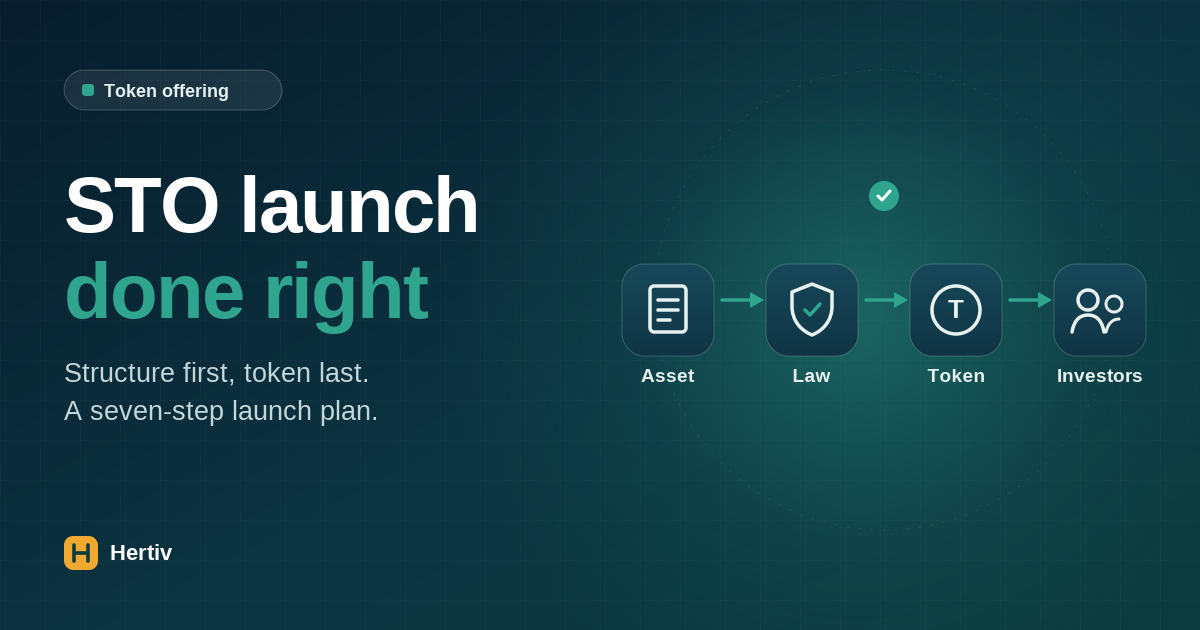
How to launch a security token offering in seven steps
A launch follows a fixed sequence, and skipping a step usually costs more than doing it in order.
- Define the asset and the rights. Write down what the token represents, what holders receive, and what they do not.
- Get legal advice and pick a jurisdiction. Confirm the token is a security, choose the exemption or licence, and set the disclosure pack.
- Design the token. Choose the chain, the standard, transfer rules, lock-ups and how rights such as dividends are paid.
- Pick a platform and a custodian. The platform handles issuance and investor checks; the custodian holds the tokens or keys.
- Prepare investors. Set the minimum investment, run identity and suitability checks, and prepare the subscription documents.
- Run the offering. Open subscriptions, collect funds into escrow, and close only when the minimum raise is met.
- List and service the token. Arrange secondary trading where allowed, pay distributions on schedule, and keep holders informed.
Each step has an owner and a sign-off. If nobody owns the legal step, it drifts; if nobody owns investor checks, the platform cannot open subscriptions. A one-page plan that names the owner and the date for each step is enough to keep a launch on track.
How do you design the token and its rights?
Token design is a legal document first and code second. The rights — dividends, voting, redemption, transfer limits — must be written in the offering documents, and the smart contract must enforce the same rules. If the code and the documents disagree, the documents win and the token is broken.
The main design choices are the chain, the token standard, the transfer rules and the lock-up. Transfer rules decide who can hold the token: verified investors only, a minimum holding period, or a whitelist that the issuer controls. Lock-ups stop early sellers from dumping the token before the project has had time to work.
Keep the design simple. One class of token with one set of rights is easier to explain to investors, easier to audit and easier to list than three classes with different terms. Complexity in the token is a cost you pay at every later step. Get the contract checked with a smart contract audit before launch.
How do you pick a platform and handle investors?
A platform does three jobs: it issues the token, it checks investors, and it records who owns what. Compare platforms on whether they support your jurisdiction, your token standard and your transfer rules — not on how slick their demo looks.
Investor handling is where most launches slow down. Every investor needs identity checks and, in many jurisdictions, proof that they qualify to buy a security. Collect the documents early, because a single missing form can hold up a subscription, and a backlog of checks at the close date can delay the whole raise.
Custody matters as much as issuance. Decide before launch who holds the tokens — the investor's own wallet, a custodian, or the platform — and write the answer into the offering documents. Investors ask about custody early, and a vague answer erodes trust. See fund tokenization for how issuers structure the underlying fund.
Example (hypothetical): a property fund launches an STO
Example (hypothetical): a property fund worth $10 million decides to tokenize it. It issues 10,000 tokens at $1,000 each, so the token supply matches the fund value exactly.
The fund sets a minimum investment of $5,000, which is 5 tokens, and a target raise of $4 million, which is 4,000 tokens. In the first round, 200 investors buy an average of $20,000 each — 200 × $20,000 = $4,000,000 — so the target is met and the offering closes on schedule.
The fund then lists the token on a licensed secondary market, pays its first distribution of $120,000 to holders — $12 per token on 10,000 tokens — and publishes a quarterly report. The launch worked because the legal structure, the rights and the investor checks were finished before marketing began, not because the token technology was novel.
What are the common mistakes?
The most common STO mistakes are minting the token before the legal work is done, promising returns you cannot control, and treating the launch as the finish line.
- Minting the token before the legal work is done. A token that does not match its offering documents is a liability, not an asset.
- Promising returns you cannot control. A token is not a guarantee of profit, and marketing that suggests otherwise attracts regulators.
- Skipping the secondary market plan. Investors who cannot sell will not buy, and a token with no trading venue is hard to exit.
- Underestimating investor checks. Identity and suitability checks take days, not minutes, and a queue of unchecked investors stalls the close.
- Treating the launch as the finish line. Distributions, reporting and holder communication continue for the life of the token, and issuers who stop after the raise lose trust.
A successful STO is a disciplined sequence: asset, law, token, platform, investors, listing. Get the order right and the token becomes a useful way to raise money; get it wrong and the launch becomes a case study in what not to do.
Key takeaways
- An STO is a regulated sale of tokens that represent a security, so securities law applies in full
- Legal structure, asset rights and jurisdiction come before token design, not after
- A launch follows seven steps: asset, law, token, platform, investors, offering, listing
- Investor checks and custody slow most launches — start them early
- Plan the secondary market before launch, or investors have no exit
Frequently asked questions
How long does it take to launch a security token offering?
A straightforward STO usually takes three to six months from legal advice to close, with the legal work and investor checks taking most of the time. The token itself can be built in weeks. Launches that rush the legal step often take longer overall, because a problem found late forces a redesign.
How much does it cost to launch an STO?
Costs vary by jurisdiction and complexity, and most of the spend goes to legal advice, audits and platform fees rather than token development. Ask for fixed quotes for the legal and platform work before you commit, and keep a reserve for the checks and filings that appear late.
Do STO investors need to be accredited?
In many jurisdictions, yes, or the offering must fit an exemption that limits who can buy. The exact rule depends on where the issuer and the investors are based, so confirm it with counsel for each market before you accept subscriptions.
Can security tokens be traded after the offering?
Yes, where a licensed venue supports them and the token's transfer rules allow it. Some tokens carry a lock-up period before trading opens. A listing is not automatic, so arrange the secondary market before launch rather than hoping one appears.
What is the difference between an STO and tokenizing a fund?
An STO is the sale event: tokens are issued to investors in exchange for money. Fund tokenization is the wider process of putting a fund's units on a chain, which may or may not involve a public offering. Many fund tokenizations use an STO as the fundraising step.
Do I need my own blockchain to launch an STO?
No. Most STOs are issued on an existing chain using an established token standard, with transfer rules enforced by a smart contract. Building a new chain adds cost and risk without helping the raise, and investors rarely ask which chain you used.


