Ethereum 2.0 Explained: Proof of Stake and What Changed
Ethereum 2.0 is the upgrade that moved Ethereum from proof of work to proof of stake. Here is what changed, how staking works, and what it means for users.
On this page
Short answer
Ethereum 2.0 is the name for the series of upgrades that moved Ethereum from proof-of-work mining to proof-of-stake validation. Validators now lock up ether to secure the network instead of miners competing with computing power, which cut the energy the network uses and set up later scaling work.
What is Ethereum 2.0?
Ethereum 2.0 is the name for the set of upgrades that changed how Ethereum reaches agreement about its ledger, moving it from proof of work to proof of stake. The best-known step was the Merge in 2022, when the existing chain began using the Beacon Chain's proof-of-stake consensus instead of miners.
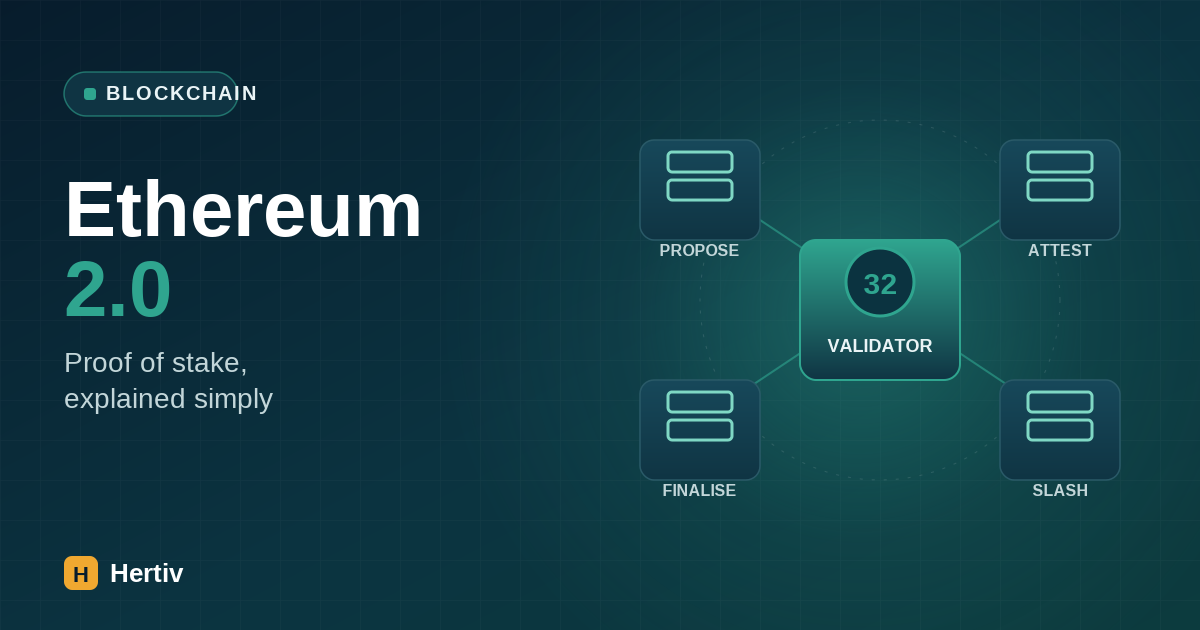
Before the change, miners competed to solve puzzles and the winner added the next block. After it, validators take turns proposing and checking blocks. A validator is an account that has locked up, or staked, 32 ether as a deposit that can be reduced if the validator behaves badly.
The upgrade did not change Ethereum's history, its accounts or its smart contracts. Existing ether, tokens and applications kept working. What changed was the mechanism that secures the chain and decides who gets to add the next block. For the basics, see what is Ethereum.
Why did Ethereum move to proof of stake?
Ethereum moved to proof of stake mainly to cut the energy the network uses and to make later scaling changes possible. Proof-of-work mining runs large amounts of computing hardware around the clock, and that energy use had become a practical problem for companies building on Ethereum.
Proof of stake also changes who can take part in securing the network. Mining rewards tend to flow to operators with cheap electricity and specialised hardware. Staking lets anyone with 32 ether, or a share in a staking pool, take part without buying mining machines.
A third reason was security design. In proof of work, an attacker needs to control most of the mining power. In proof of stake, an attacker needs to control most of the staked ether, and misbehaviour can destroy the attacker's own deposit. That penalty, called slashing, is a deterrent that mining does not have.
How does proof of work differ from proof of stake?
Proof of work and proof of stake answer the same question, which is who gets to add the next block, but they do it in opposite ways. One spends energy to prove effort; the other risks a deposit to prove commitment.
| Feature | Proof of work | Proof of stake |
|---|---|---|
| Who adds blocks | Miners with computing power | Validators chosen from stakers |
| Main cost | Electricity and hardware | Capital locked as a deposit |
| Energy use | High, continuous | Low, no mining race |
| Penalty for bad behaviour | Wasted electricity | Deposit reduced (slashing) |
| Entry requirement | Mining hardware | 32 ether, or a pool share |
On Ethereum, validators are picked at random to propose blocks, and other validators check, or attest, that the block is valid. A block needs enough attestations before it is treated as final. Finality means the block is extremely unlikely to be reversed, which matters for exchanges and applications that settle payments.
What changed for users and developers?
For ordinary users, very little changed on the surface. Wallets, addresses and transactions work the same way, and gas fees did not fall because of the Merge. The upgrade changed consensus, not how much space each block holds, so fees still depend on demand for block space.
For developers, smart contracts kept running without changes. The main difference is in the tools around the chain: block times became more regular at 12 seconds, and finality became explicit, so applications can wait for a block to be final before treating a payment as settled.
For people who run infrastructure, the change was large. Mining operations stopped, and node operators moved to running validator and consensus clients instead. Teams building on Ethereum should read how to implement Ethereum alongside the consensus change, since client setup and staking are now part of the picture.
What came after the Merge?
After the Merge, the next steps focused on scaling and on letting stakers withdraw. The Shanghai upgrade in 2023 allowed validators to withdraw staked ether, which completed the move to proof of stake by giving stakers an exit.
Scaling work then turned to layer 2 networks, which process transactions off the main chain and settle them back on it. The Dencun upgrade in 2024 added a cheaper way for layer 2 networks to post their data to Ethereum, which lowered their operating costs.
The longer-term plan is to keep improving how much data the chain can handle, so that layer 2 networks can grow without fees rising sharply. Stakers who run their own validator also need to keep both clients updated, since outdated software can miss attestations and cost rewards. If you are weighing the cost of building on the chain, Ethereum cost covers the fee side in more detail.
Example: how staking adds up for a small pool
Example (hypothetical): a small staking pool collects ether from 40 members and wants to run its own validators. Each validator needs a 32 ether deposit, so the pool works out how many validators it can run from its total.
The pool holds 320 ether in total. Dividing 320 by 32 gives 10 validators. Each validator is then chosen at random to propose blocks and to attest to blocks proposed by others, and the pool's share of block proposals is roughly its share of all staked ether.
If the pool later grows to 640 ether, it can run 20 validators, because 640 divided by 32 is 20. The arithmetic is simple, but the operational work is not: each validator needs a machine that stays online, a consensus client and an execution client, and monitoring so that downtime does not cost the pool money.
What are the common mistakes?
The most common mistakes with Ethereum 2.0 are treating the Merge as a fee fix, staking without understanding the lock-up, and assuming proof of stake removed all scaling work.
- Expecting lower gas fees. The Merge changed consensus, not block space, so fees still rise when demand is high. Layer 2 networks are where cheaper transactions usually live.
- Staking without an exit plan. Solo staking needs 32 ether and a machine that stays online. Pool staking is simpler, but the pool takes a fee and adds counterparty risk.
- Ignoring client diversity. Running the same consensus client as everyone else means a bug in that client affects many validators at once.
- Confusing staking with yield. Staking rewards come from issuance and fees, and they change as more ether is staked. They are not a fixed interest rate.
Key takeaways
- Ethereum 2.0 moved the network from proof-of-work mining to proof-of-stake validation
- Validators stake 32 ether and can lose part of it for bad behaviour
- The Merge did not lower gas fees; it changed consensus, not block space
- Staking withdrawals arrived with the Shanghai upgrade in 2023
- Scaling now happens mainly on layer 2 networks, not on the main chain
Frequently asked questions
What is Ethereum 2.0 in simple terms?
Ethereum 2.0 is the upgrade that changed how Ethereum agrees on its ledger, replacing energy-hungry mining with validators who stake ether as a deposit. The chain, its accounts and its smart contracts stayed the same; only the security mechanism changed.
Did Ethereum 2.0 lower gas fees?
No. The Merge changed consensus, not how much data fits in a block, so fees still depend on demand. Cheaper transactions usually come from layer 2 networks, which process activity off the main chain and settle it back on Ethereum.
How much ether do you need to stake?
Running your own validator needs 32 ether. If you hold less, you can join a staking pool, where many people combine their ether and share the rewards, minus the pool's fee and with the pool's own risks.
What happens if a validator goes offline?
An offline validator misses attestations and can lose a small amount of its deposit over time. Longer or repeated downtime costs more, and deliberately harmful behaviour can trigger slashing, which removes a larger share of the deposit.
Is Ethereum 2.0 finished?
No. The move to proof of stake is done, but scaling work continues. Later upgrades focus on cheaper data for layer 2 networks and on making the chain easier to run, rather than on changing consensus again.
Do I need to do anything with my ether?
No. Existing ether did not need to be moved or converted when the Merge happened. Anyone offering to convert your ether for a fee after the upgrade is almost certainly running a scam.


