Intelligent Agents in Travel: What They Do and Where They Help
Intelligent agents in travel plan trips, compare options, book what fits and rebook after disruption. Here is what they can do, where they fail, and how to start.
On this page
Short answer
Intelligent agents in travel are software systems that take a travel goal, plan the steps, use booking tools and data, and act on their own until the trip is arranged or they need a person to decide. They search, compare, book and monitor, while a person sets the goal, the budget and the rules.
What are intelligent agents in travel?
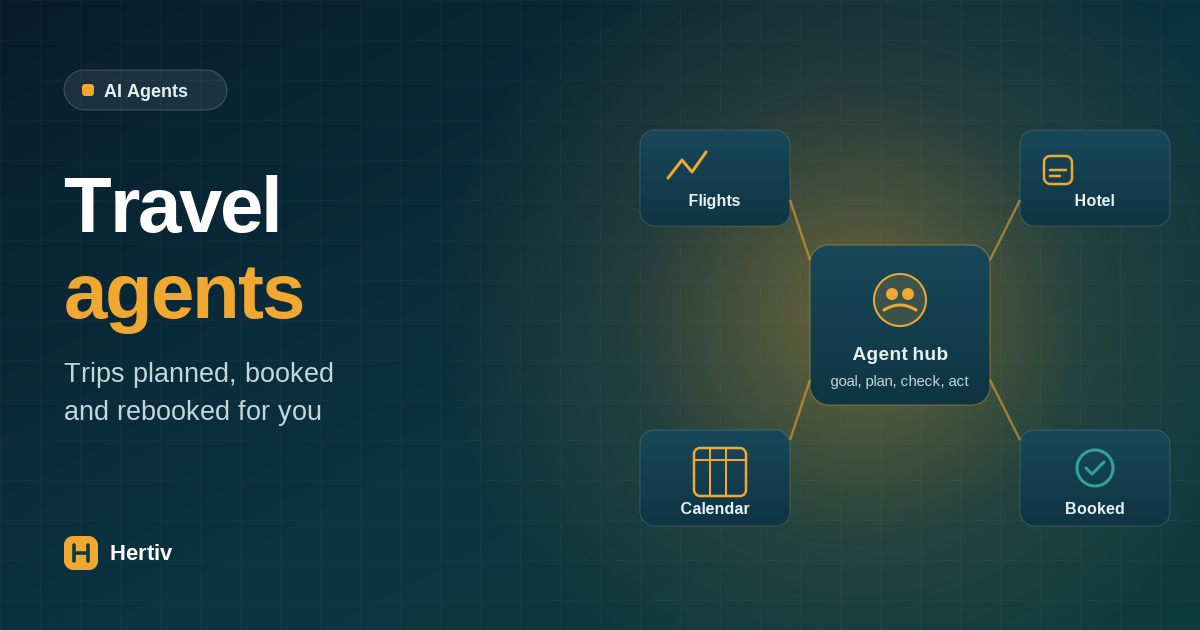
Intelligent agents in travel are software systems that take a travel goal, plan the steps, use booking tools and data, and act on their own until the trip is arranged or they need a person to decide. Unlike a search box that returns a list of flights, an agent works through the task: it reads the request, checks options, books what fits, and reports back.
An agent is defined by what it does, not by the model behind it. It has a goal, such as "get me to Lisbon for under a set budget", access to tools such as flight search, hotel booking and calendars, and the ability to check its own results before acting. When a step fails, it tries another route instead of stopping.
Travel is a natural fit because a trip is a chain of small decisions that depend on each other. The flight sets the arrival time, the arrival time sets the hotel check-in, and the hotel location sets the transport. An agent can hold all of those dependencies in view while a person would have to check them one by one.
What can a travel agent actually do?
A travel agent can search, compare, book, monitor and change a trip, but only within the limits and permissions a person has set. The table below shows the usual jobs and what the agent needs for each one.
| Job | What the agent does | What it needs |
|---|---|---|
| Search flights and hotels | Compares times, prices and layovers | Access to booking search tools |
| Build an itinerary | Orders flights, stays and transfers into a plan | Dates, budget and traveller preferences |
| Book and pay | Books the chosen options and pays with a stored method | Payment permission and spending limits |
| Watch for changes | Checks for delays, cancellations and price drops | Booking references and alert rules |
| Rebook after disruption | Finds the next workable flight or room | Authority to change bookings |
| Answer questions | Explains the plan and the rules in plain words | Access to the trip record |
The booking step is where most teams draw the line. Many agents are allowed to search and propose, while the payment step waits for a person to confirm. That split keeps the convenience of automated search and the control of a human decision on money.
For teams scoping their first agent, the AI agent development page covers how to define the goal, the tools and the checks before any code is written.
How does an agent plan a trip?
An agent plans a trip by breaking the goal into steps, working through them in order, and checking each result before moving on. The plan is a sequence, not a single guess.
- Read the goal. The agent turns the request into a set of facts: dates, destination, budget, travellers, and any fixed constraints such as a morning flight or a hotel near the conference.
- Search the first step. It usually starts with the flight, because the flight fixes the arrival time that everything else depends on.
- Check the result against the goal. If the cheapest flight arrives at 2 a.m., it may fail the traveller's rule about night arrivals, so the agent tries the next option.
- Plan the next step. With the flight fixed, it searches for a hotel that matches the check-in time and the budget left over.
- Fill the gaps. Transfers, insurance and activities are added last, because they depend on the flight and hotel that are already chosen.
- Show the plan for approval. The agent presents the whole trip with prices and rules, and books only after the traveller agrees.
When a step has no good answer, the agent should say so instead of forcing a bad one. A flight that does not exist or a hotel that is sold out is a fact the traveller needs, not a gap to hide. The general pattern is the same across sectors, as the AI agent use cases guide shows.
Example (hypothetical): rebooking after a cancelled flight
Example (hypothetical): a traveller is booked on a 9 a.m. flight to a meeting that starts at 3 p.m. The airline cancels the flight at 7 a.m., and the traveller asks the agent to fix it.
The agent searches for alternatives and finds three: a 10 a.m. flight arriving at 1 p.m. for $180, an 11 a.m. flight arriving at 2 p.m. for $140, and a 1 p.m. flight arriving at 4 p.m. for $110. The 1 p.m. flight is cheapest, but it arrives after the meeting starts, so it fails the goal.
The agent picks the 10 a.m. flight. It costs $40 more than the 11 a.m. option, but it leaves a 2-hour buffer before the meeting instead of a 1-hour buffer. It then moves the airport transfer from 11 a.m. to 1 p.m. and tells the hotel the new arrival time. The numbers are invented to show the arithmetic, not a real booking.
The point is that the agent weighed time against price and kept the meeting as the fixed constraint. A search tool alone would have shown the cheapest flight first, which was the wrong answer for this traveller.
Where do travel agents help most, and where not?
Travel agents help most where the trip is a routine sequence with clear tools and a checkable result: booking a standard business trip, rebooking after a delay, or tracking prices for a holiday that is already planned. The job has a right answer that a person can verify quickly.
They help less where the goal is vague or the stakes are high. A honeymoon, a first trip to a country the traveller does not know, or a journey with medical needs involves judgement about comfort, safety and taste that an agent cannot weigh. Those trips still need a person, or a human travel adviser, in charge.
The same line applies to money. An agent can hold a budget and stay inside it, but a traveller who has never set a budget has not given the agent a rule to follow. The agent will pick the cheapest option by default, which may be a flight with two stops and a 5 a.m. departure. Clear rules make the agent useful; vague ones make it annoying.
Security matters here too. An agent that can pay, change bookings and read travel documents needs scoped permissions, logging and a way to stop it. The guide to securing AI agents covers the controls that belong in place before an agent touches real bookings.
What are the common mistakes?
The most common mistakes with travel agents are giving them too much access too soon, letting them book without a check, and treating a demo trip as proof the agent is ready.
- Payment access with no limits. An agent that can spend without a cap will eventually book the wrong thing at the wrong price. Set a spending limit per trip and require approval above it.
- No logging. If the agent's steps are not logged, nobody can explain why it chose a flight or a hotel. Log every search, decision and booking.
- Skipping the disruption test. Most demos show a smooth booking. Test the agent on a cancelled flight, a sold-out hotel and a passport that expires too soon.
- Vague goals. A goal like "plan something nice" cannot be checked. A goal like "two nights in Lisbon, under $800, arriving before 6 p.m." can.
- Forgetting the traveller's rules. Seat preferences, loyalty programmes and dietary needs are not details. They are the rules that decide whether the trip works.
Each mistake has the same root: the agent was given a job that nobody defined tightly enough, so it guessed. A tight goal, a spending limit and a human check on payment prevent most of the damage.
How do you start with an agent in your travel product?
You start with an agent in a travel product by picking one narrow job, giving it clear rules, and measuring it on real trips before widening its scope.
- Pick one job. Price tracking for a fixed route, or rebooking after delays, is a good first job. It has a clear input, a clear output and a human who can check the result.
- Write the rules down. Budget, arrival times, seat and hotel preferences, and the spending limit above which a person must approve. If a rule is not written down, the agent cannot follow it.
- Connect one tool at a time. Start with search, then add booking, then add payment. Each new tool adds a new failure mode, so test it before adding the next.
- Log everything. Every search, every decision and every booking should be recorded with the reason the agent gave for it.
- Measure on fixed cases. Run the agent on the same set of trips every week and count how many it completes correctly. Without that, quality drifts silently.
Once one job runs reliably for a month, the case for the next job writes itself, because you can show the trips completed and the time saved. The payment side is covered by stablecoins in travel, which explains one way travel payments are changing.
Key takeaways
- A travel agent works through a trip step by step, checking each result before moving on
- Agents help most on routine trips with clear tools and a checkable result
- Booking and payment should stay behind a spending limit and a human check
- Disruption handling, not smooth booking, is the real test of an agent
- Start with one narrow job, written rules and weekly measurement
Frequently asked questions
What is an intelligent agent in travel?
An intelligent agent in travel is software that takes a travel goal, plans the steps, uses booking tools and data, and acts on its own until the trip is arranged. It differs from a search box because it works through the task and checks its own results, instead of just returning a list of options.
Can an AI agent book flights and hotels?
Yes, if it has access to booking tools and permission to pay. Many teams let the agent search and propose, while the payment step waits for a person to confirm. That split keeps the convenience of automated search and the control of a human decision on money.
What happens when a flight is cancelled?
A good agent searches for alternatives, checks each one against the traveller's rules, picks the option that keeps the trip workable, and moves the transfer and hotel times to match. It should also tell the traveller what changed and why, instead of silently rebooking.
Are travel agents safe to use?
They can be, if they are built that way: scoped permissions, a spending limit, logging of every action, and a human check on payments. The risk is an agent with broad access and no oversight, so the security design matters as much as the model.
Do travel agents replace travel advisers?
No. Agents handle the routine, repeatable trips, while people keep the trips that need judgement about comfort, taste and risk. Most teams find the agent handles a share of the volume and the human adviser handles the rest better, because there is time for the hard cases.
What should a team build first?
Start with one narrow job that is high volume, routine and easy to check, such as price tracking for a fixed route or rebooking after delays. Build it small, measure it weekly on fixed cases, and expand only after the checks are passing.


