What AI Does to a Business: Impact, Gains and Risks
AI changes a business in four places: how work gets done, what customers experience, what it costs to run, and what can go wrong. Here is how to weigh each one.
On this page
Short answer
AI changes a business by taking over routine work, personalising what customers see, and turning data into decisions faster than people can. The impact shows up first in support, sales and operations, then in costs, jobs and risk, and the size of the change depends on how much of the work is already digital and how well the data is organised.
What is the impact of AI on a business?
AI changes a business by taking over routine work, personalising what customers see, and turning data into decisions faster than people can. It is not one change but a set of changes that arrive at different speeds: a support team feels it in weeks, a finance team in months, and the whole organisation over years.
The impact is easiest to see in work that follows a pattern. Answering common questions, drafting documents, sorting tickets, forecasting demand and flagging unusual transactions are all pattern work, and AI handles the first pass well. Work that needs judgement, trust or a relationship with a customer changes more slowly, because the AI can draft but a person still has to decide.
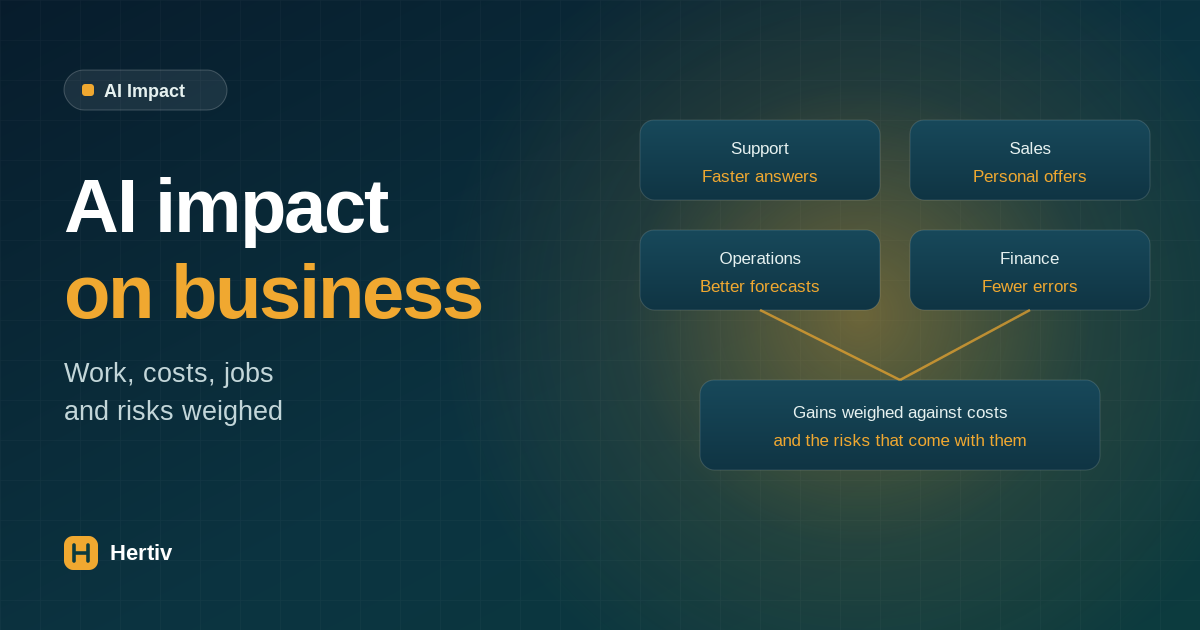
The table below shows where the impact lands first and what changes in each area.
| Area | What changes first | What stays human |
|---|---|---|
| Customer support | Drafting answers, triaging tickets | Complaints, refunds, trust |
| Sales and marketing | Lead scoring, draft copy, briefs | Relationships, negotiation |
| Operations | Forecasting, scheduling, checks | Exceptions, judgement calls |
| Finance | Invoice checks, anomaly flags | Approvals, audits, sign-off |
| Product and engineering | Code drafts, tests, documentation | Design choices, architecture |
| People and HR | Screening, scheduling, summaries | Hiring decisions, disputes |
The pattern is the same in every row: the AI takes the repetitive first pass and the person keeps the decision. A business that plans around that split gets value quickly; one that expects the AI to decide on its own will be disappointed.
How does AI change what customers experience?
AI changes what customers experience in three ways: faster answers, more personal service, and fewer errors in routine transactions. A customer who gets a correct answer in seconds instead of waiting a day notices the difference, and a shop that recommends the right product notices it in sales.
The risk is that a bad AI answer is worse than a slow human one. A chatbot that invents a price, a policy or a delivery date creates a complaint that costs more than the time saved. The businesses that do this well keep a human in the loop for anything that commits the company, and they measure the answers, not just the speed.
Personalisation is the change customers notice most and trust least. Recommending a product a customer actually wants feels helpful; using data a customer did not expect you to have feels intrusive. The line is different for every business, and it is worth testing with real customers before rolling it out widely. For how AI agents change the customer side specifically, see AI agents for customer segmentation.
One practical test is the escalation rate. If the share of customers who ask for a human goes up after AI is introduced, the AI is not helping, however fast it answers. If it goes down while satisfaction holds, the change is working.
What does AI do to business costs?
AI changes business costs in two directions at once: it cuts the cost of routine work and adds new costs for data, tooling and oversight. The net effect depends on how much routine work the business has and how much it spends on the new costs.
The savings come from time. A support team that drafts answers with AI handles more tickets per person, a finance team that checks invoices with AI spends less time on manual review, and a marketing team that drafts copy with AI produces more variants. The savings are real but they are not free: someone has to clean the data, write the prompts, check the output and fix the mistakes.
| Cost | Goes up or down | What decides it |
|---|---|---|
| Routine labour time | Down | Volume of pattern work |
| Software and model fees | Up | Usage and vendor pricing |
| Data cleaning and upkeep | Up | How messy the data is |
| Review and oversight | Up | How much output needs checking |
| Error and rework | Down, if checked | Quality of review |
The honest way to judge the cost impact is to measure one workflow before and after, including the review time. A team that counts only the time saved and ignores the time spent checking will overstate the gain, and a business that does that across many teams will wonder why its costs did not fall.
How does AI change jobs and skills?
AI changes jobs by removing the repetitive parts of a role and raising the value of the parts that remain. A support agent who no longer types the same answer fifty times a day spends more time on the hard cases. A junior analyst who no longer builds the same report by hand spends more time deciding what the numbers mean.
That shift needs new skills. Staff need to know how to write a good prompt, how to check an AI answer, and when to trust it and when to doubt it. Those are not technical skills in the old sense; they are judgement skills, and they are learned by doing the work with the AI, not by reading about it.
The risk is that a business automates the work junior staff learn from. If a junior lawyer never reads a contract because the AI summarises it, they never learn to read one. The businesses that handle this well keep juniors on the review step, so they learn by checking the AI's work rather than by doing the routine work the AI took over.
For a practical view of how AI agents change day-to-day operations, see how AI agents improve business operations.
What are the risks of AI for a business?
The risks of AI for a business are wrong answers, leaked data, legal exposure and overdependence. Each one is manageable, but only if the business names it before the AI goes live.
Wrong answers are the most common risk. An AI that invents a price, a policy or a fact will do so confidently, and a customer who acts on it will expect the business to honour it. The fix is grounding: the AI should answer from the business's own documents, and anything it cannot find should go to a human.
Data leakage is the risk teams underestimate. Pasting customer data into a public AI tool can breach privacy law and contracts, and the data may be used to train a model the business does not control. The fix is to use tools with a data agreement that states the data is not used for training, and to keep sensitive data inside systems the business controls.
Legal exposure follows from both. A business is responsible for what its AI says to customers, even if the AI wrote it. That means someone has to own the AI's output, check it, and be able to explain how it was produced. For the retail side of the same question, see the impact of AI in retail.
Example (hypothetical): a support team adopts AI
Example (hypothetical): a support team handles 1,200 tickets a week, and each ticket takes an agent about 12 minutes to answer by hand. That is 1,200 x 12 = 14,400 minutes, or 240 hours, of answering time a week.
The team adds an AI that drafts answers from the help centre, and an agent reviews and sends each draft in about 5 minutes. The same 1,200 tickets now take 1,200 x 5 = 6,000 minutes, or 100 hours, a week, so the team saves 240 - 100 = 140 hours a week.
The saving only holds if the drafts are good. In the first month the team finds that 60 tickets a week contain a wrong price or policy, and each one takes an extra 10 minutes to fix, which is 600 minutes, or 10 hours, a week. The net saving is 140 - 10 = 130 hours a week, and the team uses the time to answer the hard tickets that the AI cannot draft.
The lesson is to measure the net saving, not the gross one. The review time and the fix time are part of the cost of using AI, and a team that ignores them will think it saved more than it did.
What are the common mistakes?
The most common mistakes businesses make with AI are starting with the tool instead of the workflow, trusting output without review, and measuring usage instead of outcomes.
- Starting with the tool. Buying an AI product before naming the workflow it will improve usually ends with a subscription nobody uses.
- No human review. AI output that goes straight to a customer without a check will eventually contain a wrong price or promise.
- Measuring usage, not outcomes. Counting how many people opened the tool says nothing about whether it saved time or money.
- Ignoring the data. An AI built on messy, outdated documents will repeat the mess faster than a person would.
- Automating the learning work. Junior staff who never check AI output never learn the job the AI is doing.
- No owner. An AI system with no named owner will drift, and nobody will notice until a customer complains.
Key takeaways
- AI takes the repetitive first pass; people keep the decisions
- Customers notice faster answers and personal service first
- Costs fall on routine work but rise on data, tooling and review
- Jobs change toward checking and judgement, not away from people
- Measure the net saving, including review and fix time
Frequently asked questions
What is the impact of AI on a business?
AI changes a business by taking over routine work, personalising what customers see, and turning data into decisions faster than people can. The impact shows up first in support, sales and operations, then in costs, jobs and risk, and its size depends on how much of the work is already digital.
Does AI save a business money?
It can, by cutting the time spent on routine work such as drafting answers, checking invoices and forecasting demand. The saving is only real after the costs of data cleaning, tooling, review and fixing mistakes are counted, so measure one workflow before and after.
Will AI replace jobs in a business?
AI removes the repetitive parts of a role and raises the value of the parts that remain, such as judgement, relationships and hard cases. Roles change more often than they disappear, and staff need new skills in checking AI output and deciding when to trust it.
What are the biggest risks of AI for a business?
Wrong answers, leaked data, legal exposure and overdependence. An AI that invents a price or policy creates complaints, and customer data pasted into a public tool can breach privacy law. Each risk is manageable if it is named before the AI goes live.
How should a business start with AI?
Start with one workflow that follows a pattern, such as support answers or invoice checks, and name the owner and the metric before you begin. Run it for a month, measure the net saving including review time, and expand only if the result holds.
How do you measure whether AI is working?
Pick one outcome metric per workflow, such as time per ticket, error rate, or cost per processed invoice, and track it on a fixed set of real cases. Usage counts, such as how many people opened the tool, say nothing about whether it saved time or money.


