How AI Is Changing Retail: Impact on Shops and Staff
AI is changing retail in four places: the shop floor, the stockroom, the website and the back office. Learn where the impact is real and where it is still small.
On this page
Short answer
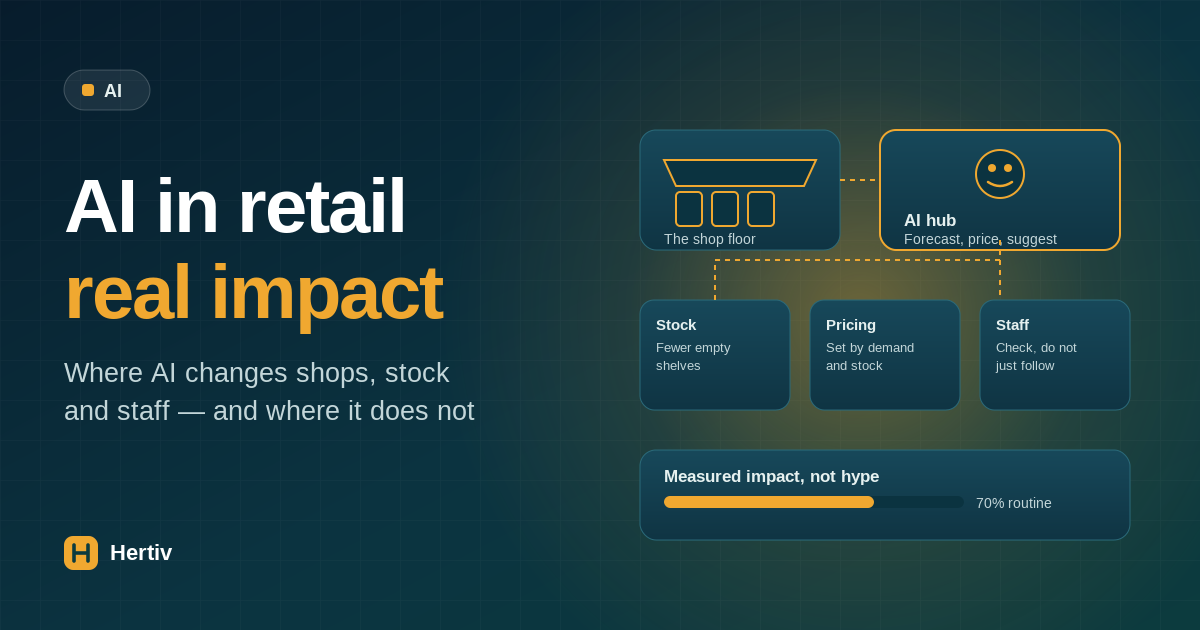
AI is changing retail by automating the routine decisions that used to take staff time: what to stock, what price to set, which products to suggest, and which customer questions to answer. The impact is largest in stock, pricing and online service, and smaller on the shop floor, where customers still value people.
What does AI change in retail?
AI changes retail by taking over the repetitive decisions that sit behind a shop: forecasting demand, setting prices, suggesting products and answering routine questions. Those decisions used to depend on a manager's habit and a spreadsheet. Now they are made from sales data, often every day or every hour.
The change is not one technology. Demand forecasting uses past sales and seasonal patterns. Recommendations use what similar customers bought. Chat and voice tools answer questions about stock, delivery and returns. Cameras and sensors count footfall and watch shelves. Each one is a separate tool with its own limits.
The impact is uneven. Online retail feels it first, because every click and purchase is already data. Physical shops feel it more slowly, because the work there is physical: stacking shelves, serving customers and handling returns. A retailer that expects AI to change everything at once will be disappointed; one that picks one decision to improve will see a result.
How does AI change what customers experience?
AI changes what customers experience mainly through recommendations and service. A website that suggests the right size, the matching item or a useful alternative saves the customer time, and that is the most visible impact. Search that understands plain language, such as "black shoes for wet weather", works the same way: it removes friction from finding a product.
Service is the second visible change. Chat tools answer routine questions at any hour: where is my order, can I return this, is this in stock near me. When the question is simple and the answer is in the system, the customer gets it in seconds instead of waiting for an agent. When the question is a complaint or a special case, a person still handles it better.
The risk is over-personalisation. Recommendations that are too aggressive feel intrusive, and a website that only shows what the customer already likes narrows what they discover. The retailers that do this well treat recommendations as a suggestion, not a push, and keep the customer in control of what they see.
How does AI change stock, pricing and the back office?
AI changes stock and pricing by making them faster and more granular. Demand forecasting predicts how much of each product each store needs, which reduces both empty shelves and excess stock. Pricing tools adjust prices by demand, stock level and competitor prices, where the retailer allows it.
| Area | What AI does | Where the gain shows |
|---|---|---|
| Demand forecasting | Predicts sales per product and store | Fewer empty shelves, less excess stock |
| Pricing | Adjusts prices by demand and stock | Better margins, fewer markdowns |
| Invoice processing | Reads invoices and flags mismatches | Less manual checking, faster payment |
| Returns review | Spots patterns in returned products | Faulty listings fixed sooner |
| Product content | Checks descriptions and images | Fewer errors going live |
The back office changes in quieter ways. AI reads invoices and delivery notes, flags mismatches, and routes exceptions to the right person. It reviews product descriptions and images for errors before they go live. It spots patterns in returns, such as a size that is consistently returned, and flags the listing for review.
These changes are where the money is, even though customers never see them. A forecast that is slightly better, applied across hundreds of products and stores, adds up to real savings in stock and markdowns. That is why predictive analytics is usually the first AI investment a retailer makes, ahead of customer-facing tools.
How does AI change retail jobs and staffing?
AI changes retail jobs by removing routine tasks and adding new ones. Staff spend less time counting stock, checking prices and answering the same questions, and more time on the work that needs a person: helping a customer choose, handling a complaint, or fixing a display that is not selling.
The shift is real but slower than the headlines suggest. Shops still need people on the floor, and the staff who remain need new skills: reading a forecast, checking an AI suggestion before acting on it, and knowing when to override it. A forecast that says a product will sell is a suggestion, and a member of staff who knows the local area may know better.
Retailers that handle this well train staff on the tools instead of presenting them as replacements. The job changes from doing the arithmetic to checking it, and that is a different skill. Teams that skip the training usually find that staff ignore the tools, and the investment quietly fails.
Example (hypothetical): one shop's first year with AI
Example (hypothetical): a clothing chain with 12 stores starts with two tools: demand forecasting for stock, and a chat tool for routine customer questions. Before the change, each store manager spent 6 hours a week on stock orders, which is 12 times 6, or 72 hours a week across the chain.
With forecasting, the ordering time falls to 2 hours a week per store, which is 12 times 2, or 24 hours a week. That is a saving of 72 minus 24, which is 48 hours a week, or about 2,400 hours a year at 50 working weeks.
The chat tool answers 1,000 questions a month, of which 600 are routine and handled without a person. If each routine question used to take 4 minutes of agent time, that is 600 times 4, which is 2,400 minutes, or 40 hours a month saved.
The numbers are invented to show the arithmetic, not a real result. The point is that the saving comes from routine work, and it only holds if staff trust the tools enough to use them.
What are the limits and risks of AI in retail?
The limits and risks of AI in retail start with data quality. A forecast is only as good as the sales history behind it, and a new product with no history cannot be forecast well. A pricing tool that learns from a bad price will repeat the mistake faster than a person would.
Bias is a real risk in recommendations and hiring tools, because the data reflects past decisions. A recommendation system trained on past purchases can keep showing the same products to the same customers and hide new ones. Regular review of what the system suggests, and to whom, is part of running it.
There is also the risk of losing the human touch. A shop that replaces staff with screens saves money in the short term and loses the reason customers came in. The retailers that get the balance right use AI for the decisions behind the counter and keep people in front of it. For teams weighing the first step, an AI readiness assessment ranks use cases against the data the team actually has.
What are the common mistakes?
The most common mistakes with AI in retail are buying the tool before naming the decision it should improve, trusting the forecast without checking it, and removing staff before the tools are proven.
- Buying the tool first. A retailer that buys a forecasting tool and then looks for a problem to solve ends up with a tool in search of a job.
- No human check. A forecast or a price that nobody reviews will eventually be wrong in a way that costs money.
- Dirty data. Sales history with missing or mislabelled products produces forecasts that look confident and are wrong.
- Cutting staff too soon. Removing floor staff before the tools are trusted leaves customers with nobody to help them.
- Measuring the wrong thing. Counting how many questions the chat tool answered says nothing about whether customers were happy.
The fix for most of these is the same: pick one decision, measure the result on real data, and keep a person in the loop until the tool has earned trust.
Key takeaways
- AI changes retail most in stock, pricing and online service, and least on the shop floor
- The biggest savings come from routine decisions made faster, not from replacing staff
- Forecasts and prices need a human check, because bad data makes confident mistakes
- Staff roles shift from doing the arithmetic to checking it
- Pick one decision, measure the result, and keep a person in the loop
Frequently asked questions
What is the biggest impact of AI in retail today?
Demand forecasting and routine customer service show the clearest impact, because both have measurable outcomes and existing human review. Recommendations on websites are close behind, since they fit the shopping flow customers already follow.
Will AI replace shop staff?
Not in the near term. AI removes routine tasks such as stock counting and answering the same questions, but shops still need people for advice, complaints and the physical work of the floor. The job changes more than it disappears, and staff need training for the new tasks.
How do small retailers start with AI?
Start with one decision that is already data-driven, such as reordering stock or answering common questions online. A small pilot on real data, with a person checking the results, teaches the team more than a large programme. Cost is a real factor, so see vendor site for current pricing.
Does AI in retail raise privacy concerns?
Yes, where it uses customer data for recommendations or cameras for counting footfall. Retailers need clear rules on what is collected, how long it is kept, and what customers can opt out of. Those rules should be written before the tools are switched on, not after.
How do you measure whether retail AI is working?
Pick one outcome per tool, such as stock-outs, markdown rates, or time to answer a customer question. Track it on real data before and after the change. Counting usage alone, such as how many questions a chat tool answered, says nothing about whether customers were helped.
What is the difference between AI in retail and e-commerce AI?
E-commerce AI works on complete data, because every click and purchase is recorded. Physical retail AI works with partial data, from tills, sensors and loyalty cards, and has to handle the physical side of the shop. The tools overlap, but the data and the limits differ.


