How to Write a Mobile App RFP That Gets Good Bids
A mobile app RFP describes the app, the users, the features and the budget so every vendor quotes on the same scope. Here is what to include.
On this page
Short answer
A mobile app RFP is a written brief sent to app developers that describes the app, its users, its features and its constraints so every vendor quotes on the same scope. A good RFP states a clear goal, lists features in priority order, names integrations and a budget range, and defines how bids will be judged.
What is a mobile app RFP?
A mobile app RFP, or request for proposal, is a written brief that a company sends to app developers to ask for a price and a plan. It describes the app, the users, the features and the constraints, so every vendor quotes on the same scope.
Without an RFP, each vendor guesses at the scope and the quotes cannot be compared. One vendor prices a simple version, another prices a rich one, and the numbers look unrelated. A good RFP removes the guessing.
An RFP is not a full specification. It gives vendors enough detail to estimate honestly and to ask good questions, while leaving room for their own suggestions. The best RFPs read like a clear problem statement, not a list of demands.
What goes in a mobile app RFP?
A mobile app RFP covers the business goal, the users, the features, the technical constraints and the way you will judge the bids. Missing any one of these invites vague quotes.
| Section | What to write | Why vendors need it |
|---|---|---|
| Background and goal | What the business does, what the app must achieve | So the vendor can suggest the right approach |
| Users | Who uses the app and what they do with it | So the design and features fit real people |
| Features | Must-have and nice-to-have, in priority order | So the price matches the scope |
| Platforms | iOS, Android, or both, and how to build | So the vendor prices the right build |
| Integrations | Payments, maps, CRM, existing systems | So hidden work is priced, not discovered later |
| Timeline and budget | Target dates and a budget range | So vendors can say honestly if it fits |
| How bids are judged | Criteria and weights, decision date | So vendors know what matters to you |
Write the features in priority order. A vendor that knows which features matter most can propose a first version that fits the budget, instead of quoting everything at once. For help thinking through the platform choice, choosing the right mobile app platform covers the trade-offs.
How to write a mobile app RFP, step by step
Writing an RFP is a short project of its own. A week of careful writing saves months of confusion later.
- Write the goal in one paragraph. State what the app must achieve for the business and for its users. If you cannot write this clearly, the vendors cannot price it clearly either.
- List the users and their tasks. Describe who opens the app and what they need to do in it. Real tasks beat generic user types.
- Sort features into must-have and nice-to-have. Be honest about what can wait. A first version with the essentials is better than a long list nobody can price.
- Describe integrations and constraints. Name the systems the app must connect to, and any rules such as data location, accessibility or app store policies.
- Set a timeline and a budget range. A range is fine, but a missing budget invites quotes from the cheapest to the most expensive with no way to compare them.
- Define how you will judge bids. List the criteria, such as relevant experience, team, approach, price and timeline, and say how much each counts.
- Send it to three to five vendors. Fewer than three gives no comparison; more than five wastes everyone's time.
Give vendors at least two weeks to respond, and answer their questions in writing so every bidder gets the same information.
Example (hypothetical): an RFP for a booking app
Example (hypothetical): a small hotel chain wants a booking app for iOS and Android. The RFP states the goal in one line: let guests book a room in under three minutes without calling the hotel.
The feature list has eight must-haves, including search, room choice, payment and booking confirmation, and six nice-to-haves, including loyalty points and local guides. The RFP names the existing booking system the app must connect to, and sets a budget range.
The core scope is estimated at 1,200 hours at $85 an hour, which is $102,000. The RFP asks vendors to price a 15% contingency separately, which adds $15,300, bringing the planned total to $117,300. Because the arithmetic is shown in the RFP, vendors can see how the budget was built and price against it honestly.
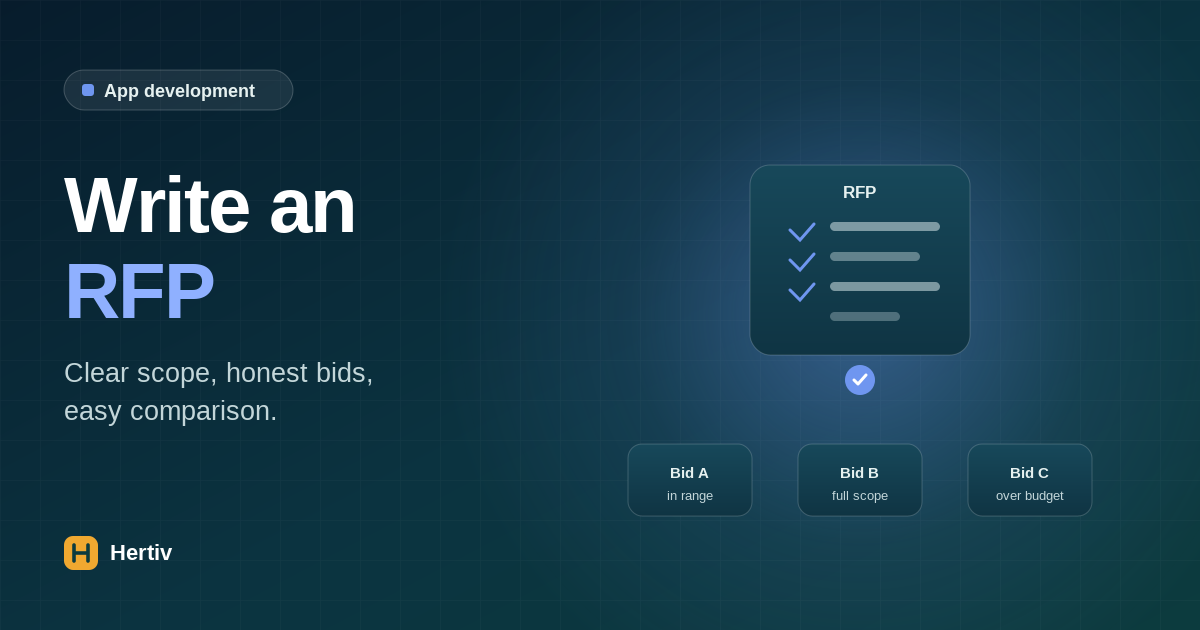
Three vendors reply. One quotes below the range and drops two must-have features; one quotes inside the range with the full scope; one quotes above it with a longer timeline. The comparison is easy because the scope was the same for all three.
Common mistakes in mobile app RFPs
The most common RFP mistakes are vague goals, endless feature lists, and hiding the budget.
- No clear goal. An RFP that lists features without saying what the app must achieve gets quotes for a feature list, not a product.
- Everything is must-have. A list of fifty must-have features cannot be priced honestly. Sort them, and let vendors propose a first version.
- Hidden budget. Vendors who do not know the budget guess, and the guesses range widely. A range focuses the quotes.
- No integrations listed. The payment gateway or booking system the app must connect to is often where the real work hides. Name every integration.
- Judging on price alone. The cheapest bid often means the thinnest team or the most cut corners. Score experience, approach and team alongside price.
How to compare the bids you get
Compare bids with a simple scorecard, not by price alone. Score each vendor on the criteria you set in the RFP, and use the same weights for all of them.
A workable scorecard gives points for relevant experience, the proposed team, the technical approach, the timeline and the price. Ask each vendor to break the price down by phase, so you can see what the first version costs and what later phases add.
Then talk to the top two vendors. A short call reveals more than a long document: ask how they would handle a change in scope, what they need from your team, and who exactly would work on the app. The answers tell you whether the team is real and whether the plan is honest.
Finally, check references. Ask past clients whether the app shipped on time, whether the price held, and whether the team stayed the same through the project. A vendor that passes the scorecard and the references is a safer choice than the cheapest quote. For a wider view of the decision, what an MVP is helps to frame the first version you should ask vendors to price.
Key takeaways
- An RFP exists so vendors quote on the same scope and the bids can be compared
- Include the goal, users, features in priority order, integrations and a budget range
- Send the RFP to three to five vendors and give them at least two weeks
- Show the budget arithmetic so vendors can price honestly
- Judge bids on experience, team, approach and price, not price alone
Frequently asked questions
How long should a mobile app RFP be?
Long enough to describe the goal, users, features and constraints, and no longer. Most good RFPs run five to ten pages. A one-page brief is too vague to price, while a fifty-page document discourages good vendors from replying.
Should I include a budget in the RFP?
Yes, as a range. A budget range focuses the quotes and stops vendors from guessing. It also lets vendors say honestly whether the scope fits, instead of quoting a cut-down version and adding costs later.
How many vendors should I send the RFP to?
Three to five is the right range. Fewer than three gives no comparison, while more than five wastes time for everyone, since each vendor spends real effort on a proposal. Pick vendors with relevant experience first.
What is the difference between an RFP and a specification?
An RFP is a brief that asks vendors for a price and a plan, while a specification is a detailed description of how the app must be built. The RFP comes first; the specification is usually written with the chosen vendor after the bid.
How do I know if a bid is too cheap?
Compare the hours and the team behind the price. A bid far below the others usually means fewer hours, a thinner team, or features left out. Ask the vendor to break down the price by phase and check the scope matches the RFP.
Can I change the scope after vendors reply?
Yes, but tell all vendors about the change and let them revise their bids. Changing the scope for one vendor only makes the comparison unfair, and the final price will not match the quote you accepted.


