How to Validate a Startup Idea Before You Build It
Validating a startup idea means testing whether real people will pay for it before you build. Interviews, landing pages and small paid tests give the answer.
On this page
Short answer
To validate a startup idea, test whether a specific group of people has a painful problem and will pay for a solution, before you build anything. Use customer interviews, a landing page, a concierge test and a small paid offer, and decide in advance what result counts as a pass.
What does it mean to validate a startup idea?
Validating a startup idea means gathering evidence that real people have the problem you want to solve and will pay for a solution, before you spend months building a product. Validation is not the same as enthusiasm: friends saying the idea sounds good is not evidence.
The test is always the same. Find the people who have the problem, watch how they solve it today, and see whether they will spend time or money on your version. If they will not, the idea needs to change, not the pitch.
Validation usually takes weeks, not months. A landing page, a set of interviews and a small manual service can answer the core question faster than any prototype. Teams that skip this step often build a polished product for a problem nobody feels strongly about, which is where the MVP idea comes in: build the smallest version only after the problem is confirmed.
Why do most ideas fail validation?
Most ideas fail validation because the problem is not painful enough, the audience is too broad, or the solution is aimed at a problem people already solve for free. Each of these is fixable, but only if you learn it before building.
A problem that is merely annoying rarely supports a business. People will pay to remove a pain that costs them real time or money each week, and they will tolerate a workaround for anything less. If your interviews keep hearing "that would be nice", the problem is probably too weak.
A broad audience is the second trap. "Small businesses" is not an audience; a specific group with a shared workflow is. Narrowing the audience makes interviews easier, the landing page sharper, and the first customers findable.
Which validation methods work best?
The validation methods that work best are the ones that ask people to spend something: time, money or reputation. A survey is cheap to run and cheap to ignore; a paid pre-order or a booked call is a real signal.
Customer interviews come first. Ten to fifteen conversations with people who have the problem, focused on how they handle it today, will reveal whether the pain is real and what they already pay to ease it. Ask about the past, not the future: what did you do last time this happened?
A landing page tests the message. If the page describes the outcome in the customer's words, a visitor who leaves an email is a weak signal and a visitor who books a call is a stronger one.
| Method | What it proves | Signal strength |
|---|---|---|
| Customer interviews | The problem is real and painful | Medium |
| Landing page | The message is clear | Low to medium |
| Concierge test | People use the manual version | High |
| Paid pre-order | People will pay | High |
| Smoke test ads | Demand exists at a price | Medium |
| Waitlist | Curiosity, not commitment | Low |
A concierge test, where you deliver the service by hand to a few customers, is the strongest cheap test. If people keep using the manual version, the product is worth building.
How do you validate an idea, step by step?
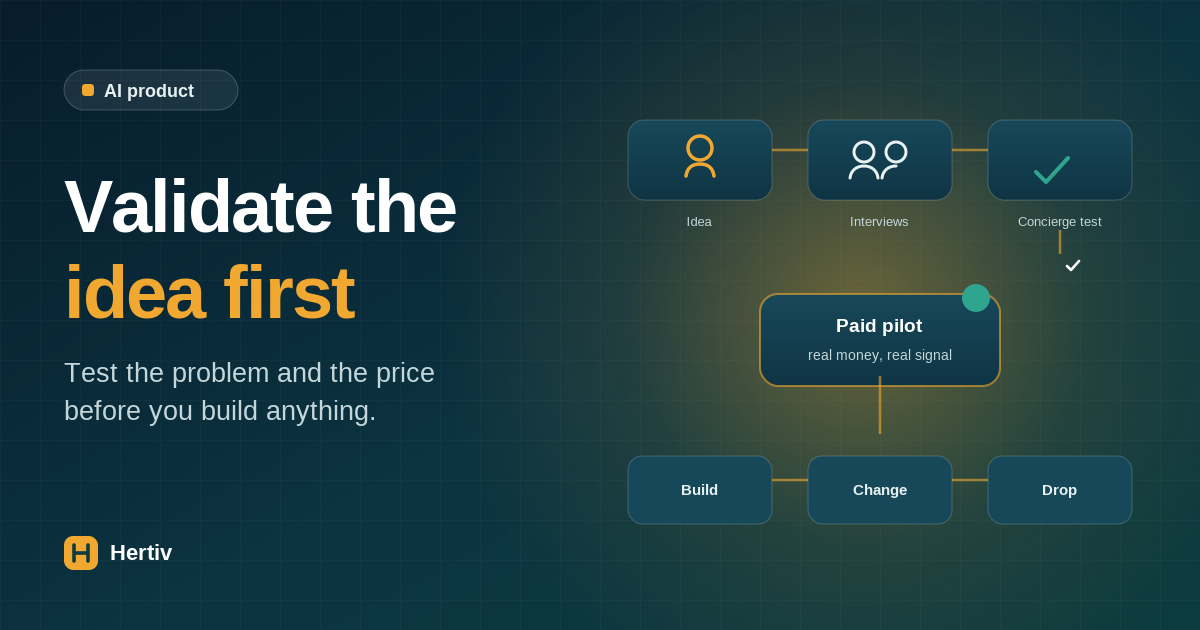
You validate an idea by narrowing the audience, testing the problem, then testing willingness to pay, in that order. Skipping the problem test and jumping to pricing is the usual mistake.
- Write the idea in one sentence. Name the audience, the problem and the outcome. If it takes a paragraph, it is not clear enough yet.
- Interview 10 to 15 people. Ask how they solve the problem today, what it costs them, and what they have already tried.
- Decide what counts as a pass. For example: at least half the interviewees describe the problem as painful and recurring.
- Build a landing page. Use the customers' own words, one clear offer, and a call to action that costs something, such as booking a call.
- Run a concierge test. Deliver the service manually to three to five customers and watch whether they return.
- Ask for payment. A small paid pilot or pre-order is the real test; free users tell you almost nothing about willingness to pay.
- Decide: build, change or drop. If the signals are weak, change the audience or the problem before writing code.
Write the pass criteria down before you start. Without them, every weak signal looks like a reason to keep going. A short proof of concept is the right next step once the idea passes these tests.
Example: validating a tool for small clinics
Example (hypothetical): a founder wants to build a tool that reminds clinic patients about follow-up appointments. Before building, she interviews 12 clinic managers and learns that missed follow-ups cost each clinic about 8 hours of staff time a week, and that two clinics already pay for a reminder service they dislike.
She builds a landing page in the managers' own words and books calls with 6 of the 12. She then runs the service by hand for 3 clinics for two weeks, sending the reminders herself. All 3 ask to continue, and 2 offer to pay $40 a month each.
The arithmetic is simple: 3 clinics x $40 = $120 a month from a manual test, plus 6 more clinics on the waitlist. That is enough evidence to build a small version for those 3 clinics first, rather than a full product for every clinic. The idea passed because the problem was painful, the audience was specific, and payment came before the build.
What are the common mistakes?
The most common validation mistakes are asking leading questions, counting polite interest as evidence, and validating the solution instead of the problem.
- Asking "would you use this?" People say yes to be polite. Ask what they did last time the problem occurred instead.
- Counting signups as validation. An email address costs nothing; a paid pilot or a booked call is the real signal.
- Validating the solution. Testing whether people like your design skips the question of whether they have the problem at all.
- Interviewing the wrong people. Friends and family are kind; strangers who have the problem are honest.
- No pass criteria. Without a decision rule written in advance, every test result can be read as encouragement.
What do you do after validation?
After validation, the next step depends on what the tests showed. A strong signal means building the smallest version for the people who already paid or booked; a weak signal means changing the audience, the problem or the offer before building anything.
If the concierge test worked, build the version that automates only the manual steps you already performed. Keep the audience narrow and the feature list short, because the first customers are the ones who will tell you what to build next.
If the signal was weak, treat the result as useful information, not failure. A pivot to a narrower audience or a sharper problem is cheaper now than after months of building. The validation work is not wasted: the interviews and the landing page tell you exactly which direction to try next.
Once the idea passes, the next step is a small testable version; see ways to test an MVP for how to run that test.
Key takeaways
- Validation tests whether people will pay, not whether they like the idea
- Interviews about past behaviour beat surveys about future intent
- A concierge test and a paid pilot are the strongest cheap signals
- Write pass criteria before testing, or every result looks encouraging
- A weak signal means change the audience or problem, not the pitch
Frequently asked questions
How many interviews are enough to validate an idea?
Ten to fifteen interviews with people who have the problem is usually enough to see the pattern. If the first five all describe the same pain and the same workaround, you have a signal; if the answers are all different, the audience is probably too broad.
What is the difference between validation and an MVP?
Validation tests the problem and willingness to pay before building. An MVP is the smallest product built after validation, to test whether the solution itself works. Validation comes first; the MVP tests the next question.
Can you validate an idea without a product?
Yes, and you should. A landing page, interviews and a manual concierge test can validate the problem and the price before any code exists. Building first is the expensive way to learn the same lesson.
What if people say they like the idea but will not pay?
That usually means the problem is not painful enough, or the price is aimed at the wrong person. Try a narrower audience with a sharper pain, or test whether the buyer is someone other than the user.
How long should validation take?
A focused validation round usually takes two to four weeks: a week of interviews, a week for the landing page and calls, and a week or two for the concierge test. If it takes months, the scope is probably too broad.
Should I validate with a survey?
A survey can support interviews, but it cannot replace them. Surveys tell you what people say they do; interviews about real past behaviour tell you what they actually did, which is the evidence that matters.


