How to Start an E-Scooter App Business, Step by Step
Starting an e-scooter app business takes permits, a fleet, an app and a charging plan. This guide covers the steps, the costs and the mistakes to avoid.
On this page
Short answer
An e-scooter app business rents electric scooters by the minute through a phone app. To start one, you need city permits, a fleet of scooters, an app for riders and staff, and a plan for charging and repairs. Most founders start small in one zone and grow only when rides cover daily costs.
What is an e-scooter app business?
An e-scooter app business is a rental service that lets people find, open and pay for an electric scooter through a phone app. Riders pay by the minute or by the ride, and the operator owns the scooters, keeps them charged and repairs them.
Most businesses use one of three models. Dockless rental puts scooters on the street for anyone to pick up. Subscription rental gives regular riders a weekly or monthly plan. A franchise model lets a local partner run the fleet under your brand and app.
| Model | How it earns | Best for |
|---|---|---|
| Dockless rental | Pay per minute or per ride | Busy city centres |
| Subscription | Weekly or monthly fee | Regular commuters |
| Franchise | Fee plus revenue share | Fast growth in new cities |
| Private hire | Fixed hire per day or event | Tourist areas and campuses |
What do you need before you launch?
Before you launch, you need permission from the city. Most cities run a permit or tender process that limits how many operators and scooters can work in each area. Apply early, because a permit can take months and may require safety plans, parking rules and data sharing.
You also need insurance for riders, third parties and your fleet, plus a registered company and a way to take payments. Check local rules on speed limits, where scooters may ride, night use and age limits, since these differ from city to city.
Then choose your fleet. Start with scooters built for sharing, not consumer models: swappable batteries, GPS tracking, strong brakes and parts you can replace quickly. A fleet of 50 to 100 scooters is a common size for a first zone.
Order spares with the first fleet, not after the first breakdowns. Tyres, brakes, batteries and lights wear fast on shared scooters, and a scooter waiting for a part earns nothing. A small stock of spares keeps most repairs to the same day.
How do you build the rider and operator apps?
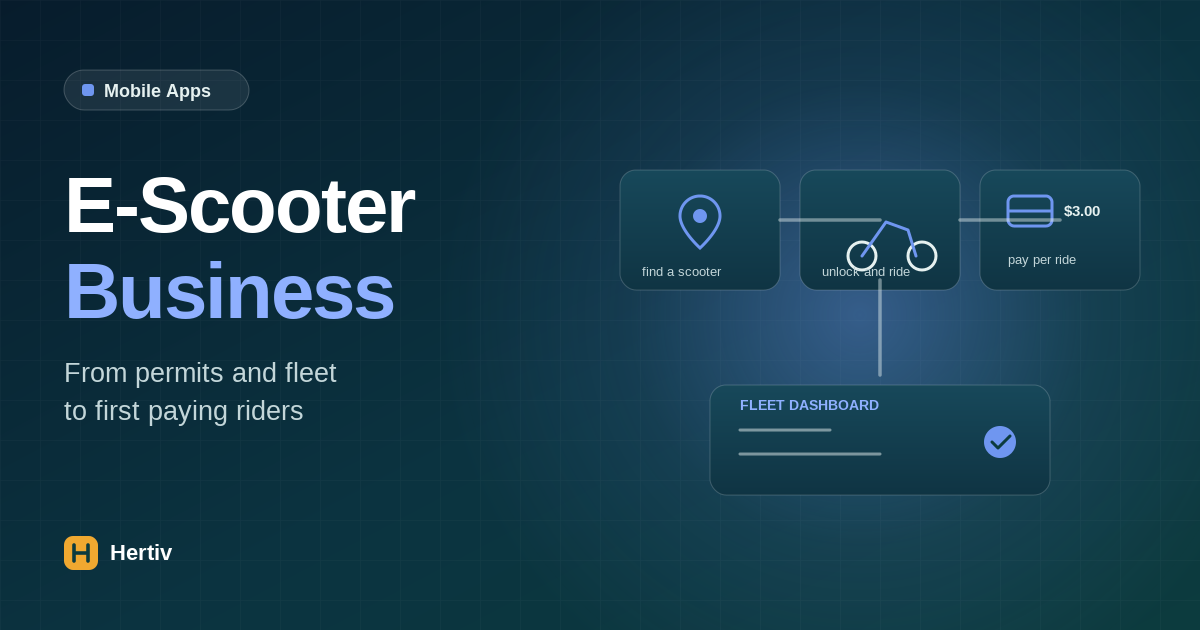
You need two apps: a rider app and an operator app. The rider app shows nearby scooters, opens one, tracks the ride and takes payment. The operator app shows battery levels, locations, faults and daily earnings, so staff know which scooters to collect and charge.
Build in this order:
- Map and open. Show scooters on a map, open by QR code, and lock the ride when it ends.
- Payments. Add card and wallet payments, per-minute pricing, and receipts.
- Safety and rules. Add speed limits, no-ride zones, parking photos and age checks.
- Operator tools. Add battery alerts, fault reports and a dashboard for your team.
- Test in one zone. Run a small pilot, fix the faults, then open more zones.
Many founders start with a cross-platform app to cover both iPhone and Android with one build. You can read about the trade-offs in our guide to native vs hybrid app development before you decide.
A checklist helps keep the build on track. Our mobile app development checklist covers the steps most first-time founders miss, from store submission to launch-day support.
How do you choose a city and a launch zone?
Choose a city where scooters are already legal and the council welcomes operators. Look for short trips that are too far to walk and too short to drive: stations, campuses, office districts and busy shopping streets.
Start in one compact zone with clear demand, not across a whole city. A small zone keeps charging and collection cheap, and it lets you learn where scooters get used, where they get left, and which streets cause complaints.
Talk to the council, local businesses and police before launch. Agree parking spots, no-ride zones and a contact for complaints. Operators that sort this early get fewer fines and faster permit renewals.
How do you run the fleet day to day?
Daily fleet work is charging, moving and fixing scooters. Staff collect low-battery scooters each evening, swap or charge batteries, and return them to busy spots before the morning rush. A scooter that sits flat all day earns nothing.
Set a simple routine: check every scooter's battery and brakes each morning, fix small faults the same day, and retire scooters that cost more to repair than they earn. Track rides per scooter per day, since that number tells you whether a zone is working.
Customer support matters too. Riders will report faulty scooters, wrong charges and parking problems. Answer fast, refund fairly when the fault is yours, and use the reports to find scooters that need repair.
Weather changes the routine as well. Rain cuts rides and leaves scooters wet, while cold weather drains batteries faster. Plan for fewer rides in winter and more charging runs, and keep a small reserve of charged scooters for the morning rush.
Example (hypothetical): a first city launch
A founder launches with 100 scooters in one city zone. Each scooter averages 4 rides a day at $3 per ride, so daily revenue is 100 times 4 times 3, which is $1,200. Over 30 days that is $36,000 in gross revenue.
Daily running costs are $400 for charging and collection, $200 for repairs and parts, and $150 for support and insurance, a total of $750 a day. That leaves $1,200 minus $750, or $450 a day before rent, staff pay and loan costs.
Before launch, the founder checks the idea with a small pilot. Our guide to how to validate your app idea explains how to test demand with real riders before spending on a full fleet. If rides per scooter fall below 3 a day, the numbers stop working, so the founder tracks that figure every morning.
Common mistakes
The most common mistake is launching too wide, too fast. A fleet spread across a whole city is hard to charge and collect, so scooters sit flat and riders find none where they need them. Start in one zone and grow only when rides per scooter stay above your break-even point.
Other mistakes include buying cheap consumer scooters that break in weeks, skipping insurance, and ignoring parking complaints until the council fines you. Each of these costs more to fix later than to plan for at the start.
- Launching everywhere at once. Start in one zone and prove the numbers first.
- Buying the wrong scooters. Use sharing-grade scooters with swappable batteries.
- Skipping permits. Get city permission in writing before you buy a fleet.
- Ignoring charging. A flat scooter earns nothing, so plan charging from day one.
Key takeaways
- Permits, insurance and a legal city come before any fleet purchase.
- Start in one compact zone and grow only when rides cover daily costs.
- You need a rider app and an operator app, with payments and safety rules.
- Track rides per scooter per day; it is the number that decides if a zone works.
- Charging, repairs and parking are daily work, not one-off setup tasks.
Frequently asked questions
Do I need a permit to run e-scooters?
In most cities, yes. Councils usually run a permit or tender process that limits operators and scooter numbers in each area. Apply early and agree parking, speed and data rules in writing before you buy a fleet.
How many scooters do I need to start?
A first zone usually starts with 50 to 100 scooters. That is enough to test demand while keeping charging and collection cheap. Add more only when rides per scooter per day stay above your break-even point.
How much does it cost to start an e-scooter business?
Costs depend on fleet size, city fees, insurance and app build, so there is no single figure. Sharing-grade scooters, permits and a first app version are the largest costs. A small pilot in one zone is the cheapest way to learn the real numbers.
How do e-scooter apps make money?
Most earn per minute or per ride, with some adding weekly or monthly plans for regular riders. Revenue depends on rides per scooter per day, so busy spots and charged scooters matter more than having a large fleet.
What is the hardest part of running the fleet?
Charging and collection. Staff must collect low-battery scooters each evening and return them to busy spots by morning. Without a tight daily routine, scooters sit flat and riders find none when they need one.
Can I run an e-scooter business on my own?
A very small fleet on a campus or resort can work with one or two people, but a city service needs staff for charging, repairs and support. Most founders hire a small operations team once the fleet passes about 50 scooters.


