How to Solve AI Development Challenges: A Practical Guide
AI projects fail on data, testing and scope more often than on model choice. Here is how to find the real blocker in your project and fix it in a sensible order.
On this page
Short answer
AI development challenges are the practical problems that slow or break an AI project, such as messy data, unclear success measures, rising costs and models that behave badly in production. Most of them are engineering and planning problems, not research problems, which means they can be fixed with a clear process, good data and honest testing before launch.
What are AI development challenges?
AI development challenges are the practical problems that slow or break an AI project, such as messy data, unclear success measures, rising costs and models that behave badly in production. They show up in almost every project, from a simple chatbot to a document processing system.
The first challenge is usually data. Models need examples that look like the real work, and most teams find their data is scattered, out of date or labelled inconsistently. The second is knowing what good looks like: without a clear measure, a team cannot tell whether a change helped or hurt.
Other challenges appear later. Costs grow as usage grows, because every request costs compute. Models that passed a demo fail on real inputs, because real inputs are messier than test data. And users lose trust fast when the system gives confident wrong answers with no way to check them.
Which challenges cause the most damage?
The challenges that cause the most damage are bad data, no clear measure of success, and a scope that keeps growing. Fix these first, because model choice matters little while they are unresolved.
| Challenge | How it shows up | First fix |
|---|---|---|
| Messy data | Wrong answers on real inputs | Clean and label a small, real sample |
| No success measure | Arguments about whether it works | Agree one metric and a target |
| Scope keeps growing | Months pass with no launch | Cut to one task and one user group |
| Cost surprises | Bills rise faster than usage value | Track cost per request from day one |
| Bad behaviour in production | Confident wrong answers | Add checks and a human review step |
| Users do not trust it | Low use after launch | Show sources and let users correct it |
Work through the table in order. A team that fixes data and measurement first usually finds the later problems are smaller than feared. A team that starts by tuning the model usually has to redo that work once the data is fixed. A short AI proof of concept is a good way to surface these problems early, while they are still cheap to fix.
How do you fix AI data problems?
You fix AI data problems by starting with a small, real sample and cleaning it properly, rather than collecting more data and hoping the volume hides the errors.
- Collect real examples. Take a few hundred real inputs from the actual work, not examples written for the demo.
- Label a small set by hand. Two people label the same items and compare, so disagreements surface the unclear rules.
- Write the labelling rules down. If two people disagree, the rule is unclear, and the model will learn the confusion.
- Check for gaps. Look for the cases that appear rarely but matter most, such as refunds, complaints or edge cases.
- Keep a clean test set apart. Never train on the data you use to judge the model, or the score will flatter the result.
Data work is slow and unglamorous, but it is where most AI quality comes from. A model trained on clean, representative data will beat a larger model trained on messy data, and it will be cheaper to run. For the build itself, AI proof of concept development covers how to run this work in a few weeks.
How do you test an AI product before launch?
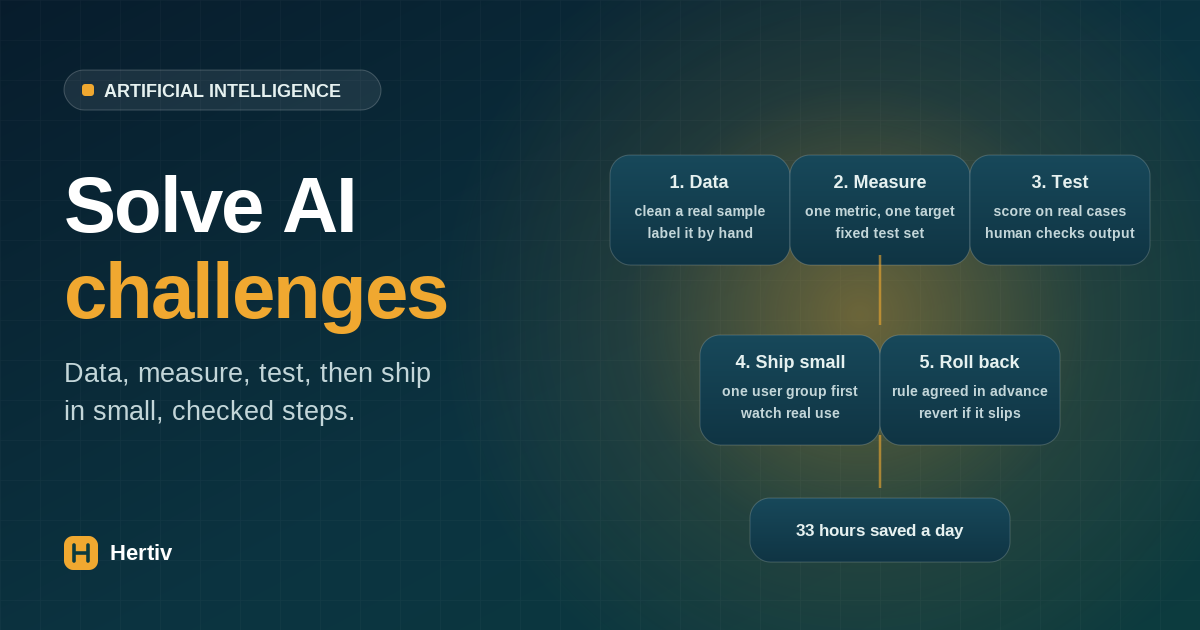
You test an AI product by scoring it on real examples with a clear pass mark, then watching it in a limited live rollout before full release.
Start with an evaluation set of a few hundred real cases, each with the right answer written down. Score the model on that set, and record the score. Every change after that is judged against the same set, so the team can see whether it helped. A model that scores well on the demo but badly on the evaluation set is not ready.
Next, test with real users in a small group. Let the model draft answers or take actions, but keep a human checking the output. Track how often the human changes the answer, and look at the cases where the model was wrong. Those cases tell you what to fix next, and they are usually a small set of patterns, not random noise.
Finally, set a rollback rule before launch. If accuracy or cost crosses a line you agreed in advance, the team rolls back to the previous version instead of debating in a crisis. That rule is what turns a risky launch into a controlled one. For the testing side, how to test AI models explains the checks in more detail.
Example (hypothetical): a support team fixes its ticket triage
Example (hypothetical): a support team handles 400 tickets a day, and each ticket takes about 6 minutes to read and route to the right team. That is 400 x 6 = 2,400 minutes, or 40 hours of routing work every day.
The team builds an AI triage tool, but the first version routes badly. The problem is data: the training labels came from an old system where half the tickets were filed under a catch-all category. The team relabels 500 real tickets by hand, writes down the routing rules, and retrains.
The new version routes well enough that a person only needs to review the uncertain cases. Review takes about 1 minute per ticket, so 400 tickets take about 400 minutes, or just under 7 hours a day. That saves about 33 hours a day, and the team spends it on the hard tickets instead of sorting.
What are the common mistakes?
The most common AI development mistakes are starting with the model instead of the problem, skipping evaluation, and launching without a human check.
- Model first, problem second. Picking a model before defining the task and the measure leads to a demo that nobody can judge.
- Training on demo data. Examples written for a presentation rarely match real inputs, so the model fails on the first real day.
- No evaluation set. Without a fixed test set, every change is a guess, and the team cannot tell if it is improving.
- No cost tracking. Usage-based pricing means a popular feature can become expensive fast, and nobody notices until the invoice arrives.
- Launching without a check. A model that acts without review will eventually make a visible mistake in front of a customer.
How to plan the next fix
You plan the next fix by picking the single blocker that costs the most, fixing it in a small step, and measuring the result before moving on.
- Name the blocker. Write one sentence: the problem, who it affects, and how often it happens.
- Pick the smallest fix. Choose the change you can test in a week, not the redesign that takes a quarter.
- Set the measure first. Agree the metric and the target before you start, so success is not decided afterwards.
- Test on the evaluation set. Compare the new score with the old one, and keep the change only if it improves.
- Roll out to a small group. Watch real use for a week, fix the new problems that appear, and then widen the rollout.
Repeat this loop. AI projects improve in small, measured steps, and each step teaches the team something about its own data and users. That steady loop is more reliable than a big redesign based on a hunch.
Key takeaways
- Most AI project problems are data, measurement and scope, not model choice
- Clean a small real sample by hand before collecting more data
- Judge every change against one fixed evaluation set
- Track cost per request from day one, before usage grows
- Launch with a human check and a rollback rule agreed in advance
Frequently asked questions
How long does it take to fix AI data problems?
It depends on the size of the sample, but cleaning and labelling a few hundred real examples usually takes days, not months. Start small: a clean sample of 500 well-labelled cases will teach you more than 50,000 unlabelled records.
What is the best model for my AI project?
There is no single best model. The right choice depends on the task, the data, the cost per request and how much checking you can do. Test two or three options on your own evaluation set and pick the one that scores best for your cases.
Why does my AI model work in the demo but fail in production?
Demo data is usually clean and narrow, while real inputs are messy and varied. The fix is to test on real examples, label the failures, and add checks for the patterns that appear most often.
How much does it cost to fix AI development problems?
Costs vary with the size of the data and the team, and vendors price differently, so check the vendor site for current plans. The cheapest fixes are usually better data and clearer measures, which cost time rather than new tools.
Should we build our own model or use an existing one?
Most teams should start with an existing model and prompt or fine-tune it, because training a model from scratch is expensive and slow. Build your own only when no existing model handles your task well enough.
How do we keep users trusting the AI system?
Show the source for answers, let users correct mistakes, and keep a human in the loop for important actions. Trust grows when the system is honest about what it does not know.


