How to Scope an AI Development Project in 6 Steps
Scoping an AI development project means defining the job, the data, the success bar and the first version before building, so the team ships something measurable.
On this page
Short answer
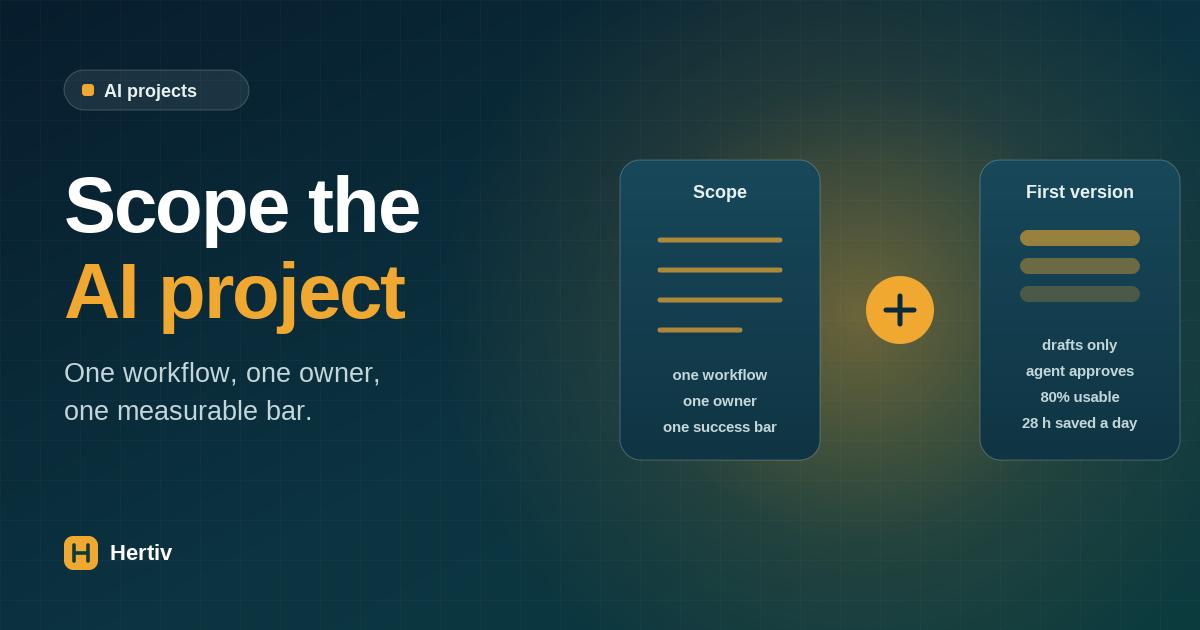
To scope an AI development project, define the exact job the system will do, the data it will use, the success bar it must clear, and the smallest first version that can prove it works. A good scope names one workflow, one owner and one measurable outcome, and leaves everything else for later.
What does it mean to scope an AI development project?
Scoping an AI development project means deciding, before any building starts, what the system will do, what data it will use, how success will be measured, and what the first version will include. The scope is the boundary: everything inside it gets built, and everything outside it waits.
AI projects fail more often from unclear scope than from weak models. A team that starts with 'improve customer service with AI' has no way to know when it is done. A team that starts with 'draft replies for the 300 most common support tickets, with a human approving each one' can plan, test and measure.
A good scope answers four questions: which workflow, which data, which success bar, and which first version. If any of those is vague, the project is not ready to start.
What does an AI project scope cover?
An AI project scope covers the workflow, the users, the data, the success bar, the first version and the limits. Writing each one down before building prevents the most common arguments later.
| Scope part | What to write down | Example |
|---|---|---|
| Workflow | The exact job the system does | Draft replies for billing tickets |
| Users | Who uses it and who checks it | Support agents approve each draft |
| Data | Sources, quality and access | Help centre and 2,000 past tickets |
| Success bar | One number and a threshold | 80% of drafts usable without edits |
| First version | What ships first, and what waits | Drafts only; no auto-sending |
| Limits | What the system will not do | No refunds, no account changes |
The limits row matters most. An AI system that cannot say no will eventually do something it should not. Writing the limits down gives the team a clear rule for when the system hands off to a human.
How do you scope an AI project in 6 steps?
You scope an AI project in six steps: pick the workflow, check the data, set the success bar, define the first version, estimate the effort, and get a decision from the owner. Each step produces a written answer that the team can check.
- Pick one workflow. Choose a job where people already copy information between systems and a wrong answer is caught by a human. Write it in one sentence.
- Check the data. Find the real inputs and the known good outputs. If you cannot gather 20 to 50 examples this month, the workflow is not ready.
- Set the success bar. Pick one number, such as the share of drafts usable without edits, and the threshold that counts as good enough to ship.
- Define the first version. List what ships first and what waits. The first version should be small enough to build in weeks, not months.
- Estimate the effort. Include integration, evaluation and change management, not just the model work. The model is rarely the hard part.
- Get a decision. The workflow owner signs off on the scope, the success bar and the first version. Without an owner, the project drifts.
A short AI proof of concept is the usual way to test a scope: a fixed set of real cases, a fixed success bar, and a decision at the end.
How do you keep an AI project scope from growing?
You keep an AI project scope from growing by writing the first version down, giving every new request a cost, and letting the owner decide what waits. Scope grows when new ideas are added without anything being removed.
Three habits help:
- A written first version. If a feature is not on the list, it is not in the first version. The list is the decision, not a draft.
- A cost for every addition. Each new request gets an estimate in days and a note on what it delays. Most requests look different once the cost is visible.
- A weekly scope check. The owner reviews the list once a week and confirms what is in and what is out. Small checks beat a big review at the end.
AI projects attract new ideas because the demo looks easy. The scope document is the counterweight: it reminds everyone what was agreed and what the success bar is.
What should you leave out of the first version?
You should leave out of the first version anything that is not needed to prove the workflow works: extra channels, extra languages, automatic actions and broad permissions. The first version proves the value; the second version expands it.
Common items to leave out:
- Auto-sending. Drafts that a human approves are safer than messages sent without review.
- Extra channels. One channel, such as email, is enough to prove the workflow before adding chat or voice.
- Extra languages. One language first, then add more once the quality bar is met.
- Write access. A system that reads data but cannot change it is far safer than one with write access.
- Broad permissions. Give the system access to the one dataset it needs, not to everything.
For guidance on what a first version can look like, how to scope an MVP you can ship in 10 weeks covers the same discipline for product scope.
Example (hypothetical): scoping a support draft project
Example (hypothetical): a support team handles 400 tickets a day. Each ticket takes an agent about 5 minutes to answer by hand, which is 400 x 5 = 2,000 minutes, or about 33 hours of agent time a day. The team wants an AI system to draft replies.
The scope they write down is narrow: draft replies for the 300 most common billing tickets, using the help centre and 2,000 past tickets as data. The success bar is that 80% of drafts are usable without edits. The first version drafts only; an agent approves every reply. Refunds and account changes are out of scope.
After a month, the drafts are usable without edits on 240 of the 300 tickets, which is 240 / 300 = 80%, meeting the bar. Agents review each draft in about 1 minute, so the daily review time is 300 x 1 = 300 minutes, or 5 hours. The team saves roughly 33 - 5 = 28 hours a day on those tickets, and the scope document is what made that number easy to check.
What are the common mistakes?
The most common mistakes in scoping AI projects are starting with the model, skipping the success bar, and letting the first version grow until it cannot ship.
- Starting with the model. Picking a model before defining the workflow leads to a demo, not a product.
- No success bar. Without one number and a threshold, nobody can say whether the project worked.
- No owner. A project with no workflow owner has no one to decide what waits and what ships.
- Bad data, late discovery. Checking the data after building wastes weeks. Check it in the scoping step.
- First version too big. A first version that takes months to build is really three projects.
- Forgetting the review step. If no human checks the output, the first confident error reaches a customer.
Before building, how to evaluate an LLM application before launch covers the test set and the checks that belong in the scope.
Key takeaways
- Scope means one workflow, one owner, one success bar and one small first version
- Check the data during scoping, not after building has started
- Write the limits down: what the system will not do is as important as what it will
- Every new request gets a cost and a decision from the owner
- The first version proves the value; expansion comes after the bar is met
Frequently asked questions
What is AI project scoping?
AI project scoping is the work of defining what an AI system will do, what data it will use, how success will be measured and what the first version includes, before any building starts. A good scope names one workflow, one owner and one measurable outcome.
How long should scoping an AI project take?
For a narrow workflow, scoping usually takes one to three weeks: a few days to pick the workflow and gather examples, and a few more to set the success bar and agree the first version. If the data is hard to find, that is a signal the workflow is not ready.
What is a good success bar for an AI project?
A good success bar is one number with a threshold, such as 80% of drafts usable without edits, or 90% of extracted fields correct. It should be measured on a fixed set of real cases, so the team can compare results over time and know when the bar is met.
Should the first version of an AI project be a proof of concept?
Often yes. A proof of concept with a fixed test set and a fixed success bar is the cheapest way to find out whether the workflow works. If it meets the bar, the team can plan the production version with real numbers instead of guesses.
Who should own the scope of an AI project?
The owner should be the person responsible for the workflow, such as the support lead or the operations manager, not the engineering team alone. The owner decides what is in scope, what waits, and whether the success bar is good enough to ship.
What happens if the data is not good enough during scoping?
Then the project should pause and fix the data first, or pick a different workflow. Building on messy or missing data produces a system that cannot be measured, and the team will spend the project arguing about quality instead of shipping.


