How to Manage a Remote Software Development Team
Managing a remote team means replacing office habits with written plans, clear rhythms and regular feedback. Here is how to set it up so the team ships well.
On this page
Short answer
Managing a remote software development team is the work of keeping a group of developers productive, aligned and supported when they work from different places and time zones. It replaces office habits, such as walking over to a desk, with written plans, a fixed meeting rhythm, clear ownership and regular feedback. The goal is a team that ships steadily without depending on who is online at the same time.
What does managing a remote development team involve?
Managing a remote software development team involves setting the direction, keeping the work visible, and supporting the people, all without sharing an office. The manager's job is to make sure everyone knows what matters, what they own, and how their work will be reviewed.
Three things change when a team goes remote. First, information stops travelling by accident, so it has to be written down. Second, time zones shrink the hours when everyone is online together, so decisions need to work without a meeting. Third, the manager sees less of the day-to-day work, so progress has to be visible in the tools, not in who looks busy.
The work itself does not change: the team still plans, builds, tests and ships. What changes is the plumbing around it. A remote team needs a written plan, a regular rhythm, and a way to raise problems early, because a problem that is invisible for a week is much harder to fix than one raised the same day.
Teams that hire remotely often start with a partner model, and the hiring side is covered in what a dedicated development team is. This article covers the managing side: the rhythm, the communication and the checks.
How do you set up the working rhythm?
You set up the working rhythm by fixing a small set of meetings and the hours when the team overlaps, then protecting both. A remote team needs fewer meetings than an office team, but the ones it has need to start on time and end with decisions.
A rhythm that works for most teams:
| Ritual | How often | What it decides |
|---|---|---|
| Daily standup | Daily, 15 minutes | What each person is doing and what is blocked |
| Planning | Each sprint | What the team will build next |
| Demo | Each sprint | What is done and ready to review |
| Retrospective | Each sprint | What to change about how the team works |
| One-to-one | Weekly | How each person is doing, in private |
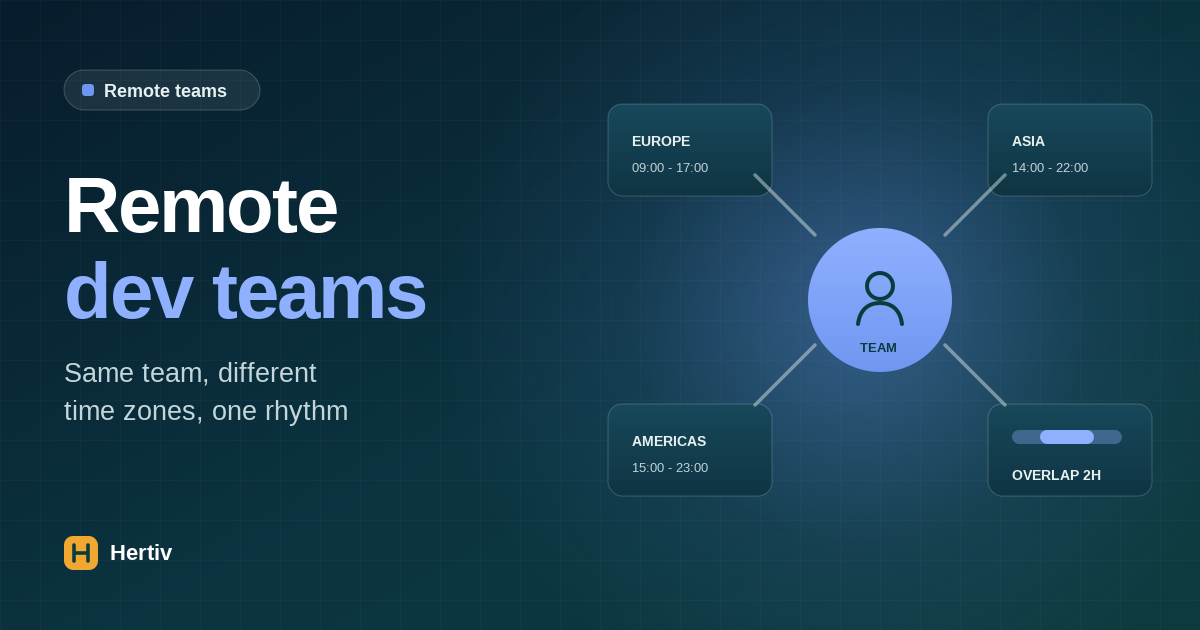
Keep the overlap hours fixed and short, usually two to four hours a day when everyone is online. Outside those hours, the team works on its own schedule, and decisions wait for the overlap or are made in writing. That is the trade that makes time zones work instead of fighting them.
Write the rhythm down and share it with the team. A new joiner should be able to read one page and know when the meetings are, what each one is for, and how to get a decision when the manager is offline.
How do you keep communication clear?
You keep communication clear by writing things down and choosing the right channel for each kind of message. In a remote team, a chat message is for quick questions, a document is for decisions, and a call is for the conversations that need tone and back-and-forth.
Decisions should live in writing, with the date, the options considered and who decided. When a decision lives only in a call, the people who were not there cannot follow it, and the team argues about it again a week later. A short written record ends that.
Status updates work better in writing too. A short daily note in the team channel, covering what was done, what is next and what is blocked, replaces the standup for people outside the overlap hours. It also creates a record the manager can read without chasing anyone.
Calls still matter, but they should have a purpose and a note. A call with no note is a call the team has to repeat. A call that ends with a written summary in the channel is a call that moves the work forward.
How do you track progress without watching screens?
You track progress by looking at the work, not at the people. The board, the pull requests and the demo show what is done; how long someone sat at a keyboard does not.
Three checks give a clear picture. First, the board: is work moving from planned to done at a steady pace, or is it piling up in review? Second, the pull requests: are reviews happening within a day, or do they wait until the end of the sprint? Third, the demo: can the team show working software each sprint, or only describe it?
These checks also show problems early. Work stuck in review usually means the reviewer is overloaded or the change is too big. Work that never reaches the demo usually means the scope was unclear. Both are fixed by changing the work, not by watching the team more closely.
Screen monitoring and keystroke tracking are a poor substitute. They measure presence, not output, and they damage trust, which is the thing a remote team runs on. If you do not trust the team, no tool will fix that, and if you do, you do not need the tool.
How do you hire and onboard remotely?
You hire remotely by testing the work, not the interview performance. A short paid task that mirrors the real job, reviewed the way real code is reviewed, tells you far more about a developer than a whiteboard question.
Onboarding is where remote teams usually fail. A new developer who cannot set up the project, find the docs and get a first change reviewed in the first week will stay slow for months. The fix is a written onboarding guide, a named buddy, and a first task that is small enough to finish in a day.
The guide should cover the setup steps, the tools and accounts, the code layout, the review process and who to ask about what. It should be tested by the next new joiner, who marks every step that does not work. A guide that is never tested rots quickly.
Hiring models differ, and the choice between hiring directly and working with a partner changes the process. The comparison in dedicated team versus freelance developers covers the trade-offs on that side.
Example (hypothetical): a six-person team across three time zones
Example (hypothetical): a six-person team works from three time zones, with two developers in each. The overlap is two hours a day, from 14:00 to 16:00 in the middle zone, and the sprint is two weeks long.
The team plans 60 points of work per sprint. With six developers, that is 10 points each, or about one point per working day. The daily standup runs in the overlap, and the rest of the day is for focused work, reviews and written updates.
One sprint, the team finishes 45 of the 60 points, and 15 points carry over. The retrospective finds the cause: reviews waited an average of two days because only one senior developer reviewed everything. The fix is simple: two developers share the review load, and changes under 200 lines are reviewed within a day.
Next sprint, reviews take under a day, and the team finishes 58 of 60 points. The arithmetic shows the point: the team did not need more hours, it needed the review bottleneck removed. The overlap hours stayed at two a day throughout.
What are the common mistakes?
The most common mistakes in managing a remote development team are copying office habits, measuring presence instead of output, and letting decisions stay unwritten.
- Copying the office schedule. Eight hours of overlap across time zones exhausts everyone. Fix two to four overlap hours and let the rest be flexible.
- Measuring presence. Green dots and keystroke counts measure sitting, not shipping. Measure the board, the reviews and the demo.
- Decisions without a record. A decision made on a call and never written down will be argued about again. Write it down with the date.
- Too many meetings. A remote team needs fewer meetings, not more. If a meeting has no decision, replace it with a written update.
- Skipping one-to-ones. A weekly one-to-one is where problems surface early. Cancel them and problems surface late, when they are bigger.
- Onboarding by shadowing. There is no desk to sit next to. A written guide and a named buddy are the replacement.
A weekly checklist for remote team leads
A weekly checklist keeps the managing work visible, so it does not get crowded out by the building work. Run through it at the same time each week.
- Read the board. Check what moved, what is stuck, and what has been in review for more than a day.
- Review the demo. Confirm the team can show working software from the last sprint, not just describe it.
- Check the blocked list. Ask each person what is blocked, and remove one blocker yourself this week.
- Hold the one-to-ones. Keep them short and private, and ask how the person is doing, not just what they are doing.
- Write one decision down. Pick the most important decision of the week and record it with the date and the reasons.
The checklist is small on purpose. A remote team runs on rhythm and trust, and both are built by small, repeated actions rather than big gestures. Teams that want help setting up the structure can talk to a partner for dedicated team support, who can provide the developers and the working rhythm together.
Key takeaways
- Remote management replaces office habits with written plans and a fixed rhythm
- Two to four overlap hours a day are enough if decisions also work in writing
- Track the board, the reviews and the demo, not who looks busy
- Onboarding needs a tested written guide and a named buddy
- A weekly checklist of board, demo, blockers and one-to-ones keeps the team steady
Frequently asked questions
How many hours of overlap does a remote team need?
Most teams work well with two to four overlap hours a day, when everyone is online together for standups, reviews and decisions. Outside those hours, developers work on their own schedule and leave written updates. More overlap than that usually means the team is using meetings to replace written plans, which is slower for everyone.
Should a remote team have daily standups?
A short daily standup works well if it stays at 15 minutes and ends with a list of blockers. For people outside the overlap hours, a written daily note in the team channel covers the same ground. The point is that everyone knows what the others are doing and what is blocked, not that everyone is on the same call.
How do you know if a remote developer is working?
Look at the work: the board, the pull requests and the demo. If work moves steadily from planned to done, reviews happen within a day, and the team shows working software each sprint, the team is working. Screen monitoring measures presence, not output, and it damages the trust a remote team depends on.
What is the hardest part of managing a remote team?
The hardest part is usually communication: decisions that were never written down, and problems that stay invisible until they are big. A written decision record, a daily update and a weekly one-to-one catch most of it. The second hardest part is onboarding, which needs a tested guide and a named buddy.
How do you handle a developer in a very different time zone?
Give them work that does not need same-day answers, and put the handover in writing. A developer 10 hours away can still ship well if the task is clear, the review happens in the overlap, and the handover note says what was done and what is next. The overlap should cover the standup and the review, not the whole day.
When should a remote team meet in person?
Meeting in person helps at the start of a project and once or twice a year after that, for planning and for trust. It is not needed every month. The time together should be spent on the work that needs a room, such as planning and retrospectives, not on tasks the team could do remotely.


