How to Make Money in the Clubhouse App
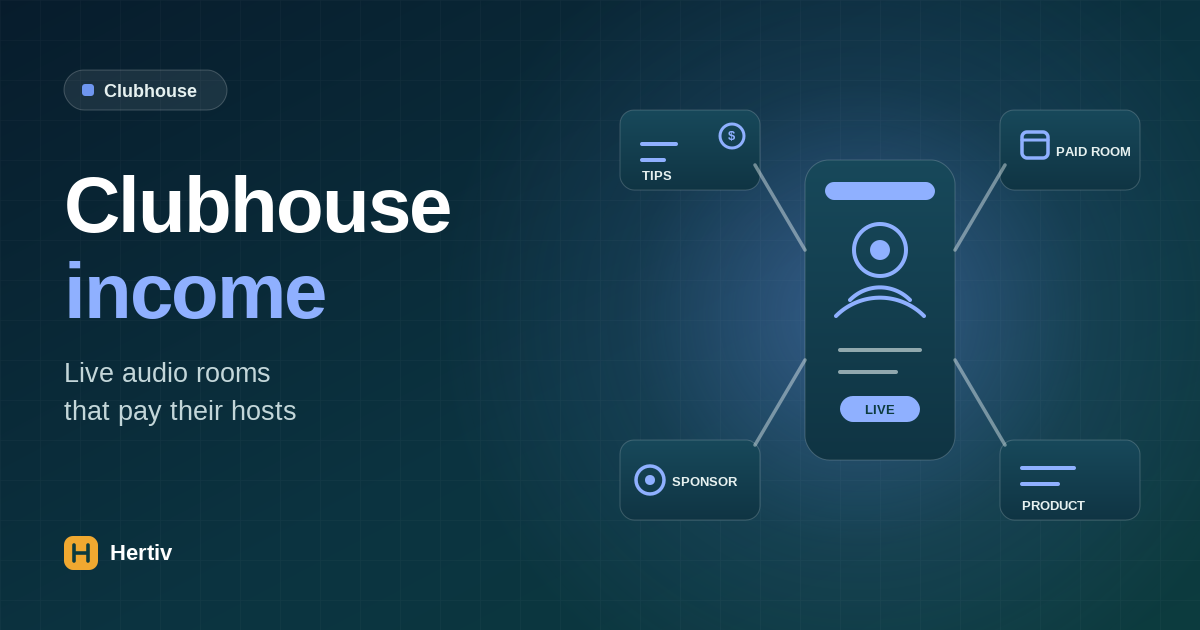
Clubhouse is a live audio app where creators earn from tips, paid rooms, sponsorships and their own products. Here is how each route works and what it takes to earn.
On this page
Short answer
You make money in the Clubhouse app by building a regular audience in live audio rooms and then earning from tips, paid rooms, sponsorships or your own products and services. Clubhouse itself does not pay most creators a salary, so the income comes from the audience you build and the offers you make to them.
What does making money in Clubhouse mean?
Making money in Clubhouse means earning income from the audience you build in its live audio rooms. Clubhouse is a social audio app where people host rooms, talk live and listen; creators earn by turning that attention into payments, bookings or sales.
The app does not pay most creators directly. Instead, it provides the stage: rooms where you can speak, a profile where listeners can find you, and payment features that let listeners send money. The income comes from the audience, not from the app.
That distinction matters for planning. A creator who treats Clubhouse as a job with a wage will be disappointed; a creator who treats it as a place to build trust with a specific audience, then sell to that audience, has a workable model. The sections below follow that order: audience first, income second.
How do creators earn money in Clubhouse?
Creators earn in Clubhouse through tips, paid rooms, sponsorships and sales of their own products or services. Each route needs a different audience size and a different amount of work.
| Income route | How it works | What it needs |
|---|---|---|
| Tips and payments | Listeners send money during a room | Regular rooms, loyal listeners |
| Paid rooms | Listeners pay to join a special room | A topic worth paying for |
| Sponsorships | A brand pays to be mentioned | A clear niche and audience size |
| Own products | Sell a course, book or service | Something to sell, a way to take payment |
| Client work | Rooms bring consulting or freelance leads | Visible expertise in the room |
| Off-platform membership | Listeners join a paid community elsewhere | A community worth paying for |
Most creators combine two or three routes. Tips alone rarely pay a living; tips plus a paid room plus one product can. Check the app's own creator pages for the current payment features, since they change over time. Validating an app idea uses the same audience-first thinking for product ideas.
How do you build an audience worth paying for?
You build an audience worth paying for by hosting a regular room on one clear topic and becoming the person people expect to hear from. Clubhouse rewards consistency: a weekly room at the same time builds a habit in listeners.
Pick a narrow topic where you can answer questions well, such as freelance pricing, property investing or learning a language. A broad room about 'business' competes with everyone; a narrow room about one problem attracts the people who have that problem and will pay to solve it.
Invite guests who bring their own listeners, and ask the audience questions so the room is a conversation, not a lecture. Record which rooms grow and which shrink, and repeat the format that grows. An audience of 200 regular listeners who trust you is worth more than 2,000 who drop in once.
How do paid rooms and tips work?
Paid rooms and tips work by letting listeners pay for access or for appreciation. In a paid room, listeners pay to join, usually for a workshop, a Q and A with a guest, or a deep dive on a topic. In a tipped room, the room is free and listeners send money if they value what they heard.
Paid rooms suit one-off events with a clear promise: a two-hour workshop on a skill, or a live review of listener work. Price them for the value of the session, not for the size of the room; a room of 50 people paying a small fee beats a room of 500 paying nothing.
Tips suit regular rooms where listeners want to support the host. Make tipping easy to find and thank tippers by name, but do not ask for tips every five minutes. The app's payment features and fees change, so check the current terms in the app before planning income around them.
How do sponsorships and selling your own products work?
Sponsorships and selling your own products work by turning the trust built in rooms into a transaction. A sponsor pays you to mention a product that fits your audience; your own product lets you keep the full margin.
For sponsorships, a brand needs to know who listens: their job, their problem, their spending. A room of 300 freelance designers is more valuable to a design-tool brand than a room of 3,000 general listeners. Keep sponsors relevant to the topic, and tell the audience when a room is sponsored.
Your own product is usually the better route. A course, a template pack, a book or a consulting call can be sold from your profile, and Clubhouse rooms become the free sample. A creator who sells a 50-dollar template to 20 listeners a month earns more than most sponsorship deals, and keeps the audience relationship.
Example (hypothetical): a weekly room that earns 400 a month
Example (hypothetical): a freelance designer hosts a weekly Clubhouse room about pricing design work. After two months the room has 180 regular listeners.
Each week, 12 listeners send a tip of 5 dollars, which is 60 dollars per room and 240 dollars over four weeks. Once a month she runs a paid workshop room for 25 listeners at 10 dollars, which adds 250 dollars. She also sells a pricing template for 25 dollars, and 4 listeners buy it each month, adding 100 dollars.
The total is 240 plus 250 plus 100, which is 590 dollars a month before fees and taxes. The room takes 2 hours a week plus 1 hour of preparation, so 12 hours a month, which works out to about 49 dollars per hour. The income is modest, but it is real, and it grows as the regular audience grows.
What are the common mistakes?
The most common mistakes are chasing listener numbers instead of trust, asking for money before the audience exists, and depending on one income route.
- Chasing big rooms. A large room of strangers earns less than a small room of regulars who trust you.
- Asking too early. Selling to an audience that has only heard you once rarely works; build the habit first.
- Depending on tips alone. Tips are irregular; pair them with a product or a paid room.
- Ignoring the app's terms. Payment features and fees change, so check the current terms before planning around them.
- No way to take payment. If listeners cannot find your product or payment link, the room earns nothing.
- Burning out. Daily rooms at odd hours are hard to sustain; a weekly rhythm lasts longer.
Start with one room a week on one topic, keep a payment link in your profile, and add a product only when listeners start asking how to work with you. If you are building an app of your own, mobile app development covers the build side.
The app development checklist covers the launch steps.
Key takeaways
- Clubhouse pays few creators directly; the income comes from the audience you build
- Tips, paid rooms, sponsorships and your own products are the four main routes
- A small regular audience that trusts you earns more than a large room of strangers
- Combine routes: tips plus a paid room plus one product beats any single route
- Check the app's current payment terms before planning income around them
Frequently asked questions
Can you make a living from Clubhouse alone?
Very few creators do. Clubhouse works best as one channel in a wider income mix, alongside a product, a service or a community elsewhere. Treat the app as the place you build trust, and earn from the offers you make to that audience.
How many listeners do you need to earn money on Clubhouse?
There is no fixed number. A room of 100 to 200 regular listeners can support tips and a small paid workshop, while sponsorships usually need a clear niche and a few hundred regulars. Trust and topic matter more than raw listener counts.
Does Clubhouse pay creators?
Clubhouse has run creator programmes and payment features at various times, but most creators are not paid a salary by the app. Check the app's own creator pages for the current programmes, since they change over time.
What is the best way to earn on Clubhouse for beginners?
Start with a free weekly room on one topic and build regular listeners. Add a payment link to your profile, then a small product once listeners ask how to work with you. Paid rooms and sponsorships come later, when the audience is steady.
Can you sell products directly in Clubhouse?
Clubhouse rooms are for conversation, not a shop. Creators link out from their profile to a product page, a booking page or a payment link, and use the room to explain the product and answer questions about it.
Is Clubhouse still worth building an audience on?
It depends on your topic and where your audience already spends time. If your listeners are active in live audio rooms, a weekly room is a cheap way to build trust. If they are not, the same effort earns more on the channel they already use.


