How to Implement Product Discovery in Your Team
Product discovery is the work before building: talking to users, testing assumptions and choosing what to build next. Here is a practical way to run it weekly.
On this page
Short answer
Product discovery is the ongoing work of finding out what to build before building it. A team talks to users, tests the riskiest assumptions with small prototypes, and only then commits engineering time. It works best as a weekly habit, not a one-off project before a launch.
What is product discovery?
Product discovery is the ongoing work of finding out what to build before building it. It covers user interviews, prototype tests, data checks and competitor reviews, all aimed at one question: is this the right thing to build, and will people use it?
Discovery sits before delivery. Delivery is building and shipping a feature well. Discovery is deciding whether the feature is worth building at all, and what form it should take. Teams that skip discovery often ship on time and learn too late that nobody wanted the result.
A good way to think about it is risk. Every product idea carries four risks: people may not want it, they may not be able to use it, it may be hard to build, and it may not pay for itself. Discovery is the work of reducing those risks cheaply, with conversations and rough prototypes, before the expensive work starts. For a fuller picture of the idea itself, see what product discovery is.
What does a product discovery process look like?
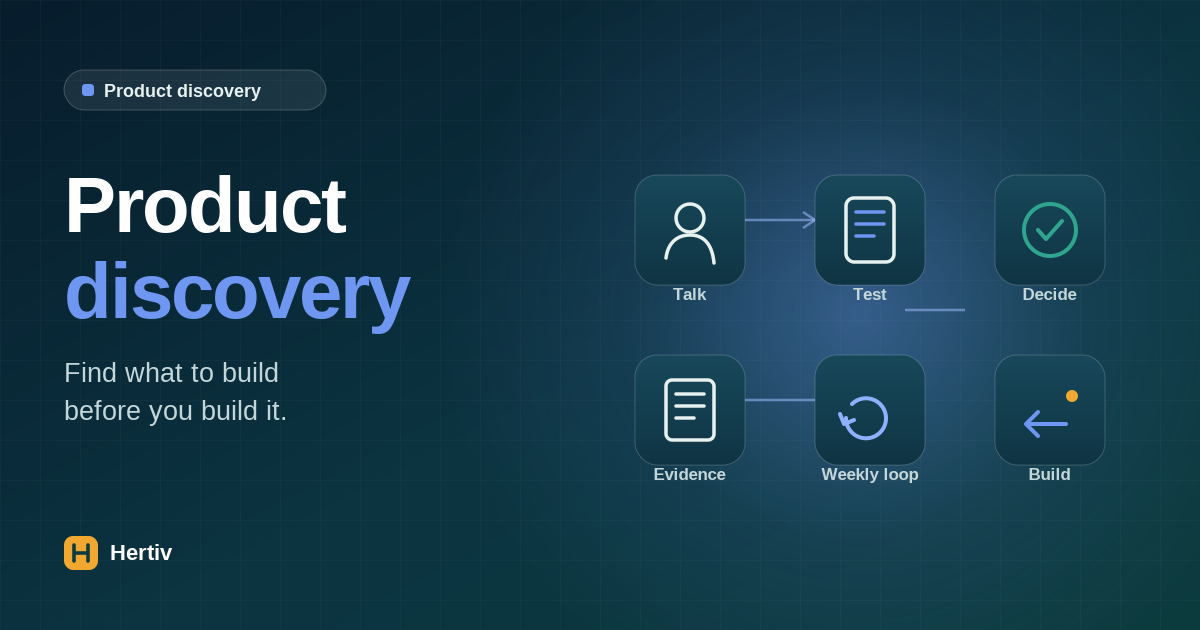
A product discovery process is a repeating loop: learn from users, form an assumption, test it with something small, and decide what to do next. The loop runs every week, and each pass makes the next decision a little less of a guess.
Most teams use a mix of activities, each suited to a different question:
| Activity | What it answers | Typical effort |
|---|---|---|
| User interviews | What problem is the user trying to solve? | 45 minutes each |
| Prototype test | Can people use this design to finish the task? | Half a day to build |
| Usage data review | Where do people stop or struggle today? | One hour a week |
| Fake-door test | Would anyone click or sign up for this? | One day to set up |
| Competitor review | How do others solve this already? | A few hours |
None of these needs a big budget. Interviews can run over video calls, prototypes can be clickable screens, and a fake-door test can be a single button on an existing page. The point is evidence before commitment.
How do you set up product discovery in your team?
You set up product discovery by giving it a fixed slot in the week, a named owner, and a short list of the riskiest assumptions to test. Without those three, discovery becomes something the team means to do when there is spare time, which is never.
- Pick one decision. Choose the next product decision that carries the most risk, such as whether to rebuild a checkout flow or add a new plan tier.
- List the assumptions. Write down what must be true for the idea to work: users have this problem, they will pay this much, the team can build it in this time.
- Rank by risk. Order the assumptions by how damaging it would be to be wrong, and test the top one first.
- Choose the cheapest test. For each assumption, pick the smallest test that could prove it wrong: five interviews, a clickable prototype, or a usage-data check.
- Run the test and record the result. Write down what you expected, what happened, and what you will do next. A one-page note per test is enough.
- Decide in the open. Share the result with the team and agree whether to build, change the idea, or drop it.
A useful rhythm is two hours of interviews and one prototype test per week, reviewed in a 30-minute meeting. Small teams can start with even less: three interviews a week and one test a fortnight. The habit matters more than the volume. If you need help shaping the process, product discovery services cover how teams usually structure it.
Which discovery methods should you use first?
The methods to use first are user interviews and usage-data review, because they answer the two questions that kill most ideas: do people have this problem, and do they struggle with the current solution?
Start interviews with people who recently tried to solve the problem, not with friendly users who like the product. Ask about the last time they hit the problem, what they did, and what it cost them in time or money. Avoid asking whether they would like a feature you have already designed; people say yes to be polite.
Then check the data. Look at where users drop off, which support tickets repeat, and which searches return no results. Data shows where the pain is; interviews explain why. A prototype test comes third, once you have a clear idea of the problem and a rough design to put in front of people.
One method to use with care is the survey. Surveys are good for ranking known options, but poor for finding problems you did not know existed. Use them after interviews, not instead of them.
Example: a team discovers a checkout problem
Example (hypothetical): a team runs an online shop and plans to rebuild its checkout page. Before writing any code, the product manager interviews 12 recent buyers, each for 45 minutes. That is 12 x 45 = 540 minutes, or 9 hours of interviews in one week.
Eight of the 12 buyers say the same thing: they could not tell whether their discount code had been applied. The team checks the data and finds that 3 in 10 checkouts are abandoned on the payment step, and that support receives about 40 messages a month about discount codes.
Instead of a full rebuild, the team builds a clickable prototype that shows the discount and the final total on one screen, then tests it with 6 more buyers. Five of the 6 complete the purchase without hesitation, and the sixth asks one question the team answers by adding a line of text.
The team ships the small change in one week instead of rebuilding checkout over two months. Discovery cost about 12 hours of work and saved roughly 7 weeks of building the wrong thing.
What are the common mistakes?
The most common product discovery mistakes are testing the solution instead of the problem, talking only to happy users, and treating discovery as a phase that ends before building starts.
- Asking about your idea, not their problem. Showing a design and asking 'would you use this?' produces polite yeses. Ask about the last time the problem happened instead.
- Only interviewing fans. People who already love the product will not tell you why others leave. Talk to people who cancelled, never signed up, or chose a rival.
- Running discovery once. A single research sprint before a launch goes stale fast. Discovery has to run every week, or decisions drift back to opinion.
- Collecting evidence and ignoring it. If the team runs tests but builds the original plan anyway, discovery is theatre. Record the decision and the reason for it.
- Testing everything. Small, low-risk changes do not need interviews. Save discovery time for decisions that are expensive to reverse.
How do you keep discovery going week after week?
You keep discovery going by making it part of the team's normal week: a fixed interview slot, a shared list of assumptions, and a short review where decisions are recorded.
Assign one person to own the interview pipeline, so there are always two or three conversations booked for the coming week. Keep a simple log: the assumption, the test, the result, and the decision. After a month, that log becomes the team's memory of why things were built the way they were.
Share findings widely. A short note after each test, sent to the whole team, does more than a long report read by one person. When engineers and designers see real user words, they make better trade-offs without being asked.
Finally, review the discovery list itself once a month. Drop assumptions that no longer matter, add new ones from support tickets and sales calls, and check that the riskiest item is always the one being tested. If you are scoping the work that follows discovery, how to scope an MVP in 10 weeks shows how teams turn findings into a build plan.
Key takeaways
- Discovery reduces the four risks of an idea: desire, usability, build effort and value
- A weekly loop of interviews, a small test and a recorded decision beats a one-off research sprint
- Test the riskiest assumption first, with the cheapest test that could prove it wrong
- Talk to people who left or never signed up, not only to happy users
- A one-page note per test keeps the team honest about what was learned
Frequently asked questions
How is product discovery different from market research?
Market research usually describes a whole market: its size, segments and trends. Product discovery is narrower and closer to the team: it tests whether a specific idea will work for specific users, using interviews and small prototypes. Discovery feeds a build decision directly, while market research feeds a strategy discussion.
How much time should a team spend on discovery each week?
A small team can start with about four hours a week: two or three user interviews and one prototype test, plus a 30-minute review. Larger teams working on risky bets spend more. The right amount is the smallest that still tests the riskiest assumption before the team commits to building.
Do small teams need product discovery?
Yes, and arguably more than large ones, because a small team cannot afford to spend a month building the wrong thing. Discovery for a small team can be light: three interviews a week and a clickable prototype before any big build. The cost is a few hours; the saving is weeks of wasted work.
What is the difference between discovery and delivery?
Discovery is deciding what to build and whether it is worth building, using evidence from users and data. Delivery is building and shipping it well. Discovery runs before and alongside delivery, not as a phase that ends. A team that only delivers will ship efficiently in the wrong direction.
How do you know when discovery is done for an idea?
Discovery is done enough when the riskiest assumptions have evidence behind them and the team can describe who the idea is for, what problem it solves, and how success will be measured. It is rarely fully done; new evidence can reopen a decision. The test is whether building now is a reasonable bet, not whether every question is answered.
Can discovery replace talking to customers after launch?
No. Discovery before launch reduces risk, but real use after launch is the strongest evidence. Keep interviewing new and churned users, watch usage data, and treat the first release as another test. Teams that stop listening after launch learn about problems from cancellations instead of conversations.


