How to Implement Polygon in Your App
Implementing Polygon means running your app on a low-cost Ethereum-compatible network: pick a network, set up wallets and testnet, deploy, and bridge assets.
On this page
Short answer
Implementing Polygon means building your application on Polygon PoS, an Ethereum-compatible network with low fees and fast blocks. You pick the network, set up a wallet and testnet, deploy your smart contract with standard Ethereum tooling, and bridge assets between Ethereum and Polygon.
What does implementing Polygon mean?
Implementing Polygon means building your application on Polygon, a network that runs alongside Ethereum and processes transactions faster and at lower cost. Your smart contracts, wallets and tokens work much like they do on Ethereum, because Polygon is compatible with Ethereum tooling.
Most teams pick Polygon when their app needs many low-cost transactions: games, loyalty programmes, NFT minting or payments. If your app only settles a few high-value transactions, Ethereum mainnet may be simpler.
Polygon has more than one network, so the first decision is which one to use. Polygon PoS is the established chain for general apps, while Polygon zkEVM is a newer chain that uses zero-knowledge proofs for stronger Ethereum alignment. This guide focuses on Polygon PoS, the common starting point.
Which Polygon network should you choose?
The network you choose decides your costs, your tooling and how your users bridge assets, so pick it before writing code. Polygon PoS and Polygon zkEVM are both live, but they suit different apps.
| Network | Best for | Key trait | Watch out for |
|---|---|---|---|
| Polygon PoS | Games, NFTs, loyalty, payments | Low fees, fast blocks, wide tooling | Separate validator set from Ethereum |
| Polygon zkEVM | Apps needing closer Ethereum alignment | Zero-knowledge proofs, EVM equivalent | Newer, smaller ecosystem |
| Ethereum mainnet | High-value settlement | Strongest security guarantees | Higher fees per transaction |
For most first builds, Polygon PoS is the practical choice: the tooling is mature, wallets and exchanges support it, and users can bridge assets easily. Move to zkEVM later if your security needs change. See Polygon vs Arbitrum for how Polygon compares with another scaling network.
How do you set up wallets, RPC and testnet?
Setting up Polygon starts with a wallet, a connection to the network and a testnet where mistakes are free. Do this before writing any contract code, because every later step depends on it.
- Add Polygon to your wallet. In a wallet such as MetaMask, add the Polygon PoS network with its chain ID and RPC address, or use a wallet that lists Polygon by default.
- Get test MATIC. Use the Polygon faucet to get test MATIC on the Amoy testnet, which is the current test network for Polygon PoS.
- Pick an RPC provider. Use a managed RPC provider for your app rather than a public endpoint, so your requests are reliable and rate-limited fairly.
- Connect your code. Point your web3 library at the RPC endpoint and the Amoy chain ID, then read a block and confirm the connection works.
- Test a transfer. Send a small test transaction on Amoy and check it in the Polygon block explorer before moving on.
Keep testnet and mainnet settings apart from day one. A config file that mixes them up is how test tokens end up on mainnet, or real funds end up on a testnet. For the development side, Polygon development covers the services and tooling involved.
How do you deploy a smart contract on Polygon?
Deploying a smart contract on Polygon works like deploying on Ethereum, because Polygon PoS is compatible with Ethereum tooling. You write the contract in Solidity, compile it with Hardhat or Foundry, and deploy it with the same commands, pointed at Polygon instead of mainnet.
The steps are straightforward, but the details matter. Compile the contract, run your tests on a local chain, then deploy to Amoy testnet and check the contract in the block explorer. Only then deploy to mainnet, with the deployer wallet holding enough MATIC for gas.
Before mainnet, verify the contract source in the explorer so users can read what it does, and set up the access controls: who can pause, mint or upgrade, and under what conditions. A contract without clear ownership rules is hard to fix later.
For anything holding user funds, get an audit before launch. See smart contract audit for what a review covers.
For the tooling side, see Polygon developer tools for the options available.
How do bridging and gas work on Polygon?
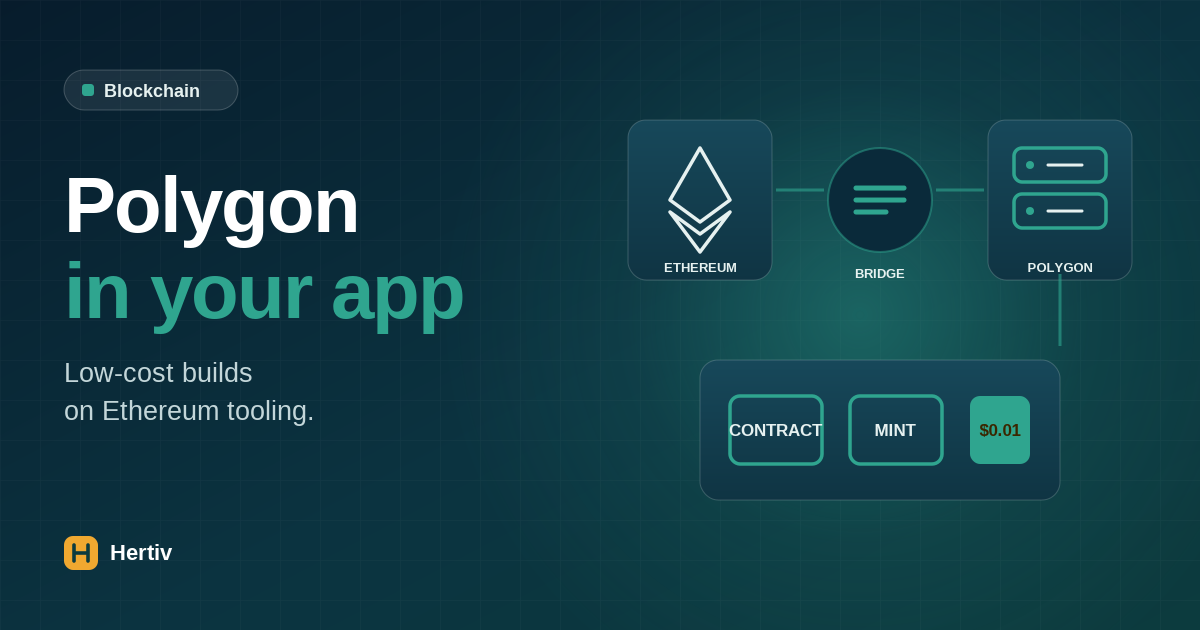
Bridging moves assets between Ethereum and Polygon, and gas on Polygon is paid in MATIC. Both are simple once you understand the two directions: deposits from Ethereum to Polygon are fast, while withdrawals back to Ethereum take longer because of the bridge's security model.
To bring assets in, a user locks tokens on Ethereum and receives the matching tokens on Polygon through the official bridge. To take assets out, the user burns the Polygon tokens and waits for the withdrawal to be processed on Ethereum, which can take hours on the PoS bridge.
Gas on Polygon is low compared with mainnet, which is why apps with many transactions choose it. Still, budget for it: every mint, transfer and contract call costs MATIC, and a busy app can run through a meaningful amount. See Polygon cost for the cost breakdown.
Example: a loyalty app issuing tokens on Polygon
Example (hypothetical): a retail chain builds a loyalty app that issues one token per dollar spent, with tokens redeemed for discounts. The team chooses Polygon PoS because the app will mint thousands of small-value tokens, and mainnet fees would cost more than the rewards.
They set up a wallet, connect to the Amoy testnet and deploy a simple token contract. Testing shows each mint costs 0.01 MATIC in gas at a planning rate. For 5,000 mints, that is 5,000 x 0.01 = 50 MATIC. At a planning price of $0.50 per MATIC, the gas bill is 50 x $0.50 = $25.
The same 5,000 mints on mainnet at a planning rate of $2 each would cost 5,000 x $2 = $10,000, which is more than the value of the rewards. The comparison is what justifies Polygon for this app.
Before launch, the team verifies the contract, sets a mint limit per wallet, and tests the bridge flow with a small amount. The app goes live on Polygon PoS with mainnet MATIC funded for the first month of minting.
What are the common mistakes?
The most common mistakes when implementing Polygon are choosing the wrong network, mixing up testnet and mainnet settings, and ignoring the bridge experience for users.
- Picking a network by name alone. PoS and zkEVM differ in tooling, fees and ecosystem size; match the network to the app, not the headline.
- Mixing testnet and mainnet config. Keep the two apart in separate config files, or a test deployment can touch real funds.
- Skipping the audit. A contract holding user funds needs a review before launch, not after the first incident.
- Hiding the bridge. Users need to see the direction, the wait time and the token address, or they will send funds to the wrong place.
- No gas budget. Low fees are not free fees; a busy app still needs a MATIC budget and someone watching it.
If you are still deciding whether Polygon fits your app, Polygon for beginners gives a gentler introduction to the network and its parts.
Key takeaways
- Polygon PoS is the practical starting point for most first builds
- Use the Amoy testnet and keep testnet and mainnet settings apart
- Deploy with standard Ethereum tooling: Solidity, Hardhat or Foundry
- Bridging in is fast; withdrawing to Ethereum takes longer
- Verify the contract and audit anything holding user funds
Frequently asked questions
What is Polygon?
Polygon is a network that runs alongside Ethereum and processes transactions faster and at lower cost, while staying compatible with Ethereum tooling. Apps use it when they need many low-cost transactions, such as games, loyalty programmes or NFT minting.
Is Polygon the same as Ethereum?
No. Polygon is a separate network that is compatible with Ethereum tools and contracts, so developers can use the same code and wallets. It settles its own blocks and has its own validator set, which is why fees are lower.
Do I need MATIC to use Polygon?
Yes. Gas on Polygon PoS is paid in MATIC, the network token. You also need test MATIC from the faucet to work on the Amoy testnet, where transactions cost nothing real.
How long does it take to implement Polygon?
A simple app can be running on the Amoy testnet in days, and a production deployment with an audit usually takes weeks. The audit and the bridge experience are the parts that most often take longer than planned.
Can I move my Ethereum contract to Polygon unchanged?
Usually yes, because Polygon PoS is compatible with Ethereum tooling and Solidity contracts. You still need to test on Amoy, check gas costs, and review any parts that assume Ethereum mainnet behaviour.
What happens if I send funds to the wrong network?
Funds sent to the wrong network are often hard or impossible to recover, because the address exists on both networks but the tokens do not. Always check the network, the token address and the bridge direction before sending.


