How to Implement Crypto Custody Step by Step
Implementing crypto custody means choosing a model, generating keys in a controlled ceremony, setting approval rules and testing with small amounts first.
On this page
Short answer
To implement crypto custody, define a written policy for who can move funds and under what approvals, choose a model such as MPC, multisig or a qualified custodian, generate keys in a controlled offline ceremony, split funds between a limited hot wallet and cold storage, and test the full flow with small amounts before moving real balances in stages.
What is crypto custody?
Crypto custody is the practice of holding and protecting cryptocurrency on behalf of someone else, so that assets are kept safe, access is controlled and every movement is recorded. A custodian may be a company, a bank or a software system, but the job is the same: keep the keys safe and release funds only under agreed rules.
The core problem is key control. Whoever holds the private keys controls the coins, and there is no password reset on a blockchain. Custody exists to make that control boring and reliable: keys are generated in a controlled setting, stored in more than one place, and used only through approvals.
| Model | Who holds the keys | Best for | Trade-off |
|---|---|---|---|
| Self-custody | Your own team | Small teams, full control | You carry all the risk |
| MPC custody | Shared key parts | Businesses needing shared control | Needs a reliable provider |
| Multisig custody | Several key holders | Treasuries and funds | Slower to approve moves |
| Qualified custodian | Licensed third party | Funds and institutions | Fees and counterparty risk |
Most businesses start with a custodian or an MPC setup rather than pure self-custody, because the operational burden of key management is larger than it first looks. For the basics of the wallets involved, see crypto wallet development.
Which custody model fits your business?
The right custody model follows from how much you hold, how often funds move and who must approve a transfer. A fund that moves money once a week has different needs from an exchange that settles withdrawals every hour.
Use these questions to narrow the choice:
- How much is at stake? Larger balances justify stronger controls and a licensed custodian.
- How fast must money move? Frequent withdrawals need a hot wallet with strict limits; slow treasuries can live mostly in cold storage.
- Who approves? If two people must sign, multisig or MPC fits. If one person approves, the risk sits with that person.
- What do regulators expect? Licensed funds and exchanges often need a qualified custodian or an audited setup.
Many teams combine models: a small hot wallet for daily operations and cold storage for the bulk of funds. The split is a risk decision, not a technical default, and it should be written down and reviewed. To compare the two shared-control models, see MPC vs. multisig wallets: which should your company use?.
How do you implement crypto custody step by step?
You implement crypto custody by deciding the model, setting up key generation, defining approval rules, then moving funds in stages while testing every control before real money is at stake.
- Define the policy. Write down who can move funds, how much, under what approvals and in which situations. Get it signed off before any keys exist.
- Choose the model and provider. Pick self-custody, MPC, multisig or a qualified custodian based on the questions in the previous section, and check the provider's security audits and insurance.
- Set up key generation. Generate keys in a controlled ceremony, with witnesses, recorded steps and no network connection for cold keys.
- Build the hot and cold split. Decide how much sits in the hot wallet for daily use and how much stays in cold storage, then set refill rules.
- Configure approvals and limits. Set per-transaction limits, daily limits and the number of signers required for each band of value.
- Test with small amounts. Move a small test amount through the full flow: request, approval, signing, settlement and reconciliation.
- Go live in stages. Move funds in tranches, reconcile each one, and keep the old setup running until the new one proves itself.
Do not rush the test stage. A custody setup that has never been tested under pressure will fail at the worst moment, usually during a market spike when withdrawal volume jumps.
How should keys be created and stored?
Keys should be created in a controlled ceremony, stored in more than one secure location, and never copied to an ordinary laptop or chat message. The ceremony is the single most important event in a custody setup, because a key created badly can never be made safe later.
A workable key setup has three parts. First, generate keys offline, on hardware designed for the job, with named witnesses present and each step recorded. Second, split the backup: store recovery material in separate physical locations, so no single break-in or fire takes everything. Third, limit access: only named people can enter the storage room, and every entry is logged.
Hardware security modules, known as HSMs, hold keys inside tamper-resistant hardware and sign transactions without ever exposing the key itself. They suit teams that need frequent signing with strong controls. For smaller setups, a multisig arrangement with keys held by different people in different places gives a similar result with simpler tooling. See MPC wallet development for institutions for one shared-control approach.
What controls keep custody safe day to day?
Day-to-day custody safety comes from approvals, limits and monitoring, not from the strength of a single key. The controls that matter are the ones that slow down a bad transfer long enough for someone to notice it.
- Multi-person approval. No single person should be able to move funds alone above a low threshold.
- Allowlist addresses. Withdrawals go only to pre-approved addresses, and adding an address needs its own approval.
- Velocity limits. Cap the value that can leave per hour and per day, so a compromised key cannot drain the wallet in minutes.
- Monitoring and alerts. Watch for unusual amounts, new addresses, odd hours and failed approvals, and alert a human in real time.
- Regular reconciliation. Match wallet balances against the ledger daily, so a discrepancy is found in hours, not weeks.
- Incident plan. Write down who freezes what, who is called and in what order, then rehearse it twice a year.
These controls also need an audit trail. Every request, approval, rejection and transfer should be logged with who, what and when, because the log is what proves the controls worked. Independent reviews help too: a smart contract audit and security review covers the on-chain parts of a custody flow.
Example: a small exchange sets up custody
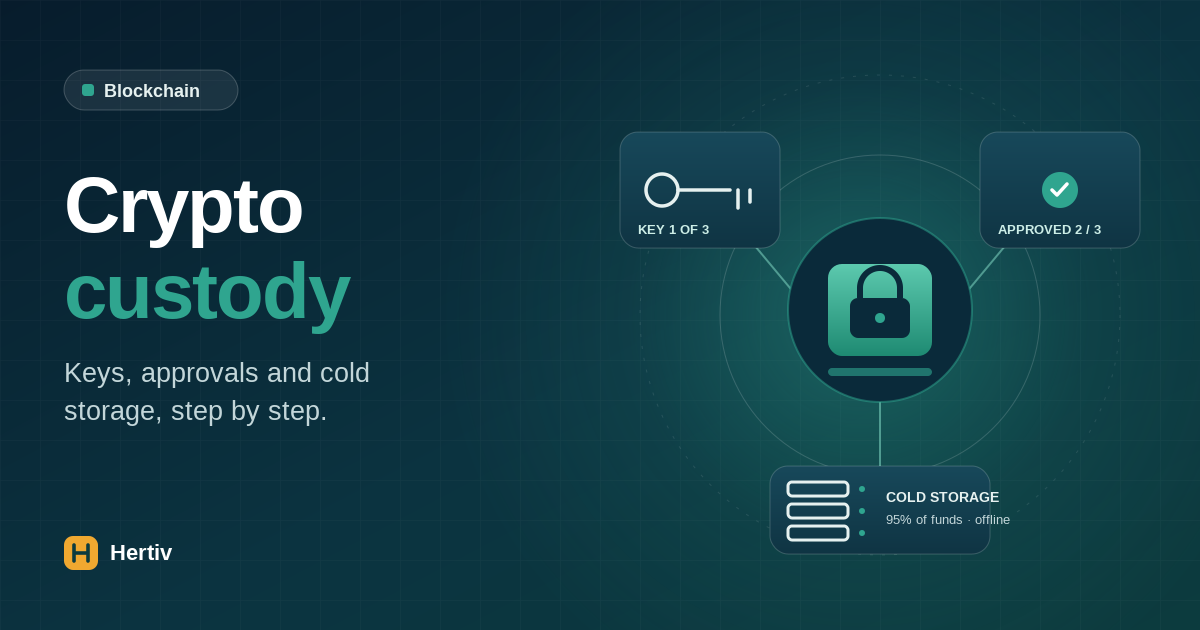
Example (hypothetical): a small exchange holds customer funds worth $2,000,000, spread across 500 customers with an average balance of $4,000 each. The team decides on a split: 5% in a hot wallet for daily withdrawals and 95% in cold storage.
The arithmetic is simple. Five percent of $2,000,000 is $100,000 in the hot wallet, and 95% is $1,900,000 in cold storage. Daily withdrawals average $60,000, so the hot wallet covers a normal day with room to spare, and the team refills it from cold storage twice a week.
Approvals are set in bands. Transfers up to $5,000 need one operations signer; transfers from $5,000 to $50,000 need two signers; anything above $50,000 needs three signers and a manager's written note. New withdrawal addresses need a separate approval and a 24-hour wait before they can be used.
After three months the team reviews the numbers: no transfer ever breached a limit, two address additions were rejected for missing paperwork, and reconciliation matched every day. The setup cost time up front, but the daily routine is now a short checklist. For typical cost ranges, see crypto custody cost.
What are the common mistakes?
The most common custody mistakes are single points of failure, untested recovery and approvals that exist on paper but not in practice.
- One person holds the keys. If that person is away, ill or leaves, the funds are stuck or at risk.
- No tested recovery. A backup that has never been restored is a guess, not a plan.
- Keys on ordinary devices. A laptop used for email and browsing is not a safe place for a private key.
- No limits on the hot wallet. A hot wallet with no cap can be drained in one session.
- Approvals by habit. Signers who approve without checking turn multi-person control into theatre.
- No incident plan. Teams without a rehearsed plan waste the first hours of an incident arguing about who decides.
- Skipping the audit trail. Missing logs make it impossible to prove what happened or to learn from it.
Fix the single points of failure first, then the limits and the logs. A custody setup that survives the loss of one person, one device or one key is the minimum worth running.
Key takeaways
- Custody is key control plus approvals, limits and a full audit trail
- Choose the model by balance size, withdrawal speed and approval needs
- Generate keys offline in a witnessed ceremony and split backups across locations
- Keep most funds in cold storage and cap the hot wallet for daily use
- Test the full flow with small amounts before moving real balances
- One person, one device or one password able to move funds is a single point of failure
Frequently asked questions
What is the difference between hot and cold custody?
A hot wallet is connected to the internet and used for daily withdrawals, while cold storage is offline and holds the bulk of funds. Most businesses keep a small hot balance with strict limits and the rest in cold storage, refilling on a schedule.
Is MPC or multisig better for crypto custody?
Both spread control across several parties, so neither is always better. MPC splits a key into parts that sign together, while multisig needs several separate keys to approve. The choice depends on your provider options, signing speed and recovery plan.
Do I need a licensed custodian?
It depends on your business and jurisdiction. Funds and exchanges often need a qualified custodian or an audited setup to satisfy regulators and partners. Smaller teams may self-custody, but they still need written policies, tested recovery and multi-person approvals.
How much should sit in a hot wallet?
Enough to cover normal daily withdrawals with some headroom, and no more. Many teams hold 2 to 10 percent in hot storage and the rest cold, with refill rules and daily limits. The exact split is a risk decision, so write it down and review it.
What happens if a key holder leaves the company?
That is why custody needs more than one key holder and a tested recovery plan. Remove the departing person's access, rotate the affected keys or signers, and update the policy. If one departure can freeze your funds, the setup has a single point of failure.
How often should custody controls be reviewed?
Review approvals, limits and address allowlists at least quarterly, and after any incident, staff change or large balance move. Rehearse the incident plan twice a year and test key recovery at least once a year, so the plan works when it is needed.


