How to Implement Adaptive AI, Step by Step
Adaptive AI keeps learning from new data after deployment, within guardrails you set. Build the feedback loop, retrain safely, and measure whether it works.
On this page
Short answer
Adaptive AI is a system that keeps learning from new data after deployment, within limits you set in advance. You implement it by capturing feedback, building a fixed evaluation set, retraining on a schedule, rolling out gradually, and keeping a rollback ready for every update.
What is adaptive AI?
Adaptive AI is a system that keeps learning from new data after it is deployed, instead of staying frozen at the version that was trained. It watches what happens in production, updates its behaviour within guardrails, and gets better at the specific job it serves.
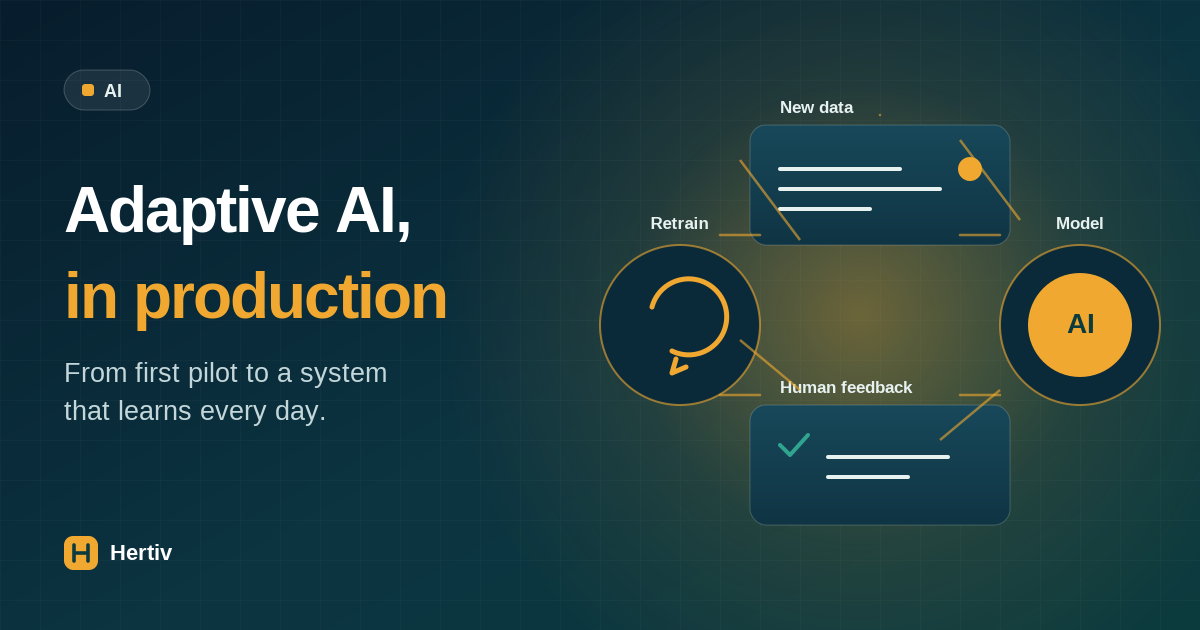
The difference from ordinary AI is the feedback loop. A frozen model answers the same way in January and in June, even if the world has changed. An adaptive system notices when its inputs shift, when users correct it, or when its accuracy falls, and it changes its behaviour in response.
That does not mean the model rewrites itself without oversight. In practice, adaptive AI means scheduled retraining, online learning on approved data, or rules that adjust thresholds as conditions change. The adaptation is planned, logged and reversible, not automatic in the wild.
Typical examples include a recommendation system that follows changing tastes, a fraud detector that adapts to new patterns, and a support assistant that learns from the answers agents correct. In each case the value comes from staying current, not from the first training run.
When does adaptive AI make sense?
Adaptive AI makes sense when the world behind the model keeps changing faster than a retraining schedule can follow. If the data, the users or the rules shift every week, a frozen model goes stale and its answers get worse.
The table below shows where adaptation pays and where it does not.
| Situation | Data changes | Adaptive AI fits? | Why |
|---|---|---|---|
| Fraud detection | Daily | Yes | Attackers change tactics constantly |
| Recommendations | Weekly | Yes | Tastes and stock change often |
| Demand forecasting | Weekly | Yes | Seasons and promotions shift demand |
| Document classification | Monthly | Maybe | New document types appear slowly |
| Credit scoring | Slowly | No | Rules are set and audited |
| Medical triage | Slowly | No | Safety rules need frozen, tested versions |
The key question is who owns the risk when the model changes. In fraud and recommendations, a small mistake is cheap and reversible. In credit or medical decisions, a change needs testing and sign-off, so a frozen model with scheduled retraining is the safer shape.
If you are unsure, start with a frozen model and add adaptation only where you can measure the drift. Many teams find that monthly retraining is enough, and that full online learning is not needed.
How to implement adaptive AI in 7 steps
You implement adaptive AI by building the loop first and the learning second: data capture, feedback, evaluation, retraining and rollout, with a human in charge of each step.
- Define what should change. Write down exactly what the system may adapt: thresholds, rankings, routing rules or model weights. Everything else stays fixed.
- Capture feedback. Log every prediction, the outcome, and any human correction. Without this record there is nothing to learn from. A support agent's corrected answer is the most valuable feedback you have.
- Set the guardrails. Decide the limits before you start: how far the model may move, which data it may learn from, and what triggers a rollback. Put the limits in code, not in a document.
- Build the evaluation set. Keep a fixed set of real cases with known good answers. Run it before and after every change, so you can tell whether the system improved or drifted.
- Retrain on a schedule. Start with scheduled retraining on approved data, such as weekly or monthly. Move to more frequent updates only when the schedule proves too slow.
- Roll out gradually. Send the updated model to a small share of traffic first, compare it with the old version, and widen the rollout only when the numbers hold.
- Monitor and roll back. Watch accuracy, error rate and user complaints after every update. If the numbers fall, roll back to the previous version and investigate.
Before starting, check whether your data and processes are ready. An AI readiness assessment will show which gaps need closing before adaptation is worth attempting.
Testing is part of every step, not a phase at the end. The guide to how to test AI models covers the evaluation sets and checks that keep an adaptive system honest.
Example (hypothetical): a support assistant that adapts
Example (hypothetical): a support team runs an AI assistant that drafts replies from the help centre. In the first month it handles 2,000 tickets, and agents correct 240 of the drafts, which is 12% of them. The corrections are logged with the original question and the right answer.
Each week the team reviews the corrections. They find that 90 of the 240 corrections come from one cause: a help article that changed when the pricing plan changed, and the assistant still quotes the old price. The team fixes the article, and the assistant's answers improve without any model change.
The remaining corrections show a pattern too: customers ask about a new feature that has no help article yet. The team writes the article, adds it to the retrieval set, and retrains the assistant on the updated content. The next week, corrections fall from 240 to 150 out of 2,000 tickets, which is 7.5%.
The arithmetic is simple: 240 minus 150 is 90 fewer corrections, and 90 divided by 240 is 37.5%, so corrections fell by more than a third in one week. The gain came from fixing the data and the content first, not from changing the model. That is the usual order: fix the source, then retrain.
After two more weekly cycles the correction rate settles at about 6%, and the team stops retraining weekly and moves to monthly. The system is still adaptive, but the rhythm now matches how fast the content actually changes.
What are the common mistakes?
The most common mistakes are letting the model learn from unchecked data, skipping evaluation, and adapting faster than the team can monitor.
- Learning from raw user input. If the model trains on whatever users type, it will learn bad behaviour, bad facts and spam. Only learn from approved, reviewed data.
- No fixed evaluation set. Without a stable test set, you cannot tell whether an update helped or hurt, so drift goes unnoticed until customers complain.
- Adapting too fast. Daily updates sound modern, but if nobody can review what changed, a bad update ships before anyone notices. Match the rhythm to your review capacity.
- No rollback plan. Every update should be reversible in minutes. If you cannot roll back, you are not adapting, you are gambling.
- Forgetting the humans. Agents and users are the feedback source. If they stop correcting the system, or their corrections are ignored, adaptation stops working.
A useful check is to ask what happens if the feedback loop breaks. If the answer is that the system keeps learning from bad data, the guardrails are not strong enough yet.
How do you measure whether adaptive AI is working?
You measure adaptive AI by the trend in the feedback, not by a single accuracy number. The numbers that matter are the correction rate, the error rate on the fixed evaluation set, and the time it takes to recover from a bad update.
Start with the correction rate: what share of outputs does a human need to fix, and is that share falling over time? A falling correction rate means the system is learning the right things. A rising one means the data or the world has moved and the system has not kept up.
Next, run the fixed evaluation set after every update. If accuracy on that set falls, the update made things worse, whatever the live numbers say. The evaluation set is the anchor that stops slow drift from looking like progress.
Finally, track the cost of adaptation itself: how much staff time goes into reviewing feedback, approving data and monitoring updates. If that cost grows faster than the benefit, the system is adapting too often or on too much data.
The return on this work is worth measuring properly. The guide to how to measure AI ROI shows how to put time saved and errors avoided into a number a budget holder can use.
Key takeaways
- Adaptive AI means a planned feedback loop, not a model that rewrites itself freely.
- Only learn from approved, reviewed data; raw user input teaches bad behaviour.
- A fixed evaluation set is the anchor that stops slow drift looking like progress.
- Fix the source data first; most gains come from content, not from the model.
- Match the update rhythm to your review capacity, and keep every update reversible.
Frequently asked questions
What is the difference between adaptive AI and machine learning?
Machine learning is how a model is trained; adaptive AI is how a deployed system keeps changing after training. An adaptive system adds a feedback loop, guardrails and scheduled retraining on top of an ordinary trained model.
Does adaptive AI need online learning?
Not usually. Most teams get the benefit from scheduled retraining on approved data, such as weekly or monthly. Online learning, where the model updates continuously, is only needed when the data changes within hours.
Is adaptive AI safe for regulated work?
It can be, if every change is tested on a fixed evaluation set, logged, and approved before rollout. In credit, health or legal work, adaptation usually means scheduled retraining with sign-off, not continuous updates.
How much data does adaptive AI need?
It needs a steady stream of labelled feedback: predictions, outcomes and human corrections. A few hundred corrections a month is enough to start; the key is that the feedback is reviewed, not just collected.
What happens if adaptive AI learns the wrong thing?
That is why guardrails and rollback exist. The evaluation set should catch a bad update before it reaches all users, and a gradual rollout limits the damage. If accuracy falls, roll back to the previous version.
How long does it take to implement adaptive AI?
The loop itself, logging, feedback capture and evaluation, takes a few weeks to build. The learning then runs on a schedule, and most teams see the correction rate fall within the first month or two.


