How to Hire a Dedicated Development Team That Delivers
Hiring a dedicated development team means choosing people, not just a vendor. Here is how to shortlist, test and start without wasting months.
On this page
Short answer
Hiring a dedicated development team means engaging a group of developers who work only on your product, usually through a vendor, for a fixed monthly fee. The team follows your roadmap and your processes, while the vendor handles hiring, payroll and equipment. The model works when you have steady work for several months and need people who learn your product deeply.
What is a dedicated development team?
A dedicated development team is a group of developers, and usually a tester and a project lead, who work full time on one client's product. The client sets the priorities and reviews the work; the vendor employs the developers, provides their equipment, and replaces anyone who leaves.
The difference from project outsourcing is control. With a project contract, the vendor owns the plan and the delivery date; with a dedicated team, you own the plan and the team works through your backlog. The difference from hiring in-house is speed and flexibility: a vendor can usually staff a team in weeks, and you can scale it up or down with notice.
The model fits products with steady, ongoing work: a SaaS product that ships every week, an internal system that keeps growing, or a startup that needs a team before it can hire locally. It fits poorly when the work is a single fixed-scope project with a clear end date. For the team model itself, dedicated development team services explain how vendors structure it.
Dedicated team vs other hiring models
The right hiring model depends on how much control you need, how long the work will last, and how much you want to manage yourself.
| Model | Who sets priorities | Best for | Watch out for |
|---|---|---|---|
| Dedicated team | You do | Steady product work over months | Needs your time to manage |
| Staff augmentation | You do | Filling one or two gaps in your team | Each hire is managed by you alone |
| Project outsourcing | The vendor does | A fixed-scope project with a deadline | Changes cost extra and take time |
| Freelancers | You do | Short tasks or specialist help | Availability and handover gaps |
| In-house hiring | You do | Long-term core team | Slow to staff, hard to scale down |
A dedicated team sits between staff augmentation and project outsourcing: you get more control than a project contract and more support than hiring freelancers one by one. If your need is really one specialist for a few weeks, augmentation is cheaper; if you need a whole product built to a fixed date, a project contract is simpler. The comparison with freelance hiring is covered in dedicated team vs freelance developer.
How to hire a dedicated development team
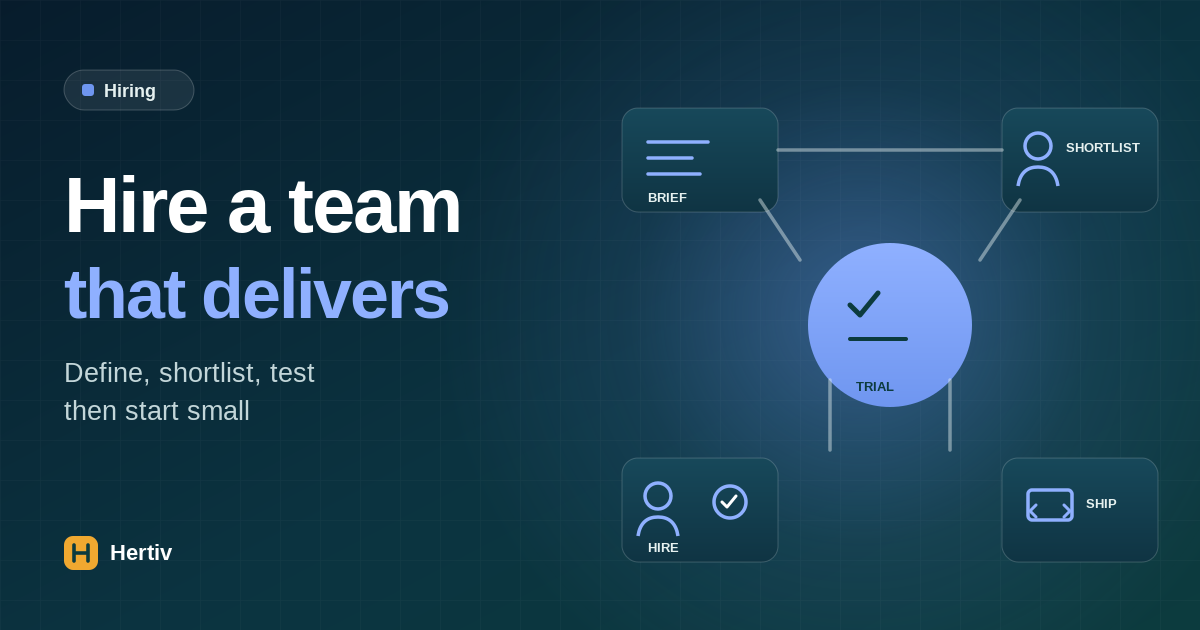
You hire a dedicated development team by defining the work, shortlisting vendors on evidence, testing the actual people, and starting small before you commit to a full team.
- Define the work first. Write down the product, the tech stack, the first three months of work, and the roles you need: how many developers, what seniority, and whether you need a tester or a lead.
- Shortlist three vendors. Look for vendors with teams in your stack, clients in your industry, and references you can call. Ask how they replace a developer who leaves, and how long that usually takes.
- Interview the actual developers. Never accept a team you have not met. Interview each person on real problems from your codebase, not on trivia.
- Run a paid trial. Give the shortlisted team a small, real task from your backlog, paid at the normal rate, and review the code and the communication as well as the result.
- Agree the working rules. Set the hours and overlap, the tools, the reporting rhythm, who owns the code, and how you end the engagement. Put it in writing.
- Start with a small team. Begin with two or three developers for the first month, then add people once the working pattern is proven.
The trial is the step most buyers skip, and it is the one that saves the most money. A team that writes clean code and communicates clearly on a small task will do the same on a large one; a team that does not will not improve after the contract is signed.
What to check before you sign
Before you sign, check four things: the people, the code, the communication, and the exit. Each one is cheap to check now and expensive to fix later.
- The people. Check that the developers you interviewed are the ones who will actually work on your product, and ask what happens if one leaves mid-project.
- The code. Review the trial task's code for structure, tests and naming. Ask the team to explain their choices; a good team can explain why, not just what.
- The communication. Check response times, the quality of written updates, and whether the team asks questions when the task is unclear. Silence is a warning sign.
- The exit. Confirm that you own the code and the documentation, that you can end the engagement with reasonable notice, and that knowledge transfer is part of the deal.
Also ask for a reference call with a current client, not only a past one. A current client will tell you how the vendor behaves when things go wrong, which is when the relationship matters most. For the definition and the roles involved, what a dedicated development team is gives the background.
Example (hypothetical): a startup hires a four-person team
Example (hypothetical): a startup needs a team to build the first version of its product over six months. It hires four developers through a vendor, at 160 hours each per month and a rate of $55 an hour.
The monthly cost is 4 developers times 160 hours times $55, which is $35,200 a month. The vendor adds a management fee of $3,000 a month for the project lead and reporting, bringing the total to $38,200 a month. Over six months that is $229,200, plus a one-off $6,000 for the trial month and onboarding, for a total of $235,200.
The startup starts with two developers in the first month and adds the other two in the second, once the working pattern is proven. That keeps the first month's cost at $19,100 instead of $38,200, and the team is already delivering when the full team starts. The lesson is to pay for the team you need now, not the team you might need later.
What are the common mistakes?
The most common mistakes when hiring a dedicated development team are hiring on price alone, skipping the trial, and managing the team as if it were a vendor.
- Choosing the cheapest vendor. The cheapest rate usually means the least experienced developers or the highest turnover. A team that needs constant replacement costs more than a team that stays.
- Skipping the trial. A sales call tells you nothing about how the team writes code. A paid trial task tells you almost everything.
- No single owner on your side. A dedicated team needs one person on the client side who sets priorities and reviews work. Without that, the team guesses.
- Treating the team as outsiders. Developers who never join your standups, never see the roadmap and never talk to users will build what they are told, not what you need.
- No knowledge transfer. If only the vendor holds the knowledge, you cannot leave. Insist on documentation and shared access from day one.
- Scaling too fast. Doubling a team in the first month doubles the communication load before the working pattern exists. Add people one at a time.
How to manage a dedicated team after hiring
You manage a dedicated team the way you manage your own developers: with a shared backlog, a daily rhythm, and regular reviews of the work itself, not of hours logged.
A workable rhythm is a short daily standup, a weekly demo of what was shipped, and a monthly review of velocity and quality. The demo matters most: it forces the team to show working software, and it gives you a real basis for judging progress. Review code, not just demos, at least once a month, and track the same quality signals you would for an in-house team, such as defect counts and time to fix.
Keep the team in the loop on the product, not just the tasks. Developers who understand why a feature matters make better decisions than developers who only see tickets. If the engagement is going well, plan the next quarter with the vendor so the team can be kept together; keeping a good team is cheaper than hiring a new one.
Key takeaways
- A dedicated team works only on your product, with you setting priorities and the vendor employing the developers
- Shortlist three vendors, interview the actual developers, and run a paid trial before signing
- Start with two or three developers, then scale once the working pattern is proven
- Check the people, the code, the communication and the exit before you commit
- Manage the team like your own developers, with a shared backlog and weekly demos
Frequently asked questions
How much does a dedicated development team cost?
Rates vary by location and seniority, so check vendor sites for current pricing. As a guide, a team of four developers working full time typically costs several tens of thousands of dollars a month, plus a management fee. The example in this article shows how the arithmetic works for one hypothetical team.
How long does it take to hire a dedicated development team?
A vendor can usually present candidates within one to two weeks and staff a small team within a month, including interviews and a paid trial. Allow extra time if you need a rare stack or senior specialists, and do not skip the trial to save a week.
What is the difference between a dedicated team and staff augmentation?
Staff augmentation adds one or two people to your existing team, and you manage each person directly. A dedicated team is a whole group, usually with its own lead and tester, that works on your product as a unit. The team model suits steady product work; augmentation suits filling single gaps.
Who owns the code a dedicated team writes?
You should. The contract must state that all code, documentation and intellectual property belong to you from the day it is written. Confirm this in writing before work starts, and check that the vendor's developers have signed agreements that support it.
Can I change the team size later?
Yes, in most contracts you can add or remove developers with a notice period, often two to four weeks. Starting small and scaling up is the safer path, since adding people to a working team is easier than fixing a team that was too large from the start.
What happens if a developer leaves the team?
The vendor should replace them, usually within two to four weeks, and hand over their work to the replacement. Ask for the replacement time in writing before you sign, and insist on a handover period where the outgoing and incoming developers overlap.


