How to Develop a Sustainable NFT Game
A sustainable NFT game lasts because its economy rewards play without inflating away and its chain uses little energy. Here is how to design one.
On this page
Short answer
A sustainable NFT game is a game whose token economy and energy use can continue for years: rewards are balanced by sinks that remove tokens, and the game runs on a low-energy proof-of-stake chain. Design the economy first, test it in a closed beta, and launch in seasons you can rebalance.
What does a sustainable NFT game mean?
A sustainable NFT game is a game whose in-game economy and energy use can continue for years without collapsing or wasting resources. It earns its keep from players who enjoy the game, not from new buyers funding earlier ones.
Sustainability has two parts, and both matter. The first is economic: the tokens and items players earn must hold value long enough for the game to stay worth playing. The second is environmental: the blockchain the game runs on should use little energy per transaction.
Most NFT games fail on the first part. They pay generous rewards to attract players, the token supply grows faster than demand, and the token price falls until playing no longer pays. When the rewards stop being worth it, players leave, and the game ends.
A sustainable game designs against that from the start. Rewards are tied to play that other players value, tokens have uses that remove them from circulation, and the team tests the economy before launch instead of hoping it balances itself. What are NFT games explains the basic model before this design work begins.
How do you design an economy that lasts?
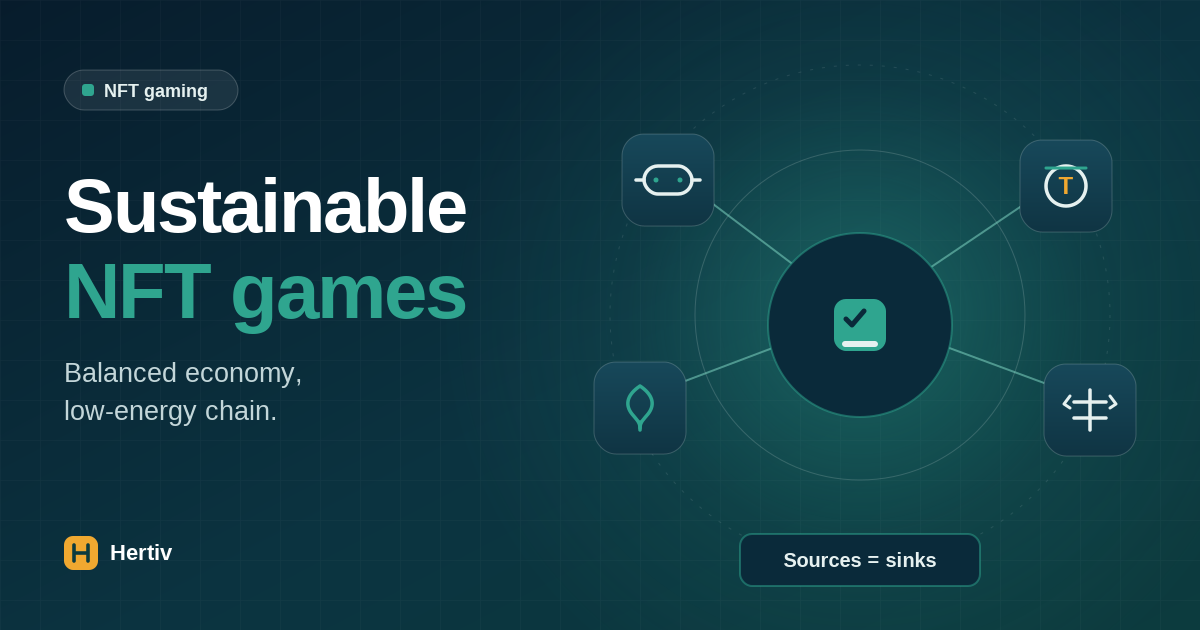
You design an economy that lasts by balancing every token that enters the game with a token that leaves it. If more tokens are earned than spent, the supply grows, prices fall, and the economy slowly dies.
| Flow | Examples | What it does |
|---|---|---|
| Sources (tokens in) | Quest rewards, wins, daily logins | Pay players for playing |
| Sinks (tokens out) | Crafting, upgrades, entry fees | Remove tokens from circulation |
| Trades | Marketplace sales between players | Move tokens, do not create them |
| Burns | Consumed items, failed crafts | Destroy tokens permanently |
The rule is simple: sources and sinks must stay close. A game that pays 1,000 tokens a day and only burns 100 a day adds 900 tokens a day to the supply, and the token will lose value unless new players keep arriving to buy it.
Good sinks are things players want: crafting a rare item, entering a tournament, upgrading a character, or customising a look. The sink must feel like part of the game, not a tax, or players will resent it and stop playing.
Rewards should also scale with skill and effort, not with time alone. A player who wins a hard match earns more than one who idles, which keeps the economy tied to play that others enjoy watching or competing against.
Which chain should you choose?
You choose a chain for an NFT game by checking its energy use, transaction fees, tooling and marketplace support, not by picking the chain with the loudest community. The chain is a long-term home for your players' items, so the choice is hard to undo.
| What to check | Why it matters | What good looks like |
|---|---|---|
| Consensus | Energy use per transaction | Proof of stake, not proof of work |
| Fees | Cost of every mint and trade | Low enough that small items stay tradable |
| Tooling | Speed of building and fixing | Wallets, SDKs and docs your team knows |
| Marketplaces | Where players buy and sell | Active trading for your kind of items |
Energy matters because players and press ask about it. A proof-of-stake chain uses far less energy per transaction than a proof-of-work chain, which is why most new NFT games choose proof of stake. Sustainable NFT solutions explains the greener options in more depth.
Fees matter because they set the smallest item worth trading. If a mint or a trade costs more than the item is worth, players stop trading small items and the marketplace goes quiet. Test the real fee on the chain you pick before you commit.
Finally, check where your players already are. A chain with an active NFT community gives your game an audience on day one, while a quiet chain means you must bring every player yourself.
How do you build a sustainable NFT game, step by step?
You build a sustainable NFT game by designing the economy before the art, testing it with real players, and launching small enough to fix what breaks. The order matters: economy first, scale later.
- Define the fun first. Write down what makes the game worth playing without any tokens. If the game is only fun because it pays, the economy will collapse when payments fall.
- Map every source and sink. List every way tokens enter and leave the game, and set numbers for each. The two sides must stay close at your expected player count.
- Pick the chain and the standard. Choose a proof-of-stake chain with low fees and a token standard your team can build on. Check the marketplace support before you mint anything.
- Build the game, not the token. Ship a playable game with a small set of items. A token that launches before the game exists is a promise, not a product.
- Test the economy in a closed beta. Let a few hundred players earn and spend for a month, watch the token supply daily, and adjust rewards and sinks before the public launch.
- Launch in seasons. Release content in seasons with clear start and end dates, so you can rebalance between seasons instead of changing the rules mid-season.
Each step reduces a different risk. The economy map catches inflation early, the closed beta catches what the map missed, and seasons give you a safe moment to fix both. How to make an NFT game covers the general build in more depth.
Example (hypothetical): a small adventure game
Example (hypothetical): a small adventure game has 1,000 active players. Each player completes about 200 quests a day across the whole game, and each quest pays 5 tokens, so the game issues 1,000 tokens a day.
Players spend tokens on crafting. Each day they craft 250 items, and each craft burns 3 tokens, so crafting removes 750 tokens a day. That leaves a net gain of 250 tokens a day, which slowly grows the supply.
The team adds a tournament entry fee of 1 token. If 250 players enter each day, the fee removes another 250 tokens a day. Now 1,000 tokens enter and 1,000 tokens leave, so the supply stays flat at the team's target.
Over 30 days, the balanced design issues and removes 30,000 tokens each, and the supply does not grow. The team watches the numbers weekly: if quests rise to 300 a day, issues rise to 1,500 tokens, and the team must add sinks or cut rewards to keep the balance.
What are the common mistakes?
The most common sustainable NFT game mistakes are paying too much too early, letting one reward dominate, and treating the token price as the game's success metric.
- Paying too much to attract players. Generous launch rewards bring players who leave the moment rewards fall. Start low and raise rewards only when the sinks can absorb them.
- One dominant reward. If a single quest pays most of the tokens, players farm it and ignore the rest of the game. Spread rewards across many activities.
- No real sinks. Cosmetics and upgrades that nobody wants do not remove tokens. Sinks must be things players actually buy.
- Launching the token before the game. A token with no game behind it is speculation, and speculators leave faster than players do.
- Ignoring energy use. Building on a high-energy chain invites criticism and puts off players who care about the footprint.
- Changing the rules mid-season. Cutting rewards without warning breaks trust. Rebalance between seasons, and explain the change.
Each mistake shortens the game's life. A game that survives is usually one that paid modestly, balanced its economy early, and treated players as players first and earners second.
How do you test sustainability before launch?
You test sustainability before launch by simulating the economy, running a closed beta with real players, and watching the token supply daily. A spreadsheet model is the start, not the proof.
Begin with a model. Put your sources and sinks in a spreadsheet, run it at three player counts (half, expected and double), and check the token supply in each case. If the supply grows fast at double the players, the design is fragile.
Then run a closed beta for at least a month. Give players the real rewards and sinks, watch how many tokens enter and leave each day, and ask players which sinks they actually enjoy. Beta behaviour is the first honest data you will get.
Set limits before launch: a maximum daily issue, a review point each season, and a rule that rewards only change between seasons. Best blockchains for NFT projects can help you compare chains once the design is ready.
If you need help with the build itself, a dApp development partner can take the design from spreadsheet to a playable game.
Key takeaways
- Sustainability means a lasting economy and low energy use
- Balance token sources with sinks, or the supply inflates
- Choose a proof-of-stake chain with low fees and active marketplaces
- Design the economy before the art, and test it in a closed beta
- Rebalance between seasons, never mid-season
Frequently asked questions
What makes an NFT game unsustainable?
An NFT game becomes unsustainable when it issues more tokens than players spend, so the token supply grows and its value falls. It also fails when rewards attract players who only play to earn, because they leave as soon as rewards drop. Both problems come from designing rewards before sinks.
Do sustainable NFT games pay less?
Usually yes at first. A sustainable game pays modest rewards that its sinks can absorb, instead of generous launch rewards that inflate the supply. Players who stay for the game itself are worth more than players who leave when the pay falls.
Which blockchains are best for a sustainable NFT game?
Proof-of-stake chains with low fees and active NFT marketplaces are the usual choice, because they keep energy use and trading costs down. Compare chains on fees, tooling and where your players already trade before you commit to one.
How do token sinks work in a game?
A sink is anything that removes tokens from circulation, such as crafting an item, entering a tournament, upgrading a character or buying a cosmetic. Good sinks are things players want to buy, so removing tokens feels like part of the game rather than a tax.
Should the token launch before the game?
No. A token that launches before the game exists is a promise, not a product, and it attracts speculators rather than players. Ship a playable game first, then add the token economy once players already enjoy playing.
How often should the economy be rebalanced?
Between seasons is the right moment. Set a season length, watch the token supply daily during it, and change rewards or sinks only when the next season starts. Changing the rules mid-season breaks trust with players who planned around them.


