How to Develop an Institutional DeFi Platform
An institutional DeFi platform adds identity checks and permissioned pools to open lending. Here are the building blocks, the build steps and the controls it needs.
On this page
Short answer
An institutional DeFi platform is a blockchain-based lending, trading or settlement system that only verified institutions can use. It combines smart contracts with identity checks, permissioned liquidity pools, regulated custody and audit trails, so banks, funds and corporates can use DeFi rails while meeting their compliance duties.
What is an institutional DeFi platform?
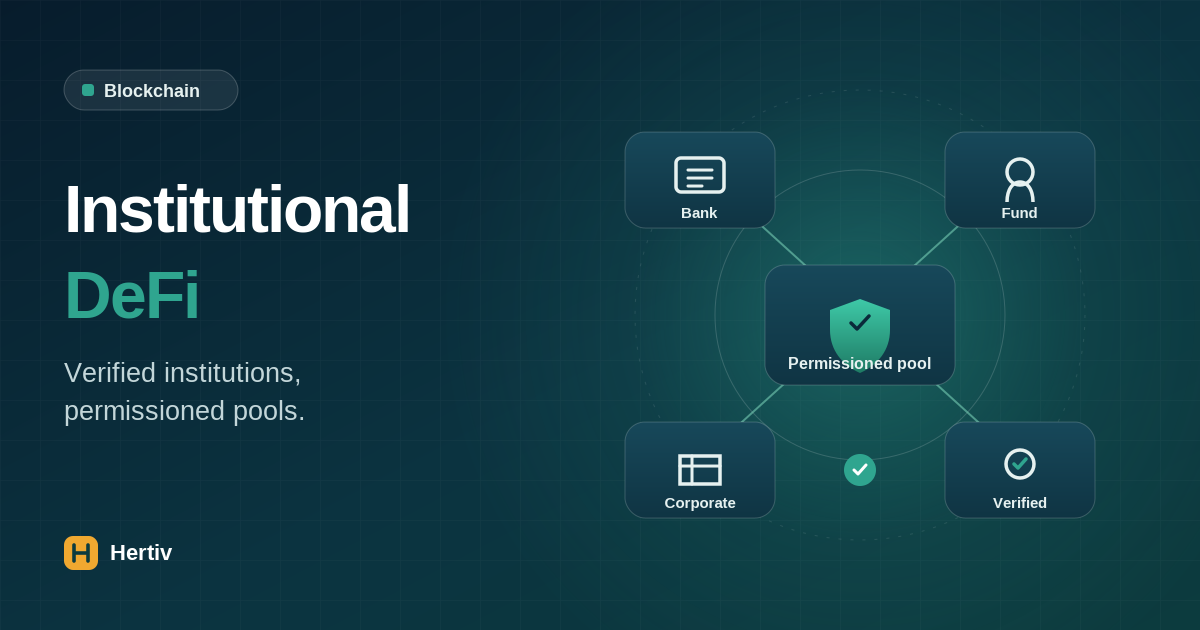
An institutional DeFi platform is a decentralised finance system built for banks, funds, corporates and other regulated firms, where every participant is identified and checked before it can trade, lend or settle. It runs on smart contracts like retail DeFi, but access is limited to wallets that have passed identity and compliance checks.
The difference is not the blockchain. It is the gate around it. In retail DeFi anyone with a wallet can join a pool or take a loan, and no one asks who they are. An institutional platform reverses that: identity comes first, and the smart contract only lets a verified wallet act. That single change is what makes the system usable by firms that answer to regulators, auditors and boards.
Typical uses include tokenised fund lending, permissioned trading of tokenised bonds or money-market funds, and settlement between institutions using stablecoins. The assets are often real-world assets on chain, such as tokenised treasury bills or fund shares, rather than volatile crypto tokens. If you are new to the basics, start with what DeFi is before planning a build.
How is it different from a retail DeFi platform?
An institutional DeFi platform differs from a retail one in who can join, what can be traded, and how much control the operator keeps. The table below sets out the main contrasts.
| Feature | Retail DeFi platform | Institutional DeFi platform |
|---|---|---|
| Who can join | Anyone with a wallet | Verified institutions only |
| Identity checks | None | KYC and sanctions screening |
| Assets traded | Mainly crypto tokens | Tokenised funds, bonds and stablecoins |
| Liquidity pools | Open to all | Permissioned, allow-listed wallets |
| Custody | Self-custody by users | Regulated custody or multi-party wallets |
| Reporting | On-chain data only | Audit trails and regulatory reports |
| Upgrades | Community votes | Governed by the operator and its clients |
The stricter model costs more to build and run, and it gives up some of the openness that retail DeFi is known for. In return, it opens the door to firms that hold real balance sheets and cannot touch an anonymous pool. That trade-off is the whole point of the institutional version.
What are the building blocks?
You build an institutional DeFi platform from six parts, and each one has a job that the others depend on. Missing any one of them leaves a gap that an auditor or a regulator will find.
- Identity and access layer. Verifies each institution, screens it against sanctions lists, and issues credentials that its wallets carry on chain.
- Permissioned pools. Smart contracts that check a wallet's credentials before letting it deposit, borrow or trade.
- Tokenised assets. The instruments the platform handles, such as fund shares, bonds or stablecoins, issued as tokens with clear legal terms.
- Custody. Where private keys live. Institutions usually use a regulated custodian or a multi-party wallet rather than a single hot key.
- Price and risk oracles. Feeds that value collateral and trigger liquidations, plus a risk engine that sets limits per borrower and per asset.
- Reporting and audit. Logs of every transaction, position and decision, in a form the compliance team can hand to an auditor.
Start with the identity layer and the pool contracts, because everything else plugs into them. A platform that adds custody and reporting later usually has to rework the parts it built first. For a broader view of the build, see the DeFi development guide.
How do you build it, step by step?
You build an institutional DeFi platform in stages, with compliance and security checked at each stage rather than added at the end. The sequence below is the usual order.
- Define the use case and the rules. Pick one product, such as tokenised fund lending, and write down who can use it, what assets it handles, and which rules apply in each market.
- Choose the chain and the asset model. Pick a chain with the finality, fees and tooling your clients need, and decide whether assets are issued by you or by a partner.
- Build identity and access first. Set up verification, sanctions screening and credential issuing, so only approved wallets can reach the pools.
- Write and audit the pool contracts. Build the lending or trading contracts, then have them reviewed by an independent auditor before any real money touches them. A smart contract audit is part of the build, not an optional extra.
- Connect custody and payments. Wire in the custodian, the stablecoin rails and the fiat on- and off-ramps that move money in and out.
- Add risk controls and reporting. Set borrowing limits, liquidation rules and price-feed checks, and build the reports the compliance team needs.
- Run a closed pilot. Let two or three friendly institutions use the platform with small amounts, fix what breaks, and only then open it wider.
Each stage should end with a review by the compliance and security teams. A platform that passes a pilot with three institutions is far more credible than one that launches to twenty at once and then finds a control missing.
What compliance and security controls does it need?
An institutional DeFi platform needs controls that a retail platform can skip, because its users are regulated firms with duties to their own regulators and clients. The controls fall into three groups.
First, identity and sanctions controls: every wallet is tied to a verified legal entity, checked against sanctions and watch lists, and re-checked when its details change. A wallet whose owner is sanctioned must be blocked from new activity at once.
Second, asset and market controls: collateral is valued from more than one price feed, borrowing limits are set per institution, and liquidations are tested so that a sharp price move does not leave the pool with bad debt. Circuit breakers can pause a pool when a feed looks wrong or a price moves too far too fast.
Third, operational controls: keys are held under multi-party rules, contract upgrades need more than one approval, and every admin action is logged. If a key is lost or a team member leaves, the platform must still work and the audit trail must still be complete.
Example (hypothetical): a tokenised fund lending pool
Example (hypothetical): a fund administrator wants a lending pool where three funds lend tokenised treasury bills to two trading firms. Only verified institutions can join, and each borrower has a limit based on its balance sheet.
The pool holds $10,000,000 of tokenised bills. The three funds supply the whole amount, and at any time up to 70% of it can be lent out, which is $7,000,000. Borrowers pay 8% a year on what they borrow, and the platform takes a 10% share of the interest for running the service.
The numbers work out like this. At full use, the pool earns 8% on $7,000,000, which is $560,000 a year. The platform keeps 10% of that, or $56,000, and the funds share the remaining $504,000 in proportion to what they supplied. A fund that supplied $4,000,000 of the $10,000,000 receives 40% of $504,000, which is $201,600 a year.
The pilot runs with $1,000,000 for three months before the full pool opens. That limits the damage if a control fails, and it gives the compliance team real transactions to review before larger amounts go in.
What are the common mistakes?
The most common mistakes in institutional DeFi builds are treating compliance as a feature to add later, trusting a single price feed, and letting one key control the whole platform.
- Bolting on identity late. Adding access checks after the pools are built usually means rewriting the contracts. Build identity into the pool logic from the first draft.
- One price feed. A single oracle is a single point of failure. Use at least two feeds and a rule that pauses the pool when they disagree.
- Weak key control. A platform run from one admin key can be drained by one mistake or one departure. Use multi-party approval for upgrades and fund movements.
- No liquidation testing. A pool that has never been tested under a price crash will find its weak point in a real crash. Simulate liquidations before launch.
- Launching too wide. Opening to many institutions at once multiplies the damage from any bug. Start with a small closed pilot and grow from there.
Key takeaways
- An institutional DeFi platform limits access to verified institutions, unlike retail DeFi
- Identity checks, permissioned pools and custody are the parts that make it usable by regulated firms
- Build identity first, then the pool contracts, then custody, risk controls and reporting
- Use at least two price feeds and test liquidations before any real money goes in
- Start with a small closed pilot and grow only after compliance has reviewed real transactions
Frequently asked questions
What is an institutional DeFi platform?
It is a blockchain-based lending, trading or settlement system that only verified institutions can use. Smart contracts run the trades, while identity checks, permissioned pools and custody keep the platform within the rules its users must follow.
How is it different from retail DeFi?
Retail DeFi lets anyone with a wallet join, with no identity checks and mainly crypto tokens. An institutional platform limits access to verified firms, handles tokenised funds and bonds, and adds custody, reporting and audit trails.
Do institutions need permissioned pools?
Yes, in most cases. A permissioned pool only lets allow-listed wallets deposit, borrow or trade, which is what lets a regulated firm use it. An open pool would expose the firm to anonymous counterparties it cannot accept.
What assets do institutional DeFi platforms handle?
Mostly tokenised real-world assets such as treasury bills, fund shares and bonds, plus stablecoins for settlement. These have clear legal terms and known issuers, which is what institutions need before they will hold them.
How long does it take to build one?
A first version with one product, identity checks and a closed pilot usually takes several months for a small team. Compliance review, contract audits and custody setup take as long as the code itself, so plan for both.
What is the biggest risk?
A control gap is usually the biggest risk: a missing identity check, a single price feed, or one key that controls the platform. These are found by audits, liquidation tests and a small pilot before launch.


