How to Develop a Winning Crypto Sports Betting Exchange
A crypto sports betting exchange lets users bet against each other with crypto instead of a bookmaker. Here is how to build one, from licence to launch.
On this page
Short answer
A crypto sports betting exchange is a platform where users place bets against each other, with the exchange taking a small commission on winnings instead of setting the odds itself. Users deposit cryptocurrency, back or lay outcomes, and settle in crypto. Winning means enough liquidity, fair odds, fast payouts and a licence that covers the markets you serve.
What is a crypto sports betting exchange?
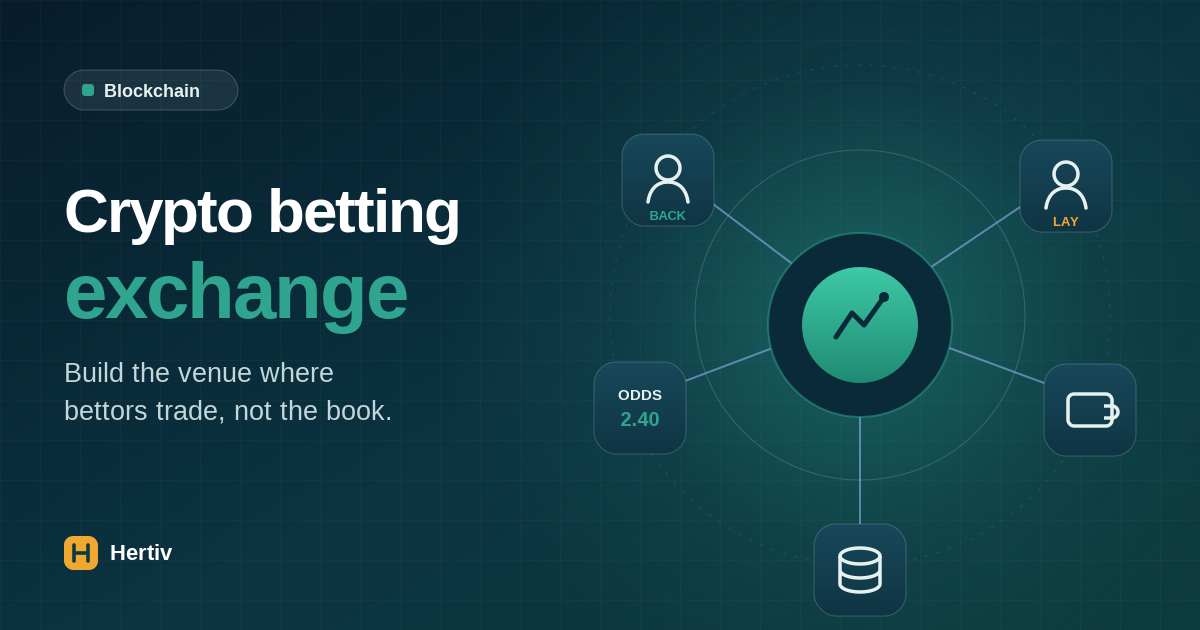
A crypto sports betting exchange is a marketplace where bettors trade against each other instead of betting against a bookmaker. One user backs an outcome at certain odds, another user lays it, and the exchange matches the two sides and takes a commission on the winner's profit.
Payments run in cryptocurrency. Users deposit crypto into a wallet, place bets, and withdraw winnings in the same currency. Settlement is usually handled by smart contracts or by the exchange's own ledger, and the odds move with supply and demand rather than being set by a trading desk.
This differs from a sportsbook, where the operator sets odds and takes the other side of every bet. On an exchange the operator is a neutral venue. That changes the business: revenue comes from commission, not from the margin built into odds, so the product lives or dies on liquidity and trust.
What separates a winning exchange from the rest?
A winning exchange is the one bettors return to, and the difference is rarely one feature. It is a set of basics done well: enough liquidity that bets get matched, odds that reflect the market, withdrawals that arrive quickly, and rules that are clear before money is staked.
| Factor | What good looks like | Why it matters |
|---|---|---|
| Liquidity | Bets matched in seconds on popular events | Thin markets drive users to rivals |
| Odds | Prices close to the best available elsewhere | Bettors compare odds before every bet |
| Withdrawals | Crypto paid out within minutes, not days | Slow payouts are the top trust killer |
| Fees | Commission stated plainly, no hidden spread | Surprise fees end accounts fast |
| Markets | Depth on the sports your users actually follow | Wide but empty markets help nobody |
| Support | Disputes answered the same day | Bet settlement disputes need fast answers |
Start with two or three sports and deep liquidity rather than twenty sports with empty order books. A bettor who cannot get a bet matched at a fair price will not wait for the market to grow.
How to build it in six steps
You build a crypto sports betting exchange in six steps, and the order matters: legal groundwork first, then the product, then liquidity, then launch. Skipping the first step is the most expensive mistake a team can make.
- Pick your markets and licence. Decide which countries and sports you will serve, then get the licence that covers them. The licence shapes your payment options and your marketing.
- Choose the betting model. Decide whether users bet against each other, against the house, or both. A pure exchange needs market makers; a hybrid needs a trading desk.
- Build the core product. Wallet, matching engine, odds feed, bet slip, settlement and admin tools. The matching engine is the part you cannot buy cheaply and fix later.
- Connect payments and custody. Decide which coins you accept, how deposits are confirmed, and how withdrawals are approved. Use a custody setup you can explain to a regulator.
- Seed liquidity. Sign market makers or run your own market-making desk with clear risk limits before you open to the public.
- Launch small and measure. Open with a few events, watch matched volume, withdrawal times and dispute rates, then widen the market list.
Teams that build the product first and look for a licence later usually rebuild the payments and onboarding flow. Legal advice belongs in the first month, not the last. For the exchange side of the build, crypto exchange development covers the matching and custody patterns that carry over.
Licence, compliance and responsible gambling
A licence is what lets you operate legally, take payments and advertise in a market. Without one, payment providers and banks will not work with you, and users have no regulator to complain to when something goes wrong.
Most teams start with one jurisdiction and expand. Common choices include Curacao, Malta, the Isle of Man and Gibraltar, each with different costs, timelines and reporting duties. Some markets, such as the United States, need state-by-state licences that most startups cannot afford at launch.
Compliance is not a one-off form. You need identity checks for larger deposits, anti-money-laundering screening, sanctions checks, and tools that let users set deposit limits, take a break or self-exclude. Responsible gambling features are a licence condition in most jurisdictions, not a nice extra.
Keep a written record of every compliance decision: which licence covers which market, what your limits are, and how disputes are handled. When a regulator asks, a clear record is worth more than a confident answer.
Liquidity, odds and the matching engine
Liquidity is the amount of money waiting to be matched at each price, and it decides whether your exchange works. A market with deep liquidity matches bets instantly at fair odds. A thin market leaves bettors waiting or forces them to accept bad prices.
The matching engine is the software that pairs back and lay bets. It must handle thousands of orders per second during a big match, keep the order book consistent, and settle bets the moment the result is confirmed. A slow or buggy engine produces disputes, and disputes in betting are expensive.
Odds come from an odds feed or from your own traders. A feed gives you prices for hundreds of events, but you still need someone watching for stale odds after a goal or a red card. Some exchanges use decentralised oracles for results; others use a data provider. Either way, the result source must be reliable, because settlement depends on it.
Market makers solve the cold-start problem. They quote both sides of popular markets so early users can always get a bet matched. Pay them a fee or a share of commission, and set limits on how much they can lose in a single event.
Example (hypothetical): a first-season launch
Example (hypothetical): a small team launches an exchange covering football and tennis in one licensed market. It signs two market makers, lists 40 events a week, and charges 2% commission on net winnings.
In the first month, 500 users place 4,000 bets worth $200,000 in total stakes. The exchange matches 90% of bets, and winners take home $95,000 after the exchange keeps $5,000 in commission on the $250,000 of winning payouts that pass through it. That is not profit yet: the team pays $8,000 a month for the odds feed, $6,000 for hosting and custody, and $4,000 for market-maker fees.
The arithmetic shows the shape of the business. At 2% commission, the exchange needs about $900,000 of monthly matched volume to cover $18,000 of monthly costs. The team therefore grows volume before it grows the market list: deeper liquidity on the same events beats wider coverage on empty ones.
By month six, matched volume reaches $1.2 million a month, commission brings in $24,000, and costs have risen to $22,000. The exchange is barely profitable, but the pattern is sound: volume grows with liquidity, and liquidity grows with volume.
What are the common mistakes?
The most common mistakes in crypto sports betting exchanges are launching without a licence, opening with thin liquidity, and treating crypto payments as a substitute for compliance.
- Launching unlicensed. Payment providers close the account, and users leave at the first dispute.
- Too many markets, no depth. Twenty sports with empty order books lose to three sports with instant matching.
- Slow withdrawals. A withdrawal that takes a day when rivals pay in minutes is a reason to leave.
- Weak result feeds. Settling bets on a stale or wrong result creates disputes that cost more than the feed would have.
- No market makers. Expecting users to provide all the liquidity on day one leaves the book empty.
- Ignoring responsible gambling. Deposit limits and self-exclusion are licence conditions, and regulators check them.
Key takeaways
- A betting exchange earns commission, so liquidity and trust matter more than odds-setting skill
- Start with a licence and two or three deep markets, not twenty empty ones
- Market makers solve the cold-start problem; set their risk limits in writing
- Withdrawals in minutes are a product feature, not an operations detail
- At 2% commission, volume must cover fixed costs before the exchange earns anything
Frequently asked questions
How does a crypto sports betting exchange make money?
It takes a commission on net winnings, usually 1% to 5%, instead of setting odds and taking the other side of bets. The operator is a neutral venue, so revenue depends on matched volume rather than on bettors losing.
Do users need crypto to bet on the exchange?
Yes, in most cases. Users deposit cryptocurrency into a wallet on the platform and withdraw winnings in crypto. Some exchanges accept stablecoins to avoid price swings during a match, and a few add card payments for deposits.
What licence does a crypto betting exchange need?
It depends on the markets you serve. Common starting points are Curacao, Malta, the Isle of Man and Gibraltar, each with different costs and reporting duties. Some countries need separate local licences, so most teams start in one jurisdiction and expand.
How much liquidity does a new exchange need?
Enough that a bet on a popular event is matched within a minute at a fair price. That usually means signing market makers before launch, since early users will not wait for an order book to fill on its own.
What is the difference between a betting exchange and a sportsbook?
On an exchange, users bet against each other and the operator takes a commission. In a sportsbook, the operator sets the odds and takes the other side of every bet, so its profit comes from the margin in the odds.
Why do crypto betting exchanges use smart contracts?
Smart contracts can hold stakes in escrow and release winnings automatically when a result is confirmed, which removes the need to trust the operator with funds. The contract code still needs an audit, because a bug in settlement logic can drain the escrow.


