How to Create a Token on the Core Blockchain
To create a token on Core, write an ERC-20 contract, deploy it with a wallet funded in CORE, and verify it on CoreScan. The Ethereum workflow applies.
On this page
Short answer
To create a token on the Core blockchain, you write an ERC-20 contract, deploy it to Core with a wallet funded with CORE for gas, and verify it on CoreScan. Core is EVM-compatible, so the same OpenZeppelin templates and Remix workflow used on Ethereum work there, and you test first on the Core testnet. Name, symbol, supply and permissions are set in the contract before deployment.
What is a token on the Core blockchain?
A token on the Core blockchain is a fungible asset created with an ERC-20 smart contract on Core, an EVM-compatible Layer 1 blockchain. Core runs smart contracts written in Solidity, so the same ERC-20 standard and the same tools used on Ethereum work there. The token lives at a contract address, and anyone can read its supply, its holders and its transfers on CoreScan, the Core block explorer.
Core itself is secured by Satoshi Plus consensus, which combines delegated Bitcoin mining power, non-custodial Bitcoin staking and CORE staking to choose validators. That design is the reason Core is described as Bitcoin-aligned, but for a token creator the practical point is simpler: Core speaks EVM, so the Ethereum workflow applies. The native token is CORE, and it pays for gas on every transaction, including your token deployment.
| Item | What it is on Core |
|---|---|
| Network | EVM-compatible Layer 1 blockchain |
| Gas token | CORE, the native token |
| Token standard | ERC-20, the same standard as on Ethereum |
| Explorer | CoreScan, for supply, holders and transfers |
| Testnet | Core Testnet2, for practice deployments |
If you have not made an ERC-20 token before, start with how to create an ERC-20 token, which covers the standard itself.
What do you need before you start?
Before you start, you need four things: a wallet, some CORE for gas, a clear token design, and a test network to practise on. The wallet is usually MetaMask or another EVM wallet, set to the Core network. The token design is the name, the symbol, the total supply and the rules for minting, burning and pausing, all decided before you write code.
- EVM wallet such as MetaMask. The wallet holds your CORE and signs the deployment.
- CORE for gas on mainnet, test CORE on testnet. Every transaction, including deployment, costs gas in CORE.
- Token name, symbol and supply. These are set in the contract and are hard to change later.
- OpenZeppelin Wizard and Remix. The Wizard generates the contract; Remix compiles and deploys it.
- CoreScan for verification. The explorer is where holders will check your token.
The design decisions matter more than the code. A token with a fixed supply behaves differently from one that can be minted later, and a token that can be paused needs a clear owner. Write the name, the symbol, the supply and the rules down first, because changing them after deployment is hard or impossible.
How to create a token on Core, step by step
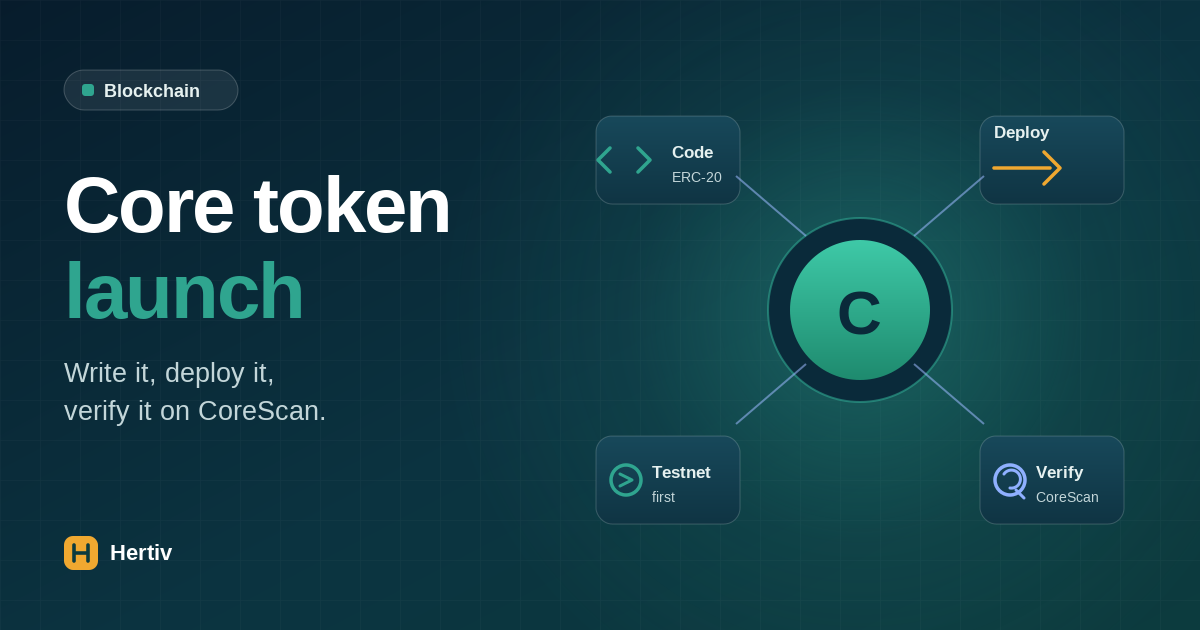
Creating a token on Core follows the same steps as on any EVM chain, with the Core network settings changed in your wallet and in Remix. The Core DAO docs walk through the same flow, using OpenZeppelin Wizard to generate the contract and Remix to compile and deploy it. Test on the Core testnet first, then deploy to mainnet.
- Generate the contract with OpenZeppelin Wizard. Pick the ERC-20 template, set the name, symbol, supply and options such as minting, burning and pausing, then copy the code.
- Open Remix and paste the code. Create a new Solidity file in Remix and paste in the contract from the Wizard.
- Compile the contract. Use the Solidity compiler tab in Remix and fix any errors before you go further.
- Connect MetaMask to Core Testnet2. Switch the wallet to the testnet and confirm it holds test CORE for gas.
- Deploy and note the contract address. Deploy from Remix with the recipient and owner addresses set, then save the address.
- Verify the contract on CoreScan. Submit the source code and compiler settings so the contract shows as verified.
- Test transfers, then deploy to mainnet. Test every function you will rely on, then repeat the deployment on mainnet with real CORE.
The Remix part of the flow is the same as on other chains, so how to create a smart contract using Remix is a useful companion.
Keep the testnet run honest. Deploy the exact contract you plan to use on mainnet, with the same name, supply and rules, and test every function you will rely on. A testnet run that skips the mint or burn functions has not tested the contract.
Example (hypothetical): a community token launch
Example (hypothetical): a gaming community launches a token called PLAY on Core with a total supply of 1,000,000 tokens. The supply is split four ways: 50% for the community, 20% for the team, 20% for the treasury, and 10% for liquidity. Each share is fixed in the contract before deployment, so no one can change the split later.
The arithmetic is simple. Community: 1,000,000 x 50% = 500,000 tokens. Team: 1,000,000 x 20% = 200,000 tokens. Treasury: 1,000,000 x 20% = 200,000 tokens. Liquidity: 1,000,000 x 10% = 100,000 tokens. The four shares add up: 500,000 + 200,000 + 200,000 + 100,000 = 1,000,000, which is the total supply.
The team also sets a minting rule: no new tokens can be created after launch, so the supply stays at 1,000,000. That choice is written into the contract, and anyone can read it on CoreScan before buying. A fixed supply does not make a token valuable; it only makes the supply honest.
How do you verify and share your token?
Verification means publishing your contract code on CoreScan so anyone can read it and check it matches what is deployed. You submit the source code and the compiler settings through CoreScan, and the explorer marks the contract as verified. An unverified contract asks users to trust you; a verified one lets them check.
Once verified, share the contract address, not a screenshot. The address is the token's identity on Core, and anyone can paste it into CoreScan to see the supply, the holders and the transfers. If a listing or a wallet asks for the address, give them the verified contract address from CoreScan.
The same token standard works on other EVM chains, so how to create tokens on Blast shows how the flow changes on a different network.
What are the common mistakes?
The most common mistakes when creating a token on Core are deploying to mainnet without a testnet run, leaving minting open, and forgetting that gas is paid in CORE, not in the token you just created.
- Mainnet first, testnet never. A bug found on mainnet costs real CORE to fix, if it can be fixed at all.
- Minting left open with no cap. An open mint function lets new tokens be created without limit.
- Wrong network selected in the wallet. A deployment on the wrong network does not land on Core.
- Contract never verified on CoreScan. Holders cannot check code they cannot read.
- No plan for liquidity or distribution. A token with no way to reach holders sits in one wallet.
A second mistake is treating the token as finished once it is deployed. A token needs a reason to exist, a way for people to get it, and a place to use it. A contract with no distribution plan is a token that sits in one wallet.
What should you do after launch?
After launch, the work moves from code to distribution. Add liquidity so people can trade the token, publish the contract address and the token rules, and answer questions in the open. The token's holders will check CoreScan, so keep the verified contract and the supply visible rather than hidden in a document.
- Add liquidity on a Core DEX. A pool lets holders buy and sell without asking you.
- Publish the contract address. Share the verified CoreScan address everywhere the token is named.
- Write the token rules down. Supply, minting and pausing should be public, not private knowledge.
- Set up community channels. Holders need a place to ask questions and report problems.
- Monitor holders and transfers. Watch CoreScan for unusual movement and for the first signs of trouble.
Keep the first weeks small. A token that launches with a clear use and a small community teaches you more than a large launch with no users, and it is far easier to support. Grow the supply in use, not in promises.
If the token is part of a larger product, crypto wallet development can help your users hold and use it inside your own app.
Key takeaways
- A token on Core is an ERC-20 contract on an EVM-compatible Layer 1
- CORE pays for gas, so the deployer wallet must hold CORE
- OpenZeppelin Wizard and Remix cover the whole flow, testnet first
- Verify the contract on CoreScan so holders can check the code
- Fix the supply split and the minting rules before deployment, not after
Frequently asked questions
Do I need to code to create a token on Core?
Not much. OpenZeppelin Wizard generates the ERC-20 contract from your choices, and Remix compiles and deploys it through your wallet. You still need to understand the choices, such as supply and minting, because the contract locks them in once deployed.
What is CORE used for when creating a token?
CORE is the native token of the Core blockchain, and it pays for gas on every transaction, including deploying your token contract. Your deployer wallet must hold CORE before you deploy, and test CORE on the testnet for practice runs.
How long does it take to create a token on Core?
The contract itself can be generated and deployed in under an hour once the design is decided. The design, the testnet run and the verification take longer, and they are the parts that matter. Rushing them is how tokens launch with the wrong supply or open minting.
Can I create a token on Core for free?
No, because deployment costs gas paid in CORE, though the amount is small. The tools themselves, OpenZeppelin Wizard and Remix, are free to use. Budget a small amount of CORE for the testnet run and the mainnet deployment.
How do I check a token on Core is real?
Paste the contract address into CoreScan, the Core block explorer. A verified contract shows its source code, its supply, its holders and its transfers. If the contract is not verified, or the address does not match the one the project published, treat it with care.
What is the difference between a token on Core and a token on Ethereum?
Very little in how it is built, because Core is EVM-compatible and uses the same ERC-20 standard and the same tools. The differences are the network, the gas token, which is CORE rather than ETH, and the consensus, which is Satoshi Plus rather than proof of stake.


