How to Choose a Crypto Token Development Company
Choosing a crypto token development company means checking its past tokens, audit record, security and pricing. Here is how to compare firms and avoid a bad hire.
On this page
Short answer
Choosing a crypto token development company means finding a firm that can design, build, test and launch a token safely, and proving it can do so before you sign. The right choice depends on the firm's past tokens, its audit record, its security process and whether its pricing matches the scope, not on its sales pitch alone.
What does a crypto token development company do?
A crypto token development company designs, builds and launches tokens on a blockchain. That usually means writing the smart contract, setting the token rules such as supply, minting and burning, testing the contract, and helping with the launch on an exchange or a sale platform. Some firms also handle the token economics, the wallet integration and the compliance paperwork.
The work splits into three parts. Design covers the token model: what the token is for, how many exist, who can mint more, and how it is distributed. Development is the smart contract itself, written and tested against attacks. Launch covers deployment, verification of the contract on a block explorer, and the steps that let people buy, hold and trade the token.
Not every firm does all three parts well. Some are strong on contracts but weak on token economics, while others are good at launch marketing but thin on security. Knowing which part matters most for your token is the first step in choosing, and it shapes every question you ask next. For the wider build picture, see blockchain development.
What should the company deliver?
A serious firm delivers a written scope, working code, test results and an audit trail, not just a deployed contract. The table below shows what to expect at each stage and what counts as a red flag if it is missing.
| Stage | What you should get | Red flag |
|---|---|---|
| Design | Token model, supply rules, distribution plan | No written model, only a price |
| Development | Smart contract code, unit tests, docs | No tests or no code review |
| Security | Internal review plus outside audit | Audit skipped or done in house only |
| Deployment | Verified contract, keys handled safely | Admin keys held by the firm |
| Launch support | Exchange listing help, monitoring plan | No plan for after launch day |
| Handover | Full code, docs and access transfer | Code kept by the firm |
Ask for these deliverables in writing before you sign. A firm that cannot list them is telling you how the project will go. The handover row matters most: if the firm keeps the code or the admin keys, you do not really own your token.
How do you check a company's track record?
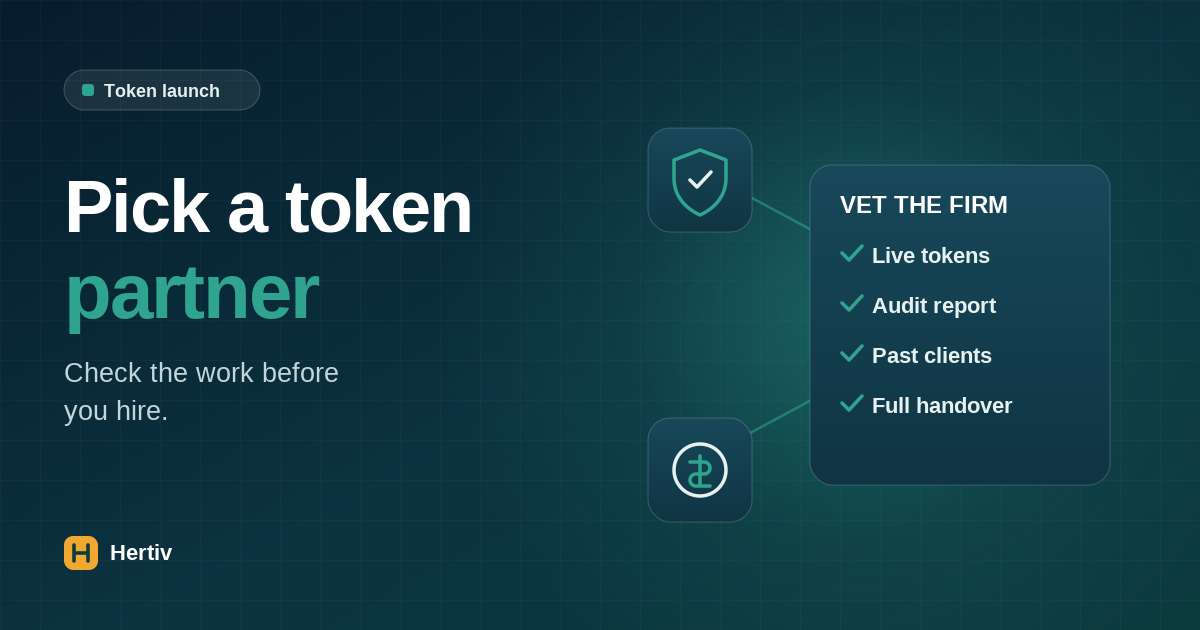
Start with the tokens the firm has actually launched, not the ones on its website. Ask for the contract addresses and check them on a block explorer: is the contract verified, does it hold real activity, and does the token still work? A firm that cannot point to live contracts is a firm to avoid.
Next, read the audit reports for those tokens. A real audit names the auditor, lists the findings and shows which were fixed. Ask whether any of the firm's tokens were hacked or had a serious bug, and what the firm did about it. An honest answer is worth more than a clean record with no detail.
- Check live contracts. Verified code and real activity beat any slide deck.
- Talk to past clients. Ask what went wrong, not just what went well.
- Ask who does the work. Find out whether the senior people you meet will write the code, or whether it goes to juniors.
- Look at the audit history. Firms that skip audits or audit themselves are cutting the most important corner.
Finally, check how the firm handles security day to day. Ask about code review, testing coverage and key management. A firm with a clear process will answer quickly; a firm that waves the question away is a risk. The audit side is covered in smart contract audit.
What does it cost?
Token development cost depends on the chain, the token standard, the complexity of the rules and whether an outside audit is included. The table below shows planning ranges for a typical project, not quotes: a simple token on a common chain costs far less than a custom token with staking, vesting and governance.
| Cost part | What it covers | Planning range |
|---|---|---|
| Design and tokenomics | Token model, supply and distribution | $5,000-$15,000 |
| Smart contract build | Contract code, tests, docs | $15,000-$50,000 |
| Outside audit | Independent security review | $10,000-$40,000 |
| Deployment and launch | Deployment, verification, listing help | $3,000-$10,000 |
| Wallet and app integration | Connecting wallets and dashboards | $5,000-$20,000 |
Be wary of prices far below these ranges. A token built for a few thousand dollars usually skips testing, skips the audit, or reuses a contract the firm does not understand. The audit alone can cost more than the cheapest builds, which is why a low quote should make you ask what was left out. For payment-side work, see stablecoin payments for business.
How do you choose in five steps?
Choosing well is a short, structured process. Rushing it is how teams end up with a token they cannot fix and a firm that has moved on.
- Write your requirements first. List the chain, the token rules, the launch date and the budget before talking to any firm.
- Shortlist three firms. Pick firms with live tokens on your chain and real audit reports, not just a nice website.
- Ask for a written proposal. Each firm should price the same scope, so the quotes can be compared fairly.
- Check the references and the contracts. Talk to past clients and verify the contract addresses on a block explorer.
- Compare on security, then price. Pick the firm with the strongest audit and testing record among the ones you can afford.
Do the reference checks yourself rather than trusting testimonials on the firm's site. A ten-minute call with a past client usually tells you more than a week of sales meetings. For the build side of the decision, see smart contract development.
Example (hypothetical): a startup picks a token partner
Example (hypothetical): a startup wants a utility token on a common chain with a fixed supply and a vesting schedule. It shortlists three firms and asks each for a written quote on the same scope.
Firm A quotes $45,000 including an outside audit. Firm B quotes $70,000 with a longer timeline and a dedicated security review. Firm C quotes $28,000 with no audit and no vesting work included. The startup checks the references: Firm A has two live tokens with clean audits, Firm B has five, and Firm C has none it can point to.
The startup picks Firm A. The build costs $45,000 and the audit finds two medium issues that cost $3,000 to fix, so the total is $48,000. Firm C would have cost $28,000 plus a separate audit of about $12,000, or $40,000, with no vesting work and no track record. The cheaper quote was not cheaper once the missing pieces were added.
What are the common mistakes?
The most common mistakes when hiring a token development company are choosing on price alone, skipping the audit, and signing before the deliverables and the handover are written down.
- Choosing the cheapest quote. A low price usually means testing or the audit was left out.
- Skipping the outside audit. An internal review is not a substitute for an independent check.
- Not checking live contracts. A firm with no tokens you can verify is a firm with no proof.
- Leaving admin keys with the firm. If the firm holds the keys, it controls your token.
- Signing without a handover clause. Without one, you may never receive the full code and docs.
Key takeaways
- A token firm should prove itself with live contracts and audit reports
- Get the deliverables, the audit and the handover in writing before signing
- Compare firms on the same written scope, and on security before price
- A quote far below the planning range usually means testing or audit was skipped
- Never launch without an independent audit, and never leave admin keys with the firm
Frequently asked questions
What should a token development company deliver?
It should deliver a written token model, tested smart contract code, an outside audit report, a verified deployment and a full handover of code, docs and access. If any of these are missing from the proposal, ask why before you sign, because each one protects you after launch.
How much does it cost to develop a crypto token?
A typical project costs tens of thousands of dollars, with the smart contract build and the outside audit as the largest parts. Simple tokens on a common chain sit at the low end, while custom rules, staking and vesting push the price up. Prices far below the usual range usually mean testing or the audit was skipped.
Do I need an audit for my token?
Yes. An independent audit is the main protection against bugs that can drain funds or lock the token. An internal review by the same firm that wrote the code is not a substitute, because it shares the same blind spots. Budget for the audit from the start rather than treating it as optional.
Which blockchain should my token use?
It depends on where your users are, what the token must do, and what your budget allows. Common chains have more tools, auditors and exchanges, while newer chains may be cheaper or faster. Ask each shortlisted firm which chain it has actually launched tokens on before deciding.
How long does token development take?
A simple token can be built and tested in a few weeks, while a custom token with vesting, staking and governance usually takes two to three months including the audit. The audit itself often takes two to four weeks, so plan the timeline around it rather than around the coding alone.
What happens if the firm disappears after launch?
That is why the handover matters. With the full code, docs and admin keys in your hands, another firm can take over maintenance. Without them, you may need to rebuild the token from scratch, so make the handover a written condition of the contract.


