How to Choose the Right AI Consulting Partner in Australia
Choosing the right AI consulting partner in Australia comes down to proof of delivery, local knowledge and a clear plan. Learn what to check before you sign.
On this page
Short answer
Choosing the right AI consulting partner in Australia means finding a firm that has shipped working AI for businesses like yours, understands Australian rules and data, and will hand you a plan you can fund. The wrong partner sells a slide deck; the right one leaves you with a working system and a team that can run it.
What is an AI consulting partner?
An AI consulting partner is a firm that helps a business find, build and run AI systems. The work usually starts with finding the right use case, then moves to a small pilot, and then to a system that runs in production with real users and real data.
A good partner does more than advise. It builds the pilot, measures the result, and helps your team take over. That matters because AI only pays off when it works in daily use, not when it looks good in a demo. For a sense of what a consulting engagement covers, see AI consulting.
In Australia, the partner should also know the local context: privacy law, industry rules, data residency expectations and the way Australian businesses buy and run software. A partner that has only worked overseas may miss those details.
What should you check first?
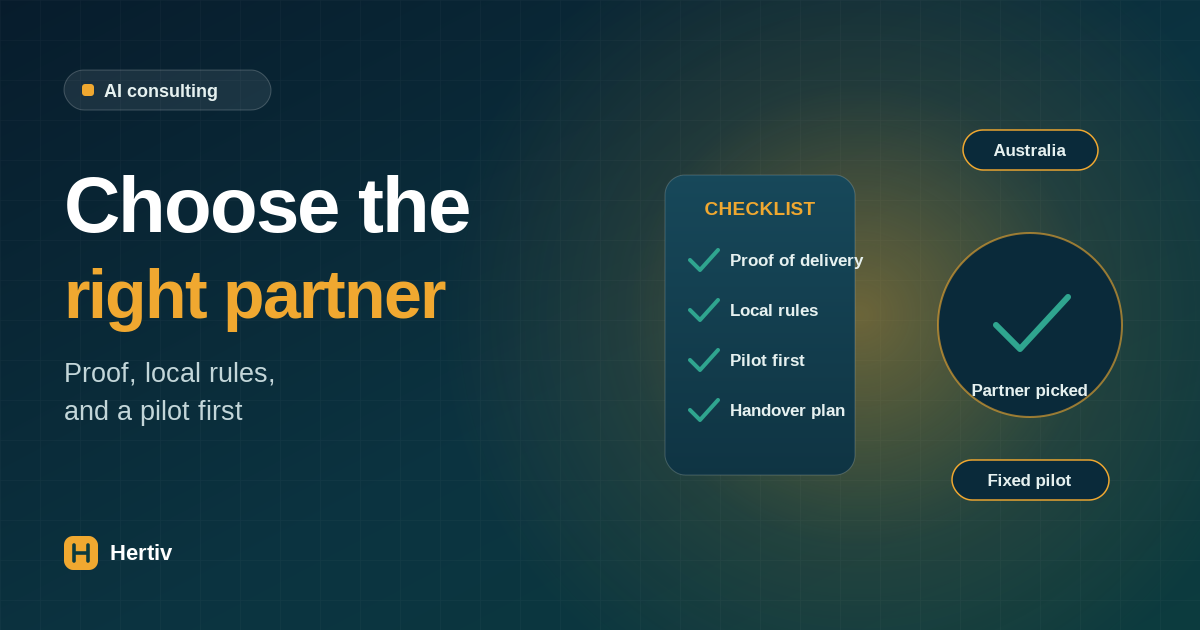
Check four things before you shortlist anyone: proof of delivery, relevant experience, how they work, and how they charge. The table below shows what to look for in each area.
| Area | What to check | Good sign |
|---|---|---|
| Proof of delivery | Working systems in production | Named use cases with measured results |
| Relevant experience | Same industry and problem type | Past work with similar data and users |
| How they work | Pilot first, then scale | Small pilot with a clear success measure |
| Local knowledge | Australian rules and data | Privacy, residency and industry rules covered |
| Team and handover | Who builds, who supports | Your team trained to run the system |
| Commercial terms | Fixed pilot price, clear scope | Written scope and exit terms |
Ask for proof, not promises. A partner should be able to describe a system it built, what it does today, and what changed for the client. If the examples are vague or unnamed, treat that as a warning sign.
How do you compare proposals?
Compare proposals on the same scope, or the comparison means nothing. Give every firm the same problem, the same data sample and the same success measure, then judge what each one would build and how they would prove it works.
Look at the team, not just the firm. Ask who will actually do the work, how much time they will spend, and what happens if they leave. A strong firm names the people and their roles in the proposal.
Check the pilot plan. A good proposal starts with a small pilot that runs in four to six weeks, uses your real data, and has a clear pass or fail measure. A proposal that jumps straight to a large build without a pilot is a risk. For how a pilot is usually scoped, see how to build an AI proof of concept.
Finally, compare the price on what it includes. A low price that excludes data work, testing and handover is not cheaper. Ask each firm to break the price into discovery, build, testing and support, so you can compare like with like.
What Australian rules should the partner know?
An Australian AI partner should know the Privacy Act and the Australian Privacy Principles, which govern how personal information is collected, used and stored. If your system handles health, finance or children's data, extra rules apply, and the partner should name them.
Data residency matters too. Many Australian organisations need data to stay in Australia or in approved regions. Ask where the data will live, where the model will run, and which third-party services will see the data. Get the answers in writing.
Industry rules add another layer. Banks, insurers, health providers and government agencies each have their own obligations, from record keeping to explainability. A partner with experience in your industry will know which rules shape the design. If the partner cannot name the rules for your industry, keep looking.
Also ask about AI governance: who approves the model, how bias is checked, and how the system is monitored after launch. A partner that has a clear answer here is more likely to build a system that lasts. For vendor shortlists, see top AI service providers.
How do you choose in 6 steps?
Choosing an AI consulting partner follows a short sequence. Work through it before you sign anything, so the decision is based on evidence rather than sales meetings.
- Define the problem. Write down one business problem, who it affects, and how you will measure success. A partner cannot help if the problem is vague.
- Shortlist three firms. Use proof of delivery and relevant experience to cut a long list to three. Check their past work in your industry first.
- Run a discovery call. Ask each firm how it would approach your problem, what data it needs, and what the pilot would prove. Judge the clarity of the answers.
- Ask for a pilot proposal. Each firm should propose a small pilot with a fixed price, a timeline and a success measure. Compare the proposals on the same scope.
- Check references. Speak to at least one past client from each firm. Ask what went wrong, how the firm handled it, and whether the system still runs.
- Agree the terms. Put the scope, the price, the timeline, data handling and the handover in writing before work starts. Include exit terms.
Keep the decision small at first. A pilot is a test of the partner as much as of the technology. If the pilot goes well, you have evidence to fund the next stage.
Example (hypothetical): a Sydney retailer picks a partner
Example (hypothetical): a Sydney retailer with 40 stores wants AI help for stock forecasting. It writes down the problem: too much stock of slow lines and too little of fast lines, costing about 12 hours a week of manual ordering.
It shortlists three firms. One proposes a six-month build with no pilot. One has no retail experience. The third proposes a four-week pilot on two stores, using the retailer's own sales data, with a clear measure: forecast accuracy against last quarter.
The retailer picks the third firm. The pilot costs a fixed fee and runs on the retailer's data in an Australian cloud region. After four weeks, the forecast is right more often than the manual orders, and the team decides to roll it out to ten more stores. The partner trains two staff to run the system, so the retailer is not locked into ongoing fees for basic operation.
What are the common mistakes?
The most common mistakes when choosing an AI consulting partner are buying on brand, skipping references, and signing a large contract before a pilot.
- Buying on brand alone. A large firm is not always the right firm. A smaller firm with retail, health or finance experience in Australia may fit better.
- Skipping reference checks. A sales deck hides problems. A ten-minute call with a past client reveals them.
- No pilot before the big build. A large contract before a working pilot is the most expensive way to learn a partner is wrong.
- Ignoring data and privacy. If the partner cannot explain where data lives and who sees it, the project will stall at legal review.
- No handover plan. If your team cannot run the system after the partner leaves, you pay for support forever. Agree the handover up front.
Key takeaways
- An AI consulting partner should build a working pilot, not just advise
- Check proof of delivery, relevant experience, working style and commercial terms before shortlisting
- In Australia, confirm privacy, data residency and industry rules in writing
- Start with a small fixed-price pilot with a clear pass or fail measure
- Agree scope, price, data handling and handover in writing before work starts
Frequently asked questions
What does an AI consulting partner do?
An AI consulting partner helps a business find the right use case, build a small pilot, and then run the system in production. The work covers data, models, integration and training, so your team can use and maintain the system after the partner leaves.
How much does an AI consulting partner cost in Australia?
It depends on scope. A small pilot usually costs a fixed fee agreed up front, while a full build is priced by scope and team size. Ask each firm to break the price into discovery, build, testing and support so you can compare proposals fairly.
Should I choose a large firm or a small specialist?
Choose on fit, not size. A large firm suits a large, multi-team programme. A smaller specialist often fits better when the problem is narrow and industry experience matters. Check proof of delivery in your industry either way.
What Australian rules affect AI projects?
The Privacy Act and the Australian Privacy Principles govern personal information. Data residency expectations and industry rules for health, finance and government add more requirements. Ask the partner to name the rules for your industry in writing.
How long should a pilot take?
A pilot usually takes four to six weeks. It should use your real data, run with real users, and have a clear success measure agreed before it starts. If a pilot has no pass or fail measure, it is not a pilot.
What should the contract include?
The contract should cover scope, price, timeline, data handling, intellectual property, handover and exit terms. Agree who owns the code and the model, and how your team takes over. Get data residency and privacy commitments in writing.


